The Bitcoin learning hub

Understand Bitcoin.Decide for yourself.

Connect Bitcoin’s ideas in eight stages, from the basics and wallet ownership to purchase costs and receiving Bitcoin. Start where you are, save your reading progress and decide whether buying is right for you. There is no purchase required to learn.

Educational content only. Not financial, investment, legal, or tax advice. Bitcoin prices can fall, and you can lose money.

Your complete Bitcoin learning path

Understand Bitcoin, then decide what to do.

Start with stage 1. Watch, listen or read, then try the example and check. The eight lessons take about 46 minutes. Detailed guides and practice are optional.

0 of 8 scenario checks answered correctly

0 of 16 detailed guides marked read

Start stage 1: What is Bitcoin?
Try the optional practice lab
Try a first purchase without spending money.

Try the deeper lessons with fictional decisions. The ten practice topics have separate progress and never mark a guide read or pass a stage check.

Open the first-purchase practice lab

You can finish this path without buying anything. A correct quiz answer shows understanding of that question; it does not establish that you can afford a purchase or that now is a good time to buy.

Choose one lesson format. Detailed guides open in new tabs; return here to mark them read. Stage 3’s expanded value guide has its own reading check.

Reading marks and successful checks are saved in this browser. They do not sync to your account. No purchase or login is needed.

Quizzes and practice updated October 23, 2026. Reading marks stay saved. Earlier answers need a fresh check for these revised questions.

Browse all 8 stages and extra learning tools
01

What Bitcoin is

What am I actually learning about? 0 of 2 guides read

How Bitcoin differs from other crypto

Bitcoin names an asset and the network that verifies its transfers. BTC is its short label; one BTC contains 100,000,000 sats. Compare the jobs money performs and the responsibilities of each system before considering a purchase.

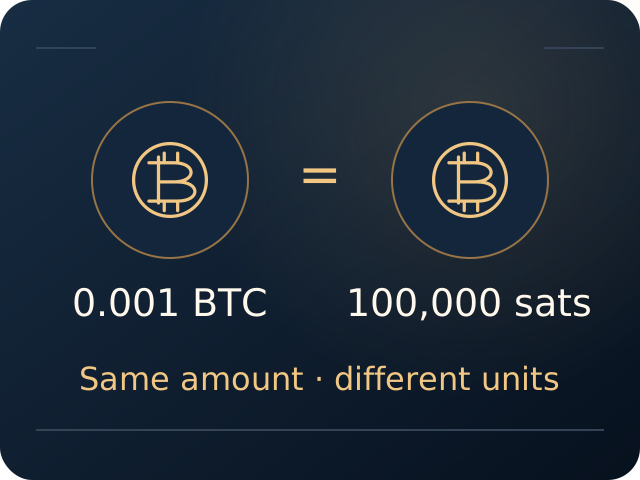
0.001 BTC equals 100,000 satoshis.
The worked example shows one amount in two units. One BTC is 100,000,000 sats.
  1. 01
    What is Bitcoin?

    Explore money, Bitcoin’s origins and its tradeoffs.

  2. 02
    Bitcoin, fractions and satoshis

    Convert BTC and sats. Detailed fee calculations can wait.

Follow the example

Maya can pay a bill, compare two prices or save for later. Those are three jobs money can do. A digital balance alone does not tell her who keeps the record or how lost access is restored. Explain one difference between a bank account and holding Bitcoin with your own keys.

Optional: go deeper on this topic

Check your understanding

Maya says, “My bank balance is already digital, so holding Bitcoin must work the same way.” Which difference should she investigate?

Practice this topic with a different example

02

How the network works

How can Bitcoin work without a central operator? 0 of 2 guides read

Try the linked-record demonstration

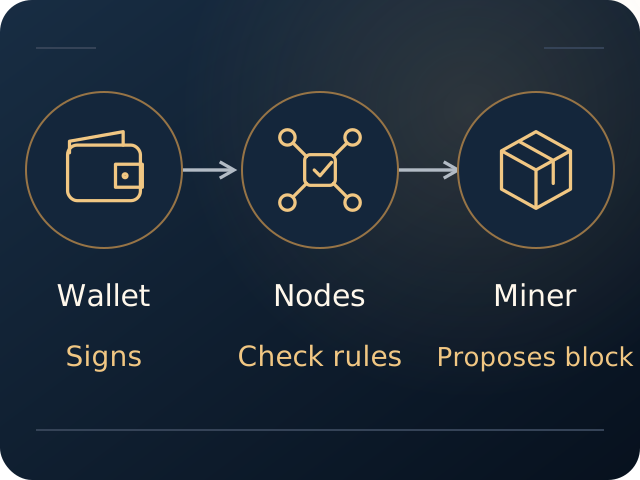
Wallets authorize payments with signatures. Full nodes check rules; miners propose blocks. Accepted blocks form the blockchain. A signature proves authorization, while validation and accumulated proof of work help a network agree on a spending history.

A wallet signs, nodes check rules, and miners propose blocks.
These are different jobs. Nodes also check proposed blocks and reject any that break the rules.
  1. 03
    See the whole system

    Explore double spending, signatures and shared history.

  2. 04
    Understand the miner’s job

    See how miners propose blocks and nodes check them. Home-mining setup can wait.

Follow the example

Maya signs two conflicting payments using the same earlier output. A signature can authorize either one; it does not decide which spend belongs in the accepted history. Explain why nodes need spending rules and a way to choose among valid histories.

Optional: go deeper on this topic

Check your understanding

Two transactions have valid signatures but spend the same earlier output. What prevents both from counting in the accepted Bitcoin history?

Practice this topic with a different example

03

Supply, price and risk

Why do people value Bitcoin, and what are the limits? 0 of 2 guides read

Bitcoin’s current rules limit issuance to 21 million BTC. A halving reduces new issuance, not your existing balance. Supply, demand and purchasing power answer different questions. A fixed supply does not promise a price or a return.

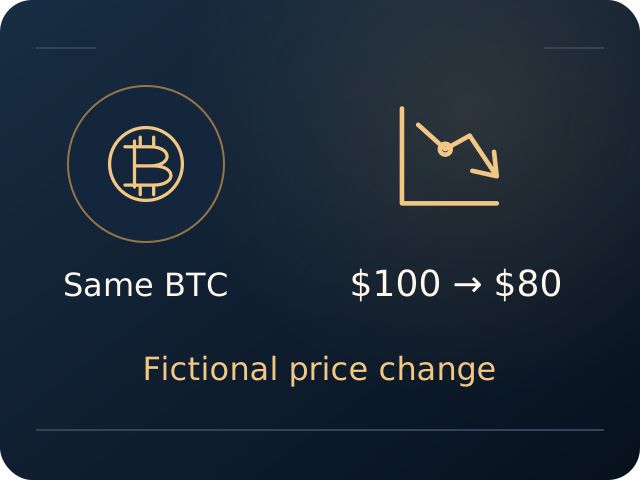
The same Bitcoin quantity has a fictional dollar value falling from $100 to $80.
The BTC amount can stay the same while its dollar value falls. Limited supply does not guarantee a rising price.
  1. 05
    Understand the supply schedule

    Compare issuance, purchasing power and demand.

  2. 06
    Why people value Bitcoin

    Compare demand, purchasing power and the strongest objections.

Follow the example

An invented basket of goods rises from $100 to $110. The same $100 buys less. Bitcoin’s new issuance and the prices of goods measure different things. Explain why predictable BTC supply alone cannot tell Maya what her Bitcoin will buy.

Optional: go deeper on this topic

Check your understanding

Bitcoin’s issuance schedule stays predictable while fewer people want to hold it. What can Maya conclude about purchasing power?

Practice this topic with a different example

04

Wallets, keys and recovery

Who controls the Bitcoin, and how is access recovered? 0 of 2 guides read

Compare custody and backup responsibilities

Custody describes who controls signing access. Mobile and hardware describe tools. A private key authorizes spending; a receiving address identifies a destination. Recovery information may recreate keys and differs from a device PIN or account password.

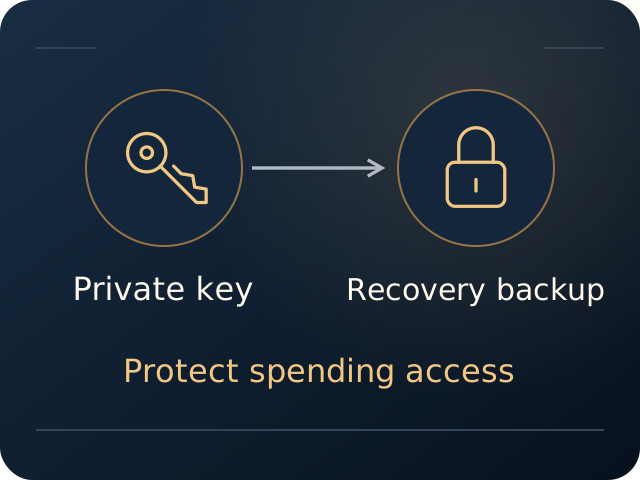
A private key and a protected recovery backup represent spending access.
A recovery backup can restore access to the keys. Keep both private; a receiving address is different and can be shared to receive Bitcoin.
  1. 07
    Understand a Bitcoin wallet

    Identify who holds keys, how recovery works and how to get a receiving address.

  2. 08
    Understand recovery information

    Learn which backups your wallet uses and how to keep them private.

Follow the example

Maya’s self-custody phone stops working. Her spending access depends on a usable recovery arrangement, not a copy of the balance screen. Describe the information her wallet’s genuine recovery process requires. Keep that plan non-secret; never write real recovery words in a lesson.

Optional: go deeper on this topic

Check your understanding

Maya’s recovery words may have been exposed. She changes the app password and replaces the phone. Has that necessarily secured the underlying Bitcoin keys?

Practice this topic with a different example

05

Transactions, fees and confirmations

What happens when Bitcoin moves? 0 of 2 guides read

An on-chain transaction spends earlier outputs and creates new ones. Inputs minus all outputs is the fee. Broadcast, block confirmation and provider account credit are different steps. Check the exact asset, supported network and receiving instructions.

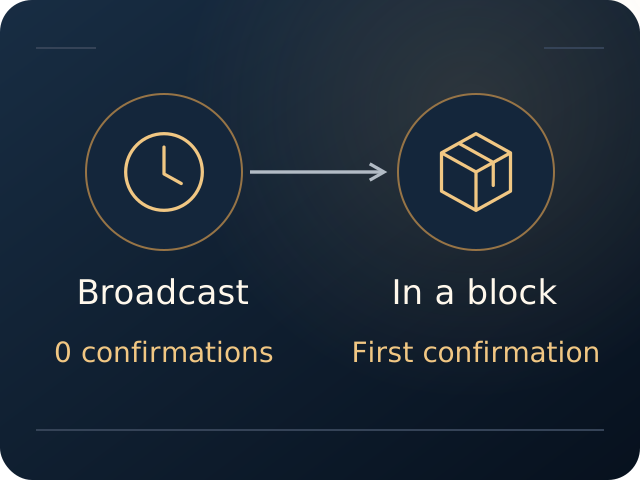
A broadcast transaction has zero confirmations; inclusion in a block gives its first confirmation.
Broadcast is not confirmation. Required confirmations depend on the receiving service; a bank receipt does not establish either network status.
  1. 09
    Follow a Bitcoin transaction

    Follow permission to spend, sharing the transfer and its first confirmation.

  2. 10
    Understand confirmations

    Follow confirmations and the receiver’s rules for making a payment available.

Follow the example

In a fictional payment, a 100,000-sat input creates 30,000 sats for Leo and 69,000 sats as change. The 1,000-sat difference is the fee. If included at height 900,000 with the tip at 900,002, it has three confirmations. Explain why neither the whole input nor an average block interval proves what Leo received or when.

Optional: go deeper on this topic

Check your understanding

An invented transaction spends 120,000 sats and creates outputs of 40,000 to the recipient and 79,000 as change. What do these amounts show?

Practice broadcast and confirmations with a new example

06

Check the person, provider and destination

What could go wrong before I move money? 0 of 2 guides read

Bitcoin checks network rules, not a recipient’s honesty. Verify identity, purpose and complete receiving details independently. A logo, valid address, QR code or successful small transfer cannot establish that an unexpected payment request is genuine.

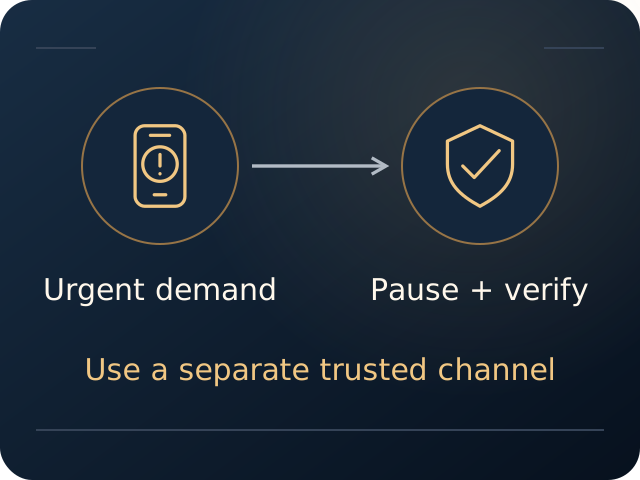
An urgent payment demand leads to pausing and independently verifying.
Stop the conversation and use a separate, trusted contact channel. Do not buy or send because someone pressures you.
  1. 11
    Recognize pressure and impersonation

    Recognize urgent demands and impersonation. Use recovery guidance only if it applies.

  2. 12
    Verify a receiving address

    Compare the whole receiving address with a trusted source.

Follow the example

An unexpected caller sends Maya a link and a phone number to “verify” changed payment instructions. Both came from the same caller. Explain how she could contact the real organization independently, and why a valid address or successful small test would not establish the caller’s honesty.

Optional: go deeper on this topic

Check your understanding

A caller sends a replacement address, a QR code and a phone number for verification. A small test payment succeeds. What still needs checking?

Practice this topic with a different example

07

Prepare for a purchase, if you choose

How do payment, verification, pricing and delivery fit together? 0 of 2 guides read

Compare total dollars and final Bitcoin at the same destination. Count included charges once. Review eligibility, custody, delivery conditions and when the price becomes binding. Wire, ACH, debit and credit have different funding and approval requirements.

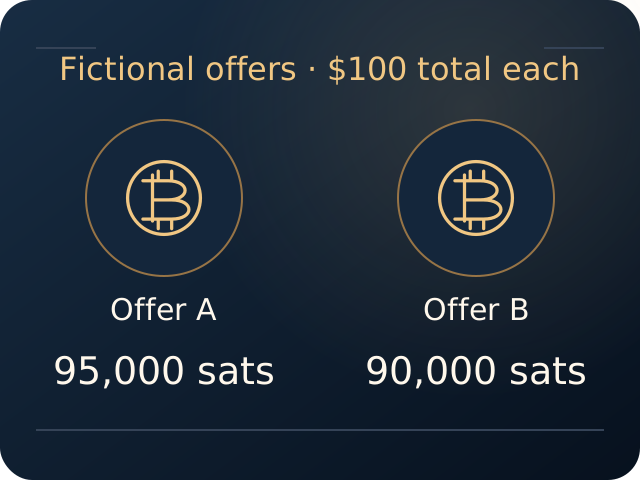
Two invented $100 offers deliver 95,000 sats and 90,000 sats.
Worked example only: compare the same total cost and destination. Then check timing, custody, eligibility and terms. These are not live offers.
  1. 13
    Understand the purchase from start to finish

    Follow your payment method from account preparation to delivery.

  2. 14
    Separate the different fees

    Separate purchase, bank or card charges and network fees.

Follow the example

Two fictional offers use the same $100 total and receiving wallet: A delivers 95,000 sats, B delivers 90,000. If A’s stated final amount already includes its charges, do not subtract them again. Explain what else Maya must check about timing, custody and eligibility before deciding.

See how the dollars, order and Bitcoin records fit together

Optional: go deeper on this topic

Check your understanding

An invented quote says $98 paid to the service plus a $2 bank charge, with 92,000 sats delivered after all provider and delivery charges. How should Maya compare it?

Practice this topic with a different example

08

Receive, keep records and keep learning

What should I check after a purchase? 0 of 2 guides read

Test what you remember and print a review sheet

A bank reference tracks funding, an order records the purchase and a TXID identifies a network transfer. Match the receiving output to the order and check confirmations. Public records do not reveal private account reviews or replace acquisition records.

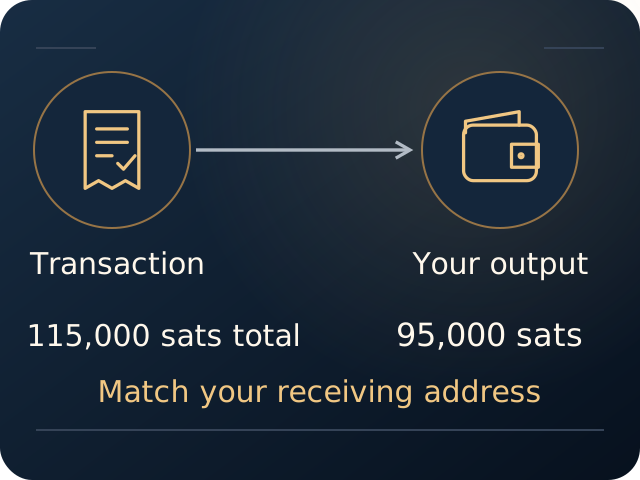
A fictional transaction totals 115,000 sats, with 95,000 sats to Maya’s address.
Match your receiving address to its output. A transaction total can include other recipients; a public record cannot prove your private account status.
  1. 15
    Check what your purchase completed

    Find the latest completed step. Investigate the status you actually see.

  2. 16
    Read a public transaction record

    Read a fictional transaction without a payment, wallet connection or account.

Follow the example

Maya’s invented records show a bank payment, a completed 95,000-sat order and a transaction with 95,000 sats to her destination plus 20,000 elsewhere. Explain which record answers funding, purchase and delivery questions. A network confirmation and provider account credit can be different steps.

See how the dollars, order and Bitcoin records fit together

Optional: go deeper on this topic

Check your understanding

A bank reference, a completed order and a Bitcoin TXID are available. Which evidence best checks the on-chain amount delivered to Maya’s verified address?

Practice this topic with a different example

Your decision after learning

Keep learning, wait or prepare a purchase.

Want to try the decisions first? Open the optional practice lab or review your practice results. You can use the preparation questions below whenever they are useful.

There is no deadline or course score that tells you to buy. Consider why you want BTC, the loss you could absorb and when you will need the dollars. Learning more about Bitcoin does not predict its next price move.

I still have questions.

Return to the topic that is unclear. Wallet control, costs and receiving instructions should make sense before you send money.

Review wallets and recovery
Review purchase costs

I want to wait.

You can keep your reading progress and return later. If losing the purchase money would interfere with bills, near-term needs or other commitments, pause and consider your circumstances before proceeding.

Revisit benefits and risks

I’m considering buying.

Use the preparation checks below. You can ask our team about the service without committing to a purchase.

Review preparation

Questions to resolve before funding

Check these privately against your own situation and the genuine order. These are preparation prompts, not account approval, investment advice or a guarantee of safety.

  • Review risks
  • Review ownership
  • Review the destination
  • Review costs
  • Review the purchase steps
  • Review scam warnings

How Crypto Dispensers can help

We’ve helped people access Bitcoin since 2017. Our team can explain account preparation, available payment methods, purchase costs and receiving-wallet checks. We cannot predict returns or recreate wallet keys or recovery information we do not hold.

Compare the wire, ACH, debit and credit options available to your account. Check location eligibility, the provider’s current terms, total costs and timing. Creating an account does not authorize a payment.

Considering a bank wire? Review this sequence.

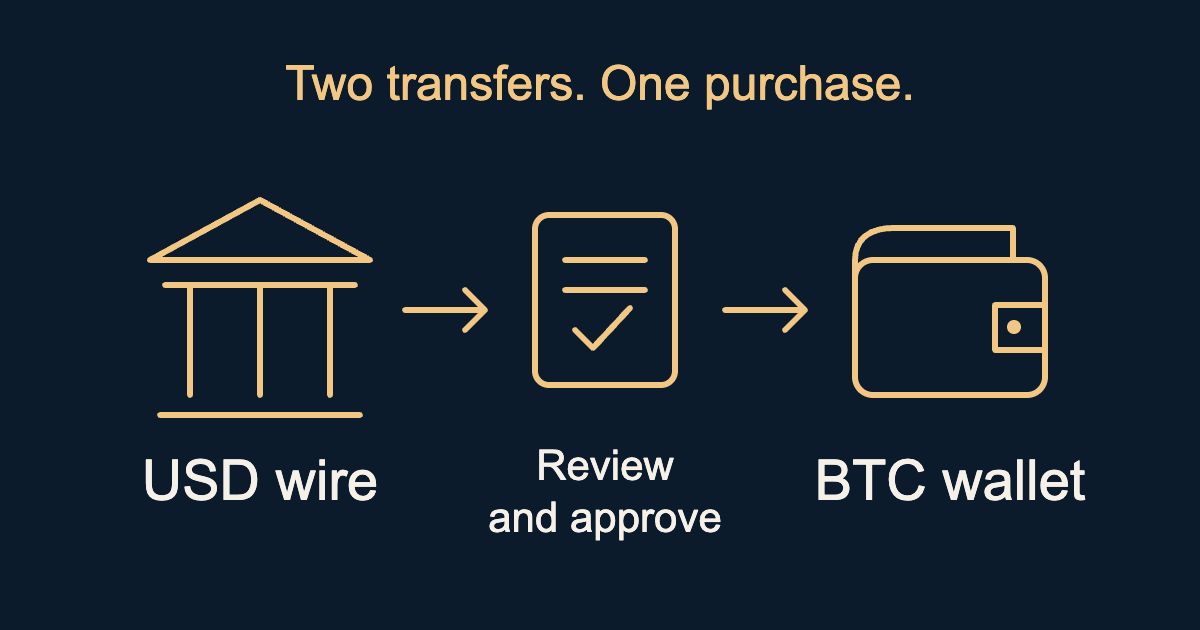
Create a request, complete the requested checks and prepare your confirmed receiving wallet. Wait for current approved bank instructions before funding. After funds arrive and required review is complete, inspect and choose whether to approve the final BTC price, costs and destination. Bitcoin delivery follows the completed purchase. Sending a wire does not lock the price.

Read the wire service and timing and purchase costs and return questions before sending money. As your transaction volume with us grows, we can review your service rate and may be able to lower it individually. There is no fixed discount schedule or automatic reduction.

About this learning path

Organized and reviewed by the Crypto Dispensers team on October 22, 2026. Our educational resources are free to read. We also offer purchase services, so we have a commercial interest if you choose to buy from us. The scenario checks are educational and do not certify that a purchase is right for you.

For independent explanations, read Bitcoin.org’s explanation of the network, its guidance before using Bitcoin and the Bitcoin developer guide to transactions. Each linked lesson provides more detail and its own context.

Search the complete guide library

One fictional purchase, explained record by record

Follow the dollars. Find the Bitcoin.

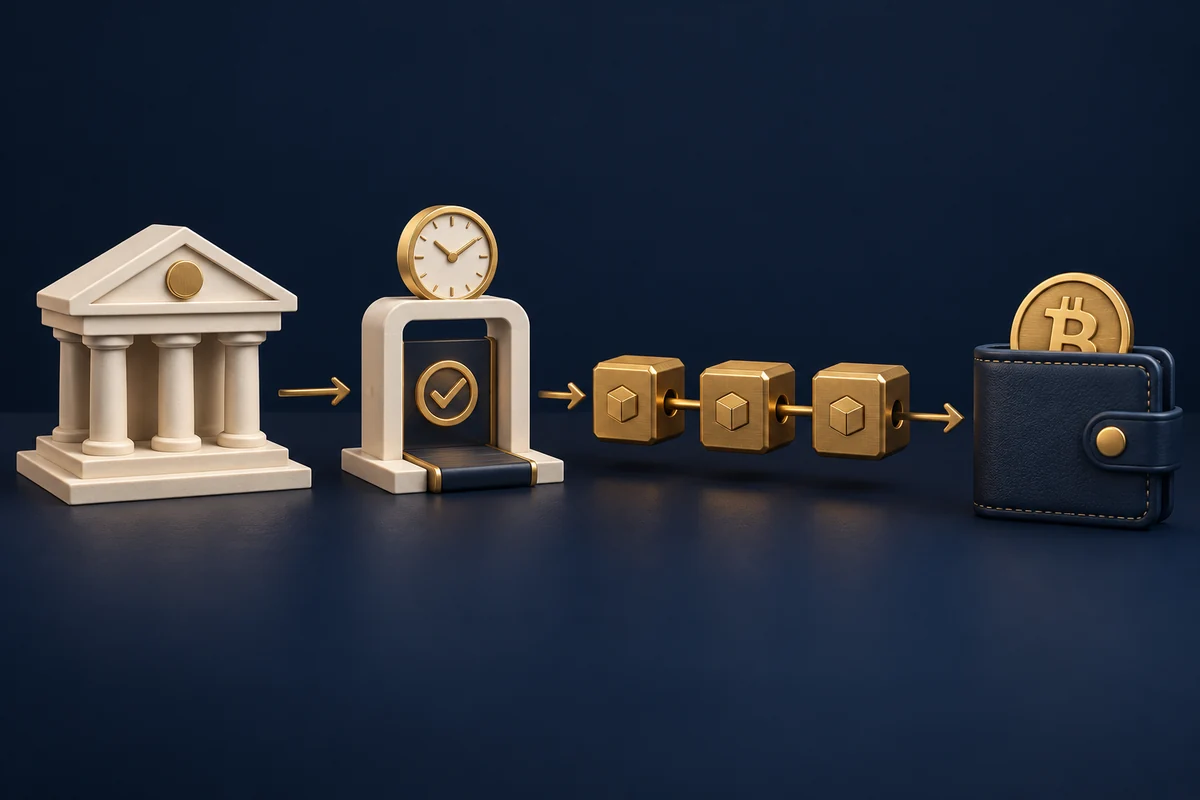
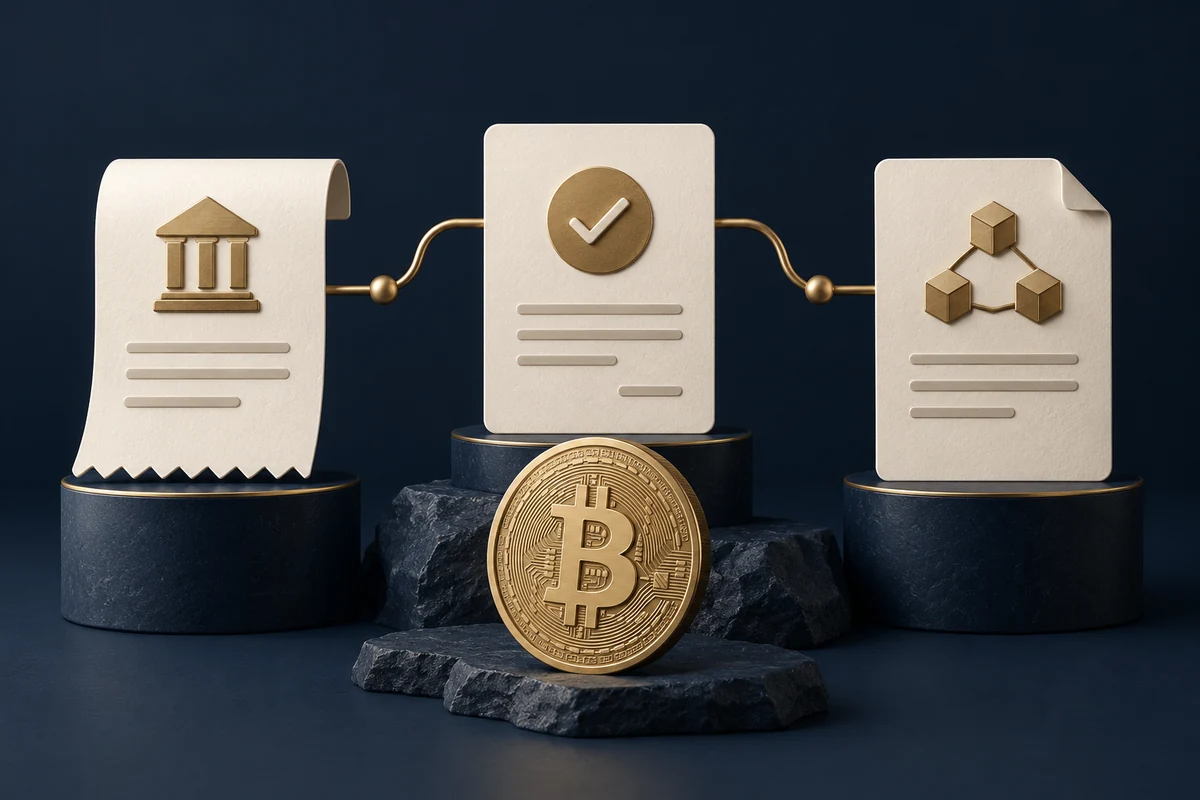
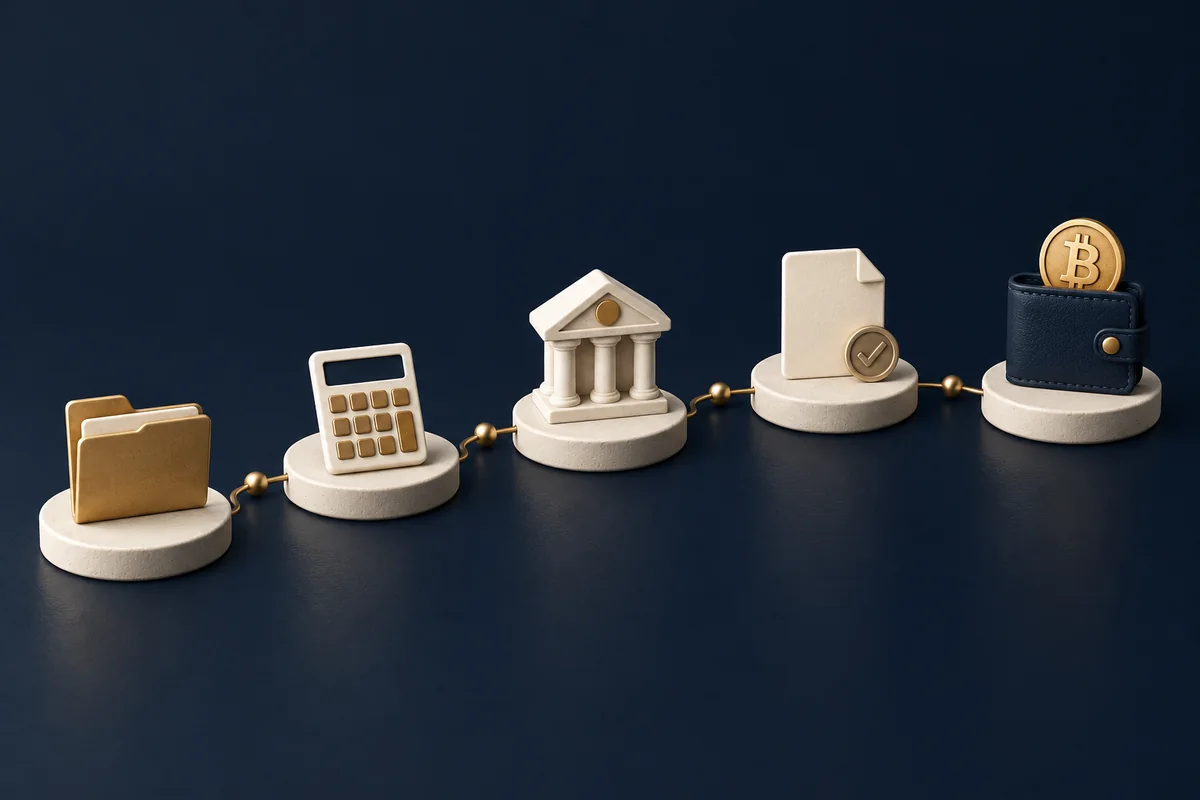
Maya’s invented $100 example connects what you’ve learned. Explore each record to see what it answers and what to check next. You won’t enter payment details or move money.

All amounts and records are illustrations, not current Crypto Dispensers quotes, account screenshots or customer evidence. Payment and price-approval steps depend on the chosen method.

Illustration 1 of 4

Fictional record

Compare the offer

A comparison, before a purchase

Total dollars
$100
Bitcoin delivered
95,000 sats
Same amount in BTC
0.00095 BTC

Learning example only · No real payment instructions

What this record tells Maya

A quote is an offer showing the purchase terms. This invented comparison says $100 total would deliver 95,000 sats. BTC and sats are two units of Bitcoin.

What she checks next

Check when you approve a price and when it is fixed for the order, what costs are included and whether the method is available to you. A comparison is not a completed purchase.

Connect it to the lesson

A second invented offer delivers 90,000 sats for the same $100 total. The first delivers 5,000 more sats. That alone does not settle timing, access or suitability.

Illustration 2 of 4

Fictional record

Read the payment receipt

Dollars: received

Dollar payment
$100 received
Bank reference
Example bank reference
Bitcoin purchase
Check the order separately

Learning example only · No real payment instructions

What this record tells Maya

A receipt records a payment. This example shows the dollars received. It does not say a Bitcoin purchase or transfer has completed.

What she checks next

Open the genuine order to find the current step. A bank reference identifies the bank payment; it is not a Bitcoin transaction ID.

Connect it to the lesson

For our wire service, final price approval comes after funds arrive and required review finishes. Use current approved instructions for the actual request. Other methods have their own sequence.

Illustration 3 of 4

Fictional record

Read the completed order

Purchase: completed

Approved total
$100
Bitcoin purchased
95,000 sats
Order reference
Example order reference

Learning example only · No real payment instructions

What this record tells Maya

This invented order records a completed purchase at the terms Maya approved when required. It identifies the Bitcoin amount bought and the total cost.

What she checks next

Check how the chosen service delivers Bitcoin. A balance held with a provider and a transfer to a separate wallet can be different steps.

Connect it to the lesson

An account login gives access to the provider’s records. A wallet manages receiving and spending access. Before buying, Maya learns who holds the keys and which backup protects access.

Illustration 4 of 4

Fictional record

Find the Bitcoin delivery

Bitcoin transfer: recorded

Maya’s receiving output
95,000 sats
Another output
20,000 sats
All outputs combined
115,000 sats

Learning example only · No real payment instructions

What this record tells Maya

An output is an amount assigned to a destination in a Bitcoin transaction. Match Maya’s confirmed receiving address to its 95,000-sat output. The combined total is not her receipt.

What she checks next

Check the genuine transaction ID and current confirmations. A confirmation means inclusion in a block on the current chain; later blocks add confirmations. A receiver can require several before making funds available.

Connect it to the lesson

A block explorer is a website for reading the public transaction record. It cannot show private account reviews. You do not need recovery words, private keys or a wallet connection to read a public record.

Try the decisions with different details

The practice lab uses new fictional examples. You can try either topic on its own, then review your purchase preparation when it’s useful.

For a real purchase, use your genuine account and current instructions. Never copy an example address, bank reference or order reference. If something is missing, identify the unfinished step before making another payment.

Learn by trying · fictional examples

Practice the eight Bitcoin stages.

Try a worked example, make a different decision and explain your reasoning. Ten topics cover all eight stages, plus address checks and optional wire preparation. You can stop and return later.

No money moves. No account or wallet needed.

0 of 10 practice checks answered correctly

Start practicing: Money, records and Bitcoin units

How practice progress works

One correct answer records a topic. A second example is optional. If a later answer is incorrect, that topic returns to your review list. These results are separate from your reading marks and stage checks.

Practice progress can be saved in this browser.

No money moves here. You do not need an account or a wallet. All amounts, offers and records are invented for learning. We will never ask for recovery words, private keys or payment details in this lab.

Choose a topic or review practice results

Practice 1 of 10 · fictional scenario

Money, records and Bitcoin units

Follow the worked example

Maya uses money to pay a bill, compare prices and save for later. Bitcoin combines an asset with a network that participants can verify. A bank account has an institution maintaining account records and its own recovery process. For quantity, 0.001 BTC and 100,000 sats are the same amount; changing the display does not create a payment.

Explain it in your own words: Describe one convenience and one responsibility that change between a bank account and self-custody.

0.001 BTC equals 100,000 satoshis.
The worked example shows one amount in two units. One BTC is 100,000,000 sats.

Try it yourself · example 1 of 2

A shop lists a meal in dollars while Maya keeps some money for next month. Which jobs of money are illustrated?

Return to this stage’s check · Read the full guide

Practice 2 of 10 · fictional scenario

Authorization, validation and shared history

Follow the worked example

Maya signs two conflicting transactions spending the same output. Either signature can authorize a transaction, but both spends cannot count in one accepted history. Full nodes check spending and block rules. Mining proposes blocks and supplies proof of work for ordering valid histories. Work does not make an invalid block acceptable.

Explain it in your own words: Explain why a signature is necessary but does not by itself resolve conflicting spends.

A wallet signs, nodes check rules, and miners propose blocks.
These are different jobs. Nodes also check proposed blocks and reject any that break the rules.

Try it yourself · example 1 of 2

A miner’s proposed block has valid proof of work but issues more BTC than the rules permit. What should a full node enforcing those rules do?

Return to this stage’s check · Read the full guide

Practice 3 of 10 · fictional scenario

Supply, demand and purchasing power

Follow the worked example

An invented basket rises from $100 to $110. An unchanged $100 buys about 90.9% of it. That is a purchasing-power comparison, not a Bitcoin issuance rate. Predictable BTC supply does not tell Maya how much people will want it, what buyers will pay or what goods will cost.

Explain it in your own words: Write one reason someone might value predictable issuance and one observation that would weaken their investment argument.

The same Bitcoin quantity has a fictional dollar value falling from $100 to $80.
The BTC amount can stay the same while its dollar value falls. Limited supply does not guarantee a rising price.

Try it yourself · example 1 of 2

In an invented economy, a basket rises from $100 to $125. What does an unchanged $100 buy?

Return to this stage’s check · Read the full guide

Practice 4 of 10 · fictional scenario

Custody, devices and usable recovery

Follow the worked example

Maya’s phone app works with a hardware signing device. The device type alone does not answer who controls keys or how recovery works. Many wallets derive keys from recovery information, sometimes with additional requirements. A hardware device cannot protect exposed recovery words or make a dishonest recipient trustworthy.

Explain it in your own words: Draft a non-secret plan for a lost device. Name the official instructions you would use without recording any recovery words here.

A private key and a protected recovery backup represent spending access.
A recovery backup can restore access to the keys. Keep both private; a receiving address is different and can be shared to receive Bitcoin.

Try it yourself · example 1 of 2

A provider offers a phone app and a password reset. What must Maya establish before calling it self-custody?

Return to this stage’s check · Read the full guide

Practice 5 of 10 · fictional scenario

Inputs, fees and confirmations

Follow the worked example

Maya’s fictional payment spends 100,000 sats, creates 30,000 for Leo and 69,000 as change, and leaves 1,000 as the network fee. At an invented 250 virtual bytes and 4 sats per virtual byte, the fee is also 1,000 sats. Inclusion at block 900,000 with the current tip at 900,002 gives three confirmations, not a promised completion time.

Explain it in your own words: Explain which delay is before broadcast and which is on the network. Who controls any fee-change options?

Try it yourself · example 1 of 2

An invented transaction is 200 virtual bytes at 6 sats per virtual byte. What is its network fee, and what does that establish about timing?

Return to this stage’s check · Read the full guide

Practice 6 of 10 · fictional scenario

Verify the asset, network and full address

Follow the worked example

Maya checks the exact asset, supported network and receiving instructions on both sides. A Bitcoin on-chain address differs from a Lightning request or a token on another network. A QR code is encoded information. A valid address format shows neither who owns it nor whether the payment request is genuine.

Explain it in your own words: Explain one thing a valid-looking address proves and two things it cannot prove about a recipient.

Check native Bitcoin and the intended receiving destination.
Before sending, verify the asset, network and complete address from a trusted source. A familiar logo or matching address ends are not enough.

Try it yourself · example 1 of 2

A wallet can scan a QR code, but it encodes a different complete address from the independently verified receiving display. What should Maya do?

Return to this stage’s check · Read the full guide

Practice 7 of 10 · fictional scenario

Independent verification and test-payment limits

Follow the worked example

An unexpected caller tells Maya to move savings to a “safe wallet.” The caller supplies a number and website to verify the request. Those are still part of the same request. Maya ends the conversation and contacts the real organization through an independently verified source. A small successful transfer cannot establish the caller’s honesty.

Explain it in your own words: Describe how you would contact the real organization without using anything supplied by the unexpected caller.

An urgent payment demand leads to pausing and independently verifying.
Stop the conversation and use a separate, trusted contact channel. Do not buy or send because someone pressures you.

Try it yourself · example 1 of 2

A message changes bank or wallet instructions and supplies a new “verification” number. Which check is independent?

Return to this stage’s check · Read the full guide

Practice 8 of 10 · fictional scenario

Compare final delivery and count costs once

Follow the worked example

For the same $100 total and receiving wallet, one invented offer delivers 95,000 sats and another delivers 90,000. Maya compares the final result after included costs. A separate $2 bank charge on a $98 service payment makes $100 total. A matching amount in a provider account can still require withdrawal, costs or a hold before reaching her own wallet.

Explain it in your own words: Explain why the largest displayed BTC account credit might not deliver the most BTC to the same separate wallet.

Two invented $100 offers deliver 95,000 sats and 90,000 sats.
Worked example only: compare the same total cost and destination. Then check timing, custody, eligibility and terms. These are not live offers.

Try it yourself · example 1 of 2

Invented offer A costs $98 to the service plus $2 to the bank and delivers 92,000 sats after included charges. B costs $100 total and delivers 90,000 sats to the same wallet. What can you conclude?

Want the worked comparison again? Revisit the purchase walkthrough’s offer record.

Return to this stage’s check · Read the full guide

Practice 9 of 10 · fictional scenario

Optional: funding and final-price approval

You can skip this wire example. For debit, credit or ACH, compare the available payment methods and follow the requirements, pricing and timing for the method you choose.

Follow the worked example

In our wire process, Maya submits the request, completes the required checks and uses current approved funding instructions. After funds arrive and required review finishes, she reviews and decides whether to approve the final price and details. Sending dollars or opening an account does not approve a Bitcoin purchase. Other payment methods have their own conditions.

Explain it in your own words: Name the record that establishes dollar funding and the separate action that approves the final Bitcoin price.

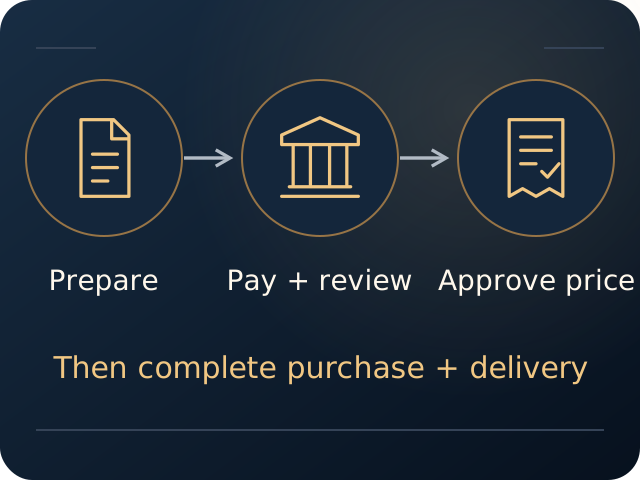
Prepare, fund and complete review, approve the final price, then complete the purchase and delivery.
Optional wire example: sending funds does not lock the Bitcoin price. Approval follows receipt of funds and required review; other payment methods have their own steps.

Try it yourself · example 1 of 2

Maya has an earlier estimate and a bank receipt showing the wire was sent. What must she still establish in our wire process?

Return to this stage’s check · Read the full guide

Practice 10 of 10 · fictional scenario

Reconcile delivery, account status and records

Follow the worked example

Maya’s bank reference tracks dollars; the order records what was bought; a TXID identifies a Bitcoin network transaction. In an invented transaction, 95,000 sats go to her address and 20,000 elsewhere. Her receiving output is 95,000, not 115,000. Confirmations do not reveal private account reviews. Keep purchase and transfer records together for later questions.

Explain it in your own words: Explain which records you would keep if the BTC quantity stayed constant while its displayed dollar value changed.

A fictional transaction totals 115,000 sats, with 95,000 sats to Maya’s address.
Match the address and its amount. This worked example uses 95,000 sats; the question below uses different details.

Try it yourself · example 1 of 2

An invented order is for 88,000 sats. Its TXID shows 88,000 to Maya’s verified address and 12,000 elsewhere. Which reconciliation is useful?

Revisit the purchase walkthrough’s delivery record

Return to this stage’s check · Read the full guide

Your practice summary

Review what you learned, then choose what to do.

Practice each topic to build your learning summary.

Any topic without a saved correct answer appears below.

    A practice result shows how you answered an example. Your decision also depends on your own circumstances, wallet responsibilities and the actual purchase terms. The learning path brings those questions together, including the option to wait.

    Try the complete quote comparison tool · Explore the fictional transaction example

    Return to the learning path

    Created and reviewed by the Crypto Dispensers team on October 22, 2026. Our team also provides purchase services. For independent explanations, see how Bitcoin works and what to know before using it.

    Explore, practice and remember

    Make the ideas click.

    Use these tools alongside the learning path. See how Bitcoin fits into cryptocurrency, change an example yourself and check what you can explain without looking.

    Where should I start?

    Pick the question you have today. These shortcuts do not mark guides read or skip understanding checks.

    I’m completely new

    Begin with BTC, satoshis and the network. Follow the eight stages at your own pace. Start stage 1

    Bitcoin or another cryptocurrency?

    See which ideas carry over and which details change between assets and networks. See the crypto map

    I need to see it work

    Change an amount and a fictional record to see what changes and why. Try the demonstrations

    I’m considering a first purchase

    Work through fictional choices, then review whether to keep learning, wait or prepare. Open the practice lab

    How does Bitcoin fit into cryptocurrency?

    Cryptocurrency is the broad category. Bitcoin is one system within it. Sharing a word, ticker or logo does not make assets interchangeable.

    Bitcoin and BTC

    Bitcoin is the network; BTC is its native asset. Satoshis are smaller BTC units. Review stage 1.

    Ethereum and ETH

    Ethereum is another network with its own rules. ETH is its native asset and pays Ethereum transaction fees. It is not a Bitcoin balance. Compare these networks.

    Stablecoins

    These tokens aim to track a reference value, often a dollar. A target price is not a guarantee. Check the issuer, reserves, redemption terms and exact supported network. See one issuer’s risk disclosure.

    Wrapped assets and bridges

    A wrapped Bitcoin token on another network adds a mechanism and assumptions beyond native BTC. It cannot simply be sent to a native Bitcoin address. Understand wrapped Bitcoin.

    Bitcoin on-chain and Lightning

    Lightning moves BTC through payment channels; it is not a new coin. A Lightning invoice is a different payment request from an on-chain address. Wallet custody and availability vary. Read an invoice.

    Provider account or your own keys

    A balance inside a provider account depends on that provider’s records and withdrawal rules. Self-custody puts signing access and backup responsibility with you. Compare the responsibilities.

    What about apps, NFTs and staking?

    Smart contracts are programs that run under a blockchain’s rules. An NFT is a distinct token record; owning one does not automatically give you copyright. Staking, lending and promised yield have different mechanisms and risks. None is required to understand or buy BTC.

    Connecting a wallet is different from signing a transaction or granting a token-spending approval. Read each request before approving it. An unfamiliar “claim” can ask for permissions that put funds at risk. Review wallet approval safety.

    Before any transfer: confirm the exact asset, network and receiving instructions on both sides. A demo or an old message is never a real payment instruction.

    Sources: Ethereum learning guide, smart contracts, Lightning design paper (PDF). Learning about an asset does not establish that we support it for your account.

    What changes when I change the example?

    These demonstrations run in your browser. They use fictional data, move no money and never need your wallet, recovery words or private keys.

    Change the unit, keep the same Bitcoin

    Enter a whole number of sats. Watch the BTC display change. There is no dollar price or purchase quote here.

    Use digits only, from 0 to 2,100,000,000,000,000 sats. Inputs are not saved or sent to analytics.

    100,000 sats = 0.00100000 BTC

    See why changing an earlier record breaks a link

    A hash is a fingerprint calculated from data. Each block below records the previous block’s fingerprint. Change the first record and compare its new hash with the reference in block 2.

    Simplified hash-link demonstration: these are real SHA-256 hashes of fictional text, not Bitcoin blocks. It omits signatures, mining and network consensus.

    This example links three fictional records. Read the explanation below if interactive controls are unavailable.

    Recalculating these toy links is easy. It does not make an altered Bitcoin history valid. Real nodes enforce transaction and block rules; proof of work makes replacing history costly, and nodes select the valid chain with the most accumulated work.

    Return to the network stage · Check the protocol explanation

    Who would control access to my Bitcoin?

    First ask who controls the signing keys. An app’s appearance, a password or a hardware device alone does not answer that question.

    A provider controls the keys

    You depend on the provider’s security, solvency, supported networks and withdrawal rules. Account recovery may help with a login, but it does not remove provider risk. Verify genuine account entry and use strong authentication.

    You control the keys

    You authorize spending and protect the wallet’s recovery method. A lost phone may be recoverable with a valid backup; a lost backup plus lost signing access may leave nobody able to recover the funds.

    Hot wallet, hardware wallet and backup: how do they connect?

    A hot wallet keeps signing keys in an online environment. A hardware wallet is designed to isolate signing keys from the connected computer or phone. Its recovery backup can restore access, so that backup needs protection too. A hardware wallet cannot make a wrong address or a malicious approval safe.

    Use the wallet maker’s genuine setup instructions. Never use recovery words supplied by someone else. Never put real recovery words into a learning tool or send them to support.

    What if someone needs access after I’m gone?

    Plan how a trusted person could locate your instructions and carry out your wishes without exposing spending access today. Keep public instructions separate from secrets. Your custody arrangement and local estate rules matter; use qualified help for your situation. Read about access and inheritance.

    Continue the wallets and keys stage · Practice an access problem · See wallet selection criteria

    What does that word mean?

    Use a short explanation here, then return to the stage or example that uses the idea. Open the full crypto glossary.

    BTC and satoshi

    BTC is Bitcoin’s symbol; a satoshi is one hundred millionth of a BTC. Return to this topic

    Blockchain

    An ordered record of blocks linked by hashes and checked under the network’s rules. Return to this topic

    Node and miner

    A full node checks the rules. A miner uses work to propose a block; that block still has to satisfy the rules. Return to this topic

    Private key and recovery backup

    A private key authorizes spending. A recovery backup can restore keys or access, depending on the wallet. Keep both private. Return to this topic

    Address

    Receiving instructions for a supported asset and network. It is different from a private key. Return to this topic

    Custody

    Who controls the keys, and therefore whose access and policies you rely on. Return to this topic

    Mempool and confirmation

    A mempool holds unconfirmed transactions known to a node. A transaction gets its first confirmation when included in a block. Return to this topic

    UTXO

    An unspent transaction output. A Bitcoin payment can create a recipient output and another output returning change to the sender. Return to this topic

    Network fee and purchase cost

    A Bitcoin network fee relates to the on-chain transaction. A purchase can also have provider, payment or withdrawal costs. Compare the complete result. Return to this topic

    Stablecoin

    A token aiming to track a reference value. Issuer, reserve, redemption and network risks still matter. Return to this topic

    Smart contract and approval

    A smart contract is a blockchain program. A token approval may authorize it to spend tokens, subject to that permission. Return to this topic

    On-chain and Lightning

    On-chain payments are recorded in Bitcoin blocks. Lightning uses payment channels and different payment requests. Return to this topic

    Input, output and change

    An input spends an earlier output. A transaction creates new outputs, including the recipient’s amount and, when needed, change returning to the sender. Inputs minus all outputs is the fee. Try the transaction example

    Virtual byte and fee rate

    A virtual byte (vB) measures transaction size for fee calculations. Multiply the size by a rate in sats per vB to estimate the network fee in sats. That calculation does not set a purchase provider’s charges or guarantee confirmation timing. Try the transaction example

    Can I explain it in my own words?

    Try answering aloud before opening each explanation. Come back after a break and try again. Remembering an answer does not establish that a purchase is affordable or suitable for you.

    Bitcoin review sheet

    Crypto Dispensers · Exercises revised October 23, 2026 · cryptodispensers.com/learn

    1. Explain paying, pricing and saving. How do a bank account and self-custody differ?

    These are three uses of money, not guarantees of stable value. A bank maintains account records and has account-recovery procedures. Bitcoin participants verify network history; self-custody spending access depends on keys and a usable recovery arrangement. Review the stage

    2. Why do valid signatures alone not resolve two spends of the same output?

    A signature establishes authorization, not a second copy of funds or the accepted order. Nodes enforce spending rules and follow the valid chain with the most accumulated proof of work. Work cannot excuse an invalid block. Review the stage

    3. A fictional basket rises from $100 to $125. What does $100 buy, and does BTC issuance answer that question?

    $100 buys 80% of the basket: 100 ÷ 125 = 0.8. Goods prices, BTC supply growth and demand are separate measurements. Predictable issuance alone does not guarantee purchasing power. Review the stage

    4. Why might a new device and app password fail to secure exposed recovery words?

    They may leave the underlying keys unchanged. Use the genuine wallet maker’s incident guidance privately. Device security, backup protection and recipient verification solve different problems. Review the stage

    5. Explain the fictional fee and confirmation arithmetic: 120,000 in, 40,000 to a recipient, 79,000 change; inclusion at 910,000, tip at 910,003.

    The fee is 120,000 − 40,000 − 79,000 = 1,000 sats. There are four confirmations while that block remains on the accepted chain. These facts do not promise an inclusion time or establish private account credit. Review the stage

    6. Why are a valid address, QR code and a successful test insufficient to verify an unexpected payment request?

    They concern data or a transfer mechanism, not the requester’s honesty or payment purpose. Independently verify identity and changed instructions using a source separate from the unexpected request. Review the stage

    7. A fictional offer costs $98 to the service plus $2 to the bank, delivering 92,000 sats after included charges. What should you compare?

    Use $100 total and 92,000 final sats at the same receiving destination. Count each charge once. Also check timing, custody, eligibility and when approval makes the price binding; arithmetic does not determine suitability. Review the stage

    8. How would you connect bank, order and TXID records without treating all transaction outputs as your receipt?

    Use the bank reference for dollars, the order for purchase terms and the matching receiving output for network delivery. Check confirmations and any receiving-account requirements separately. Keep acquisition dates, amounts and costs with the transfer record. Review the stage

    Before deciding to buy

    • Know what asset you would receive, where it would be held and who controls access.
    • Understand the complete cost, payment steps and conditions for delivery.
    • Consider price falls and the money you need for other commitments.
    • Verify the provider and recipient independently. Keep secrets private.
    • Choose to keep learning, wait or consider a purchase. You do not owe anyone a purchase.

    Where can I check this or go deeper?

    These references let you check the explanations and explore further. A source link is not an endorsement of its products, every opinion or every claim on the site.

    Prefer a book, course, video or audio?

    These are external resources. Their privacy practices, commercial interests and viewpoints can differ from ours.

    Who created this, and how do I report something confusing?

    The Crypto Dispensers team created this toolkit and reviewed its explanations against the linked references on October 22, 2026. The date applies to this toolkit, not every article in the library. We provide paid crypto services, so we have a commercial interest if you later choose to buy from us.

    Tell our team what needs a clearer explanation. Include the topic or page link and the sentence that confused you. Do not send recovery words, private keys or full payment information.

    The eight-stage Bitcoin course

    Watch, listen or read.

    Choose one format: watch the illustrated lesson, listen to its narration or read the same transcript. The closing example is worked through for you. The stage quiz and practice lab use different situations so you can apply the ideas, rather than repeat the example’s answer.

    Technical terms are explained in the lessons. You can also use the quick glossary below for inputs, change, virtual bytes and confirmations. Open the quick glossary.

    Eight lessons · about 46 minutes total · Conversational AI-generated narration · No login or purchase required

    All eight stages revised October 23, 2026 with deeper explanations. Videos, audio and transcripts match.

    Playback positions can be saved in this browser.

    1. What Bitcoin is

    (5:05)

    Stage 1 of 8 · Your learning goal

    What makes money work?

    Explore money, Bitcoin’s origins and the copying problem, then distinguish the asset, units and responsibilities.

    Open stage 1: example, guides and check

    The closing example is explained in the lesson. Apply the same ideas to the stage check, whose question may be different.

    Captions are included in the picture. You can also enable the English text track in your player.

    Listen to the same lesson

    The audio explains every diagram in words. You can switch to Watch at the same point if a visual would help.

    You can follow the full explanation without watching the screen.

    Read the lesson

    What makes money work?

    Imagine you've finished a week's work and get paid. You can spend those dollars today, compare two prices, or keep some for later. Money connects what you do now with something you might need in the future. That familiar idea gives us a way into Bitcoin. Before thinking about buying any, let's ask what money does, what makes a digital payment work, and why someone would try a different design.

    Money does three jobs

    Money helps people pay, price and save. Economists call these a medium of exchange, a unit of account and a store of value. Those are names for three jobs you already know. The jobs don't always fit together neatly. Something you hope will rise in value may be awkward for pricing groceries. Something convenient for spending may buy less over time. A useful comparison asks which job matters to you.

    Your dollars are already digital

    Your bank balance is already digital. Bitcoin's distinctive idea is that people can hold its asset and check the transfer history without one institution keeping the authoritative account book. A network means computers communicating with each other. Banks also provide services, including account recovery and payment dispute processes. Bitcoin's base network has no help desk that can reset a private key or cancel a confirmed payment. Different designs create different responsibilities.

    Why copying is a problem

    Send a photo to two friends, and both can keep a copy. Money needs a different result. Once you've spent particular funds, you mustn't be able to spend those same funds again. This is called the double-spending problem. A bank can prevent it by keeping the account record. Bitcoin asks whether a public network can agree on the spending history without a single central record keeper. That's the puzzle behind its design.

    Where Bitcoin began

    Satoshi Nakamoto published the Bitcoin whitepaper in two thousand eight, and the network began operating in two thousand nine. A whitepaper is a document explaining a proposed system. Satoshi's identity remains unknown. The paper describes electronic payments between willing participants, using cryptographic proof and a shared history to prevent double spending. Its timing during a financial crisis helps explain interest in alternatives. It doesn't establish every motive of its creator.

    One name, two meanings

    Bitcoin names both the network and its asset. An asset means something you can own. BTC is the short label for the Bitcoin asset. Owning it doesn't give you shares in a company. Cryptocurrency is a broader category. Other cryptocurrencies have their own assets and rules. A familiar logo doesn't make them interchangeable. When we say Bitcoin in this course, we're talking about this particular system and its asset.

    One amount, two units

    One Bitcoin divides into one hundred million smaller units called satoshis, or sats. Like dollars and cents, these units help us describe an amount. You don't need a whole Bitcoin to understand or use the system. Maya, our fictional learner, sees one thousandth of a Bitcoin, written zero point zero zero one BTC. That's one hundred thousand sats. Changing the display from BTC to sats changes the unit, not how much Bitcoin she has.

    What attracts people to it?

    Some people value controlling their own spending keys, using an open payment network, or checking a published issuance schedule. Issuance means the creation of new Bitcoin. These are reasons to study the system, even without buying. Each raises a practical question. Who helps if you lose access? Will the other person accept Bitcoin? What will a transfer cost? Could its value change before you spend it? The design gives us questions to explore, rather than one answer for everybody.

    Explain it without a price chart

    Try describing Bitcoin without mentioning its market price. What does the network record? Who can authorize spending? Why doesn't copying a wallet create extra coins? You can pause and put those ideas into your own words. Then name one feature you find useful and one limitation that matters to you. Stage two follows the copying problem through an actual example. You can keep learning without opening an account or moving money.

    Try the stage one check

    Before you continue, Maya's display switches from one thousandth of a Bitcoin to one hundred thousand sats. Did she receive extra Bitcoin, exchange it for a different asset, or simply change the unit? Only the unit changed. Return to stage one for its example and understanding check. The deeper written guide also links to the opening of the whitepaper and an explanation of money's three jobs.

    Revised October 23, 2026. What is money? Bank of England. Bitcoin.org FAQ. Bitcoin whitepaper.

    AI-generated narration with original educational diagrams. Examples are illustrations, not account screenshots or customer evidence.

    2. How the network works

    (5:55)

    Stage 2 of 8 · Your learning goal

    How can a public network agree?

    Follow a fictional payment, signatures, validation and competing histories. Consider the costs and remaining trust.

    Open stage 2: example, guides and check

    The closing example is explained in the lesson. Apply the same ideas to the stage check, whose question may be different.

    Captions are included in the picture. You can also enable the English text track in your player.

    Listen to the same lesson

    The audio explains every diagram in words. You can switch to Watch at the same point if a visual would help.

    You can follow the full explanation without watching the screen.

    Read the lesson

    Which payment should count?

    Imagine Maya has one spendable Bitcoin amount. She signs two conflicting transactions using it. One pays Leo, and the other pays Noor. A transaction is a proposed record of spending. Both payments can't spend the same funds on the accepted history. A signature can show permission to spend, but it can't by itself choose which payment counts. Bitcoin needs both spending rules and an agreed order. A bank uses its own records. Let's see how a public network approaches the problem.

    A key authorizes spending

    A private key is secret computer information used to authorize spending. A wallet prepares a transaction and uses the required keys to make a digital signature. Other computers can check that signature without learning the secret key. This proves something about authorization. It doesn't prove a payment request is honest or settle the order of conflicting payments. Keep permission, ordering and the recipient's honesty as separate questions.

    Follow a fictional payment

    Suppose Maya controls an unspent amount of one hundred thousand sats. She wants to pay Leo thirty thousand. Her transaction creates thirty thousand sats for Leo and sixty-nine thousand sats of change for her. The remaining one thousand sats is the network fee. One hundred thousand in, ninety-nine thousand in outputs, and one thousand as the fee. An output assigns an amount under spending conditions. These amounts are invented arithmetic, not a recommended fee.

    Nodes check the spending rules

    A node is a computer running Bitcoin software. A full node checks transactions and proposed blocks against the rules it enforces. It checks spending authorization, the amounts and whether an earlier amount has already been spent in the history it accepts. If a conflicting payment spends Maya's original amount first on the accepted chain, she can't spend it again there. Her wallet doesn't send a file containing coins, and its signature doesn't publish her private key.

    Miners propose blocks

    A block groups transactions together. Miners repeatedly calculate hashes, which are fingerprints derived from block data, until they find a result that meets the required target. This search is called proof of work. Finding that result takes computing resources. Other nodes can check it quickly and still check the block's other rules. Mining work helps order valid history. It doesn't make an invalid payment or an excessive reward acceptable.

    Blocks connect to earlier blocks

    Accepted blocks form the blockchain, a linked transaction history. Each block refers to an earlier block through its hash. Changing earlier information changes the fingerprints that later blocks refer to. An attacker can't make an altered history acceptable simply by recalculating those links. It must contain valid transactions and sufficient accumulated proof of work. These requirements explain why the record involves more than a list of payments.

    What if two blocks arrive together?

    Two miners can find valid blocks close together. Some nodes may hear about one first, while others hear about the other. For a time, there can be competing valid histories. Nodes follow the valid chain with the most accumulated proof of work. Later blocks can extend one branch until it becomes the history they follow. A payment in the other branch may become unconfirmed again or conflict with spending on the accepted branch.

    Why confirmations help

    Broadcast means a transaction has been shared with other computers. Its first confirmation means inclusion in a block on the current chain. Later blocks add confirmations and generally reduce the chance of reversal through a competing chain. This isn't one vote per computer. Creating thousands of computer identities doesn't create thousands of votes over the history. Proof of work gives the ordering process a cost, while full nodes keep checking validity independently.

    Why use electricity?

    Proof of work makes competing to propose blocks costly, while checking the result is quick. Its search serves the ordering of Bitcoin's history. It isn't solving medical research problems or other outside calculations. Electricity and equipment are real costs. Whether the system's benefits justify them is a further question people disagree about. Energy consumption and emissions also aren't identical measures. The deeper mining guide explains these distinctions without promising every attack is impossible.

    Where trust still remains

    You don't have to run mining equipment or a node to learn about Bitcoin. Most people still rely on software, devices and services. If a provider holds the keys, its security and withdrawal practices matter too. Self-custody means managing your own spending keys and recovery information. It can reduce reliance on a custodian while increasing your responsibilities. The network can check rules. It can't decide whether this is the recipient or payment you intended.

    Does expensive work excuse a bad block?

    Now try this: a miner finds valid proof of work, but its block claims more new Bitcoin than the rules permit. Must a full node accept it because the work was expensive? No. It checks the other rules and rejects the block. Choosing between valid histories is different from accepting an invalid one. Return to stage two for its understanding check, then explore how the supply rules fit into the miner's reward.

    Revised October 23, 2026. Bitcoin whitepaper. Bitcoin developer guide.

    AI-generated narration with original educational diagrams. Examples are illustrations, not account screenshots or customer evidence.

    3. Supply, price and risk

    (5:53)

    Stage 3 of 8 · Your learning goal

    Why do people value Bitcoin?

    Separate issuance, purchasing power and demand. Examine the strongest arguments, objections and assumptions.

    Open stage 3: example, guides and check

    The closing example is explained in the lesson. Apply the same ideas to the stage check, whose question may be different.

    Captions are included in the picture. You can also enable the English text track in your player.

    Listen to the same lesson

    The audio explains every diagram in words. You can switch to Watch at the same point if a visual would help.

    You can follow the full explanation without watching the screen.

    Read the lesson

    A useful feature is not a price

    Why would people value something digital? Start with three questions. What do the rules permit? What would someone use it for? And what are buyers and sellers willing to pay? Your answers can point in different directions. Bitcoin's current rules cap issuance at twenty-one million BTC. Nodes enforcing those rules reject excessive new issuance. That describes a quantity constraint. It doesn't establish a fair market price or guarantee demand.

    What a halving changes

    Miners can receive newly created Bitcoin within the block subsidy limit, plus fees from existing Bitcoin. A halving cuts the subsidy limit in half every two hundred and ten thousand blocks. It is based on block height, not a calendar appointment. Transaction fees don't create extra supply. A halving doesn't halve your wallet balance or automatically double Bitcoin's price. More mining work doesn't let a miner ignore the permitted reward.

    Issuance and purchasing power differ

    New issuance measures growth in the Bitcoin quantity. Consumer price inflation measures changes in the prices of goods and services. One is about an asset's supply. The other is about what money buys. Bitcoin's supply schedule is predictable under its current rules, but its purchasing power isn't fixed. Calling it scarce doesn't establish that it will reliably preserve the money you need for everyday spending.

    Try a basket-of-goods example

    Suppose a familiar basket of goods costs one hundred dollars and later costs one hundred and ten. An unchanged one hundred dollar balance buys about ninety point nine percent of that basket. This is an invented example, not a current inflation reading. Holding a fixed Bitcoin quantity doesn't guarantee you can still buy the basket either. Its dollar price can fall. To compare purchasing power, you need both the asset's market value and the prices of what you intend to buy.

    Why people value different assets

    A company share can represent a claim on a business. A bond sets out payment obligations. Gold has physical uses and a monetary history. Bitcoin offers transfer on its network and rules that participants can inspect. Bitcoin itself doesn't pay its holder dividends or interest, and no issuer promises redemption for dollars. Different assets give people different reasons to value them. A stock or bond valuation method can't simply be copied across.

    Use and speculation can coexist

    Some people value direct control of spending keys, global transfers or restricted issuance. Others buy mainly because they expect a future buyer to pay more. One person can have several motives. A useful payment network can also attract speculation. Speculative demand can leave quickly. A real use case doesn't establish that any particular price is reasonable. Ask whether a claim describes a feature or predicts future adoption.

    The same Bitcoin can be worth less

    Maya holds one thousandth of a Bitcoin in this fictional example. At an invented price of one hundred thousand dollars per Bitcoin, it's worth one hundred dollars before costs. At eighty thousand dollars per Bitcoin, it's worth eighty dollars. No Bitcoin moved, but its displayed dollar value fell. A supply cap doesn't stop that loss. A long holding period doesn't guarantee recovery, and an attractive feature doesn't make Bitcoin suitable for money you'll need soon.

    Why disagree about fixed supply?

    Supporters value an issuance schedule that doesn't expand in response to a policy decision. Critics ask how a system with inflexible supply handles changing demand, credit and economic shocks. Predictability is a design choice with tradeoffs. Ordinary monetary systems also do more than print notes. Commercial bank lending can create deposits within financial and regulatory constraints. You can compare these designs fairly without assuming one asset meets every need.

    Take the strongest questions seriously

    There is no agreed formula that gives Bitcoin a dependable fair price. Its lack of cash flow, price volatility and competition from other systems are serious questions. A precise price target needs assumptions beyond a supply cap. Mining uses electricity and equipment, and on-chain space is limited. Supporters and critics disagree about whether the benefits justify those costs. Listen for the evidence and assumptions on both sides, rather than treating enthusiasm or skepticism as proof.

    What would change your mind?

    Choose one feature you find interesting and a condition under which it might not help. For example: I value predictable issuance, but my purchasing power could still fall if demand falls. Then try the same exercise with a skeptical argument. What evidence would make you reconsider either view? Understanding Bitcoin doesn't require agreeing with every case for owning it. You can learn, wait or decide never to buy. A lesson score can't make that financial decision for you.

    Does limited supply guarantee a return?

    If new issuance falls while fewer people want to hold Bitcoin, must its price rise? The supply rule alone can't tell you. Think about buyers, sellers and what they're willing to pay. Return to stage three for its price-loss example and check. The written supply and value guides link to primary explanations and further questions. Next comes who controls the keys, another part of understanding the system before buying.

    Revised October 23, 2026. Inflation: Federal Reserve. How money is created: Bank of England. Bitcoin.org FAQ.

    AI-generated narration with original educational diagrams. Examples are illustrations, not account screenshots or customer evidence.

    4. Wallets, keys and recovery

    (5:54)

    Stage 4 of 8 · Your learning goal

    Who can spend it?

    Identify who controls the keys and how access can be recovered before choosing a wallet.

    Open stage 4: example, guides and check

    The closing example is explained in the lesson. Apply the same ideas to the stage check, whose question may be different.

    Captions are included in the picture. You can also enable the English text track in your player.

    Listen to the same lesson

    The audio explains every diagram in words. You can switch to Watch at the same point if a visual would help.

    You can follow the full explanation without watching the screen.

    Read the lesson

    Who can authorize spending?

    Imagine Maya's phone stops working. Her Bitcoin hasn't turned into missing files inside the phone. The network records spendable amounts. The question is whether she can still get the information needed to authorize spending. A wallet helps manage that access and shows information about the network. Some wallets hold signing keys. Others only monitor activity, or work with a separate signing device. A balance on a screen doesn't by itself establish who can spend it.

    Custody and device are different choices

    Custody describes who controls the keys. With a custodian, a provider manages them and you use its account system. With self-custody, you manage the keys or the signing arrangement yourself. Each has different recovery responsibilities. Mobile and hardware describe tools. A phone app can be custodial or self-custodial. A hardware device can protect signing keys while an app shows activity. Choose by the control and recovery process, rather than assuming a particular device removes every risk.

    Four kinds of information

    A receiving address is information a sender can use to pay you. A device PIN or account password controls access to a particular tool or service. A private key authorizes spending. A recovery backup may recreate those keys. These aren't interchangeable. Support may help recover a provider login, but it can't recreate self-custody information it doesn't hold. Sharing recovery words can give someone spending access even if they don't know your device PIN.

    What the recovery words recover

    Many wallets use a recovery phrase, sometimes called a seed phrase. Under common designs, the words help derive a family of keys and addresses. They don't contain a downloaded copy of your coins or a receipt for every payment. Some setups also use a separate passphrase, or a different recovery design altogether. Exact compatibility matters. Don't assume any set of recovery words opens the same accounts in every app. Follow the genuine documentation for your particular wallet.

    A hardware device has limits

    A hardware wallet is designed to isolate signing keys from an internet-connected phone or computer. Its trusted display can help you verify the destination and transaction details before approval. Use the maker's current instructions. It can't make a dishonest recipient trustworthy, and it doesn't replace a backup. If recovery information is exposed, an attacker may not need the original device. Device security, backup protection and payment verification solve different parts of the problem.

    Plan for loss before it happens

    Before adding funds, explain how you would recover from a lost phone, a damaged device or an inaccessible provider account. Identify the official recovery process and the information it needs. A plan that depends entirely on the lost device isn't complete. Use a maker-supported backup check when available, following its verified instructions privately. Don't reset a funded wallet or enter real recovery information into this lesson as an experiment. A successful paper exercise alone doesn't prove your backup works.

    Protect the backup and its context

    A backup needs protection from theft, accidental loss and damage. Storage choices have tradeoffs. Multiple copies can reduce one kind of loss while increasing exposure if they are poorly protected. Use the security method appropriate to the wallet's design. Keep non-secret notes about the product and recovery requirements, but don't put recovery words into email, support chat or a shared study sheet. A photograph or cloud copy can expose them to accounts and devices you didn't intend to trust.

    If access or a backup is exposed

    If you suspect someone saw recovery information, changing an app password or buying a replacement device doesn't necessarily replace the underlying keys. Stop sharing information and use the wallet maker's verified incident guidance. Moving funds to a newly secured setup may be necessary, but requires careful verification and can involve fees. Don't follow a stranger's recovery link or send another payment to unlock help. Tracing a transaction isn't the same as having authority to recover funds.

    Future access needs a plan too

    Think beyond the next phone upgrade. Someone you trust may eventually need to locate your recovery arrangements. A plan can explain where to find appropriate instructions without placing the spending secrets in an ordinary shared document. Complex arrangements can add ways to make a mistake. Seek suitable professional advice for legal or inheritance decisions, and learn the exact wallet process. The goal is a setup you can maintain and recover, not the largest possible collection of security products.

    Try the recovery decision

    A person using a familiar company logo asks Maya for recovery words to check an incoming payment. Would an address or transaction reference answer the delivery question without giving spending access? Think about which information each task needs. Keep the words private and contact genuine support independently. Return to stage four for its understanding check. Then write a non-secret recovery plan: who controls access, how recovery works, and which verified instructions you would use.

    Revised October 23, 2026. Bitcoin developer guide: wallets. BIP 39 recovery-phrase specification. Bitcoin.org: securing your wallet.

    AI-generated narration with original educational diagrams. Examples are illustrations, not account screenshots or customer evidence.

    Stages 5 to 8

    5. Transactions and confirmations

    (5:40)

    Stage 5 of 8 · Your learning goal

    What moves, what does it cost and what is confirmed?

    Follow inputs, change and fees. Count confirmations while keeping network status separate from provider processing.

    Open stage 5: example, guides and check

    The closing example is explained in the lesson. Apply the same ideas to the stage check, whose question may be different.

    Captions are included in the picture. You can also enable the English text track in your player.

    Listen to the same lesson

    The audio explains every diagram in words. You can switch to Watch at the same point if a visual would help.

    You can follow the full explanation without watching the screen.

    Read the lesson

    Separate the payment systems

    Maya wants to understand a Bitcoin payment before sending one. She first identifies the asset, the supported network and the receiving instructions. A familiar ticker alone doesn't answer all three questions. An on-chain Bitcoin address is different from a Lightning payment request, and a token on another network has different rules. Don't choose a network only because its displayed fee is lower. Both sides must support the exact transfer you're considering.

    A wallet spends earlier outputs

    An output assigns an amount under particular spending conditions. Until it is spent, it is called an unspent transaction output, or UTXO. A wallet's balance can be the total of several such amounts. To send, the wallet selects earlier outputs as inputs and creates new outputs. It signs using the required keys. The coins aren't files being copied out of the phone. This structure helps explain change, fees and why a transaction can pay more than one destination.

    Work through the amounts

    Use the same fictional payment as stage two. Maya spends an input of one hundred thousand sats, assigns thirty thousand to Leo and sixty-nine thousand back to herself as change. The difference, one thousand sats, is the network fee. The fee isn't an extra output paid to Leo. The recipient doesn't receive the whole input. When reading a transaction, match the intended destination to its output rather than treating every output as your receipt. All these amounts are invented arithmetic.

    Fee rate and total fee differ

    A virtual byte is a unit used to measure a transaction's weight for fee calculations. Suppose a fictional transaction is two hundred and fifty virtual bytes and uses a rate of four sats per virtual byte. Its total network fee is one thousand sats. Sending more dollars' worth of Bitcoin doesn't by itself determine that size. Inputs, outputs and their types matter. Network fees, a provider's purchase charges and a bank's charges are different costs. An example isn't a live estimate or a promised confirmation time.

    Broadcast is not a confirmation

    Broadcast means a signed transaction has been shared with other computers. Some nodes may hold it in their local collection of unconfirmed transactions, called a mempool. There isn't one universal waiting list seen identically by everyone. Inclusion in a block on the current chain gives the first confirmation. Later blocks add confirmations. A receiving service may require a particular count and other account checks before crediting an available balance. Broadcast, confirmation and account credit are different events.

    Count blocks without promising a clock

    In this fictional example, a transaction is included at block height nine hundred thousand. When the chain tip is nine hundred thousand and two, it has three confirmations: the block containing it, plus two later blocks. The count is the current tip minus the inclusion height, plus one, while that block remains on the accepted chain. Bitcoin targets about ten minutes between blocks on average. It doesn't promise the next block, or your transaction's inclusion, at an exact time.

    Why history can change

    Competing valid blocks can temporarily create different branches. Nodes follow the valid chain with the most accumulated proof of work. If another branch wins, a recent transaction's confirmation count can change, and the payment may become unconfirmed or conflict with another spend. More confirmations generally reduce reversal risk. They don't establish the recipient's honesty or turn the wrong destination into the right one. Network assurance and checking the purpose of a payment remain separate tasks.

    Find out who can change a fee

    Some wallets support replacing an unconfirmed transaction with a higher-fee version. Other techniques depend on spendable outputs, policy and control. These are conditional tools, not a universal button that cancels or guarantees a payment. If a provider prepared the withdrawal, ask that provider about its options. Don't pay an unfamiliar accelerator promising certainty or share keys to speed things up. Confirm which transaction and step are pending before attempting any change.

    Provider waiting and network waiting

    A bank payment, account review or withdrawal request can be pending before any on-chain transaction exists. A public explorer can't show a private provider review. A bank receipt can't prove that Bitcoin was broadcast. Describe the exact status and record you have. Ask whether funding arrived, whether the purchase completed and whether a transfer was broadcast. Sending the same payment again doesn't diagnose the delay and can create a second transaction.

    Try explaining zero confirmations

    Maya sees a genuine Bitcoin transaction with zero confirmations. Does that show that her bank never sent dollars, that the recipient already credited her account, or only that it isn't included in a block on the current chain? Only the last conclusion follows from zero confirmations. Return to stage five for its example and check. Try the fee arithmetic and confirmation count in your own words. Neither calculation promises a completion deadline.

    Revised October 23, 2026. Bitcoin developer guide: transactions. Bitcoin developer guide: blocks and confirmations. Bitcoin.org: what you need to know.

    AI-generated narration with original educational diagrams. Examples are illustrations, not account screenshots or customer evidence.

    6. Verify before buying or sending

    (5:43)

    Stage 6 of 8 · Your learning goal

    Who are you dealing with?

    Verify the request and receiving details independently before buying or sending.

    Open stage 6: example, guides and check

    The closing example is explained in the lesson. Apply the same ideas to the stage check, whose question may be different.

    Captions are included in the picture. You can also enable the English text track in your player.

    Listen to the same lesson

    The audio explains every diagram in words. You can switch to Watch at the same point if a visual would help.

    You can follow the full explanation without watching the screen.

    Read the lesson

    Start with why the payment is requested

    Maya gets an unexpected call claiming her bank savings are at risk. The caller says she must buy Bitcoin and send it to a safe wallet. Before considering an address or a fee, she questions the purpose of the payment. A technically valid transaction can still be part of a scam. Pressure, secrecy and instructions to move money for protection are reasons to stop the conversation. Contact the real organization using details you find independently, rather than the caller's link or number.

    Independent means a separate source

    Replying to the same message doesn't independently verify it. Calling a number inside that message may lead back to the same person. Even a familiar caller ID, company logo or convincing document can be copied. Use a previously verified account, a known official website or another trusted contact method. Explain what was requested and ask whether the organization actually gave those instructions. Don't let someone keep you on the line while directing every step.

    Treat changed instructions as a new decision

    Suppose an email says a bank beneficiary or Bitcoin receiving destination has changed. That change creates a fresh verification task, even when an earlier request was genuine. Don't assume that the conversation's history proves the new message is safe. Contact the responsible provider through a separately verified channel. For a wire purchase, use instructions approved for your actual request. A payment sent to a Bitcoin address and a bank wire sent to a beneficiary are different actions. Don't substitute one set of details for the other.

    Address format cannot verify a person

    A valid-looking address tells you little about the person behind it. A format check may catch some typing errors, but it doesn't prove ownership, honesty or that the intended recipient supplied the address. An address copied from recent activity can also belong to someone else. Obtain current receiving instructions from a trusted source, confirm the asset and network, and compare the full destination shown before approval. A matching prefix and ending aren't a complete comparison.

    A QR code is another way to read data

    A QR code is a scannable representation of information. It can encode the wrong destination just as text can. Read the destination and any amount your wallet displays after scanning. Use a trusted display when your device provides one. If a wallet, provider or device shows a mismatch, pause and resolve it through verified instructions. Don't change networks, ignore a warning or use a stranger's alternative address merely to make the screen accept the payment.

    A successful small payment has limits

    A small test can help check a supported receiving setup, but it has costs and limitations. It doesn't prove that an investment offer is real, that a stranger is trustworthy or that a later changed destination is safe. Fraudulent schemes can allow early withdrawals to encourage larger deposits. If you use a test for a legitimate transfer, agree the process with the recipient and verify the later payment independently. Don't split a bank wire without approved instructions.

    Support needs the question, not your keys

    To ask about delivery, describe the status, time and appropriate order or public transaction reference. Genuine ordinary purchase support doesn't need your private keys or recovery words. Login codes and passwords also need protection. Someone offering remote access to fix a wallet may gain control over what you see or approve. Stop if you can't understand the request. Find the verified support process independently rather than accepting help from whoever contacts you first.

    If you have already paid

    If you suspect fraud after paying, stop further payments and promptly contact the bank, wallet service or purchase provider through verified channels. Explain which payment happened and preserve messages, timestamps, amounts and transaction references. Report suspected fraud through official channels such as the FTC or FBI's Internet Crime Complaint Center where applicable. A report or tracing result doesn't guarantee recovery. The options depend on the actual payment system, timing and circumstances.

    A recovery offer can be another scam

    An unexpected person may claim they can recover stolen Bitcoin after another payment. A chart tracing funds doesn't give that person control over the receiving keys or authority to seize funds. Official-looking credentials aren't enough to establish that power. The FBI warns about fraudulent cryptocurrency recovery services. Don't send money or sensitive information to an unknown recovery contact. Keep the original evidence and use independently verified support and reporting channels.

    Practice the independent response

    Return to Maya's unexpected caller. What should she do before buying anything? Name the official source she would use, which details she would verify, and what information she would keep private. She stops and verifies through a separate trusted channel. Return to stage six for the pressure and receiving-address checks. Recognizing the reason for a payment matters just as much as reading the address correctly.

    Revised October 23, 2026. FTC: cryptocurrency scams. FBI: cryptocurrency recovery fraud. Bitcoin.org: what you need to know.

    AI-generated narration with original educational diagrams. Examples are illustrations, not account screenshots or customer evidence.

    7. Compare costs and prepare a purchase

    (5:39)

    Stage 7 of 8 · Your learning goal

    What will you pay and receive?

    Compare complete costs, final BTC, price approval and delivery conditions.

    Open stage 7: example, guides and check

    The closing example is explained in the lesson. Apply the same ideas to the stage check, whose question may be different.

    Captions are included in the picture. You can also enable the English text track in your player.

    Listen to the same lesson

    The audio explains every diagram in words. You can switch to Watch at the same point if a visual would help.

    You can follow the full explanation without watching the screen.

    Read the lesson

    A purchase decision starts before an account

    Understanding Bitcoin gives you a better set of questions. It doesn't establish that buying is appropriate or affordable. Consider bills, near-term needs and the loss you could absorb before choosing an amount. Maya can keep learning, wait or consider a purchase. A lesson score doesn't make that financial choice for her. Creating an account is a separate step from authorizing a payment or accepting a purchase price.

    Define the result you want to compare

    A useful comparison starts with the same total dollars and the same receiving destination. Bitcoin credited inside a provider account may require another withdrawal, a fee or a hold before it reaches a separate wallet. Ask what the offer includes: the amount paid, final Bitcoin, applicable charges, destination and delivery conditions. A low advertised percentage doesn't settle the full comparison. Crypto Dispensers offers purchase services, so our own comparisons also have a commercial interest.

    Work through two invented offers

    Imagine two fictional offers for one hundred dollars total, delivered to the same supported destination. Offer A delivers ninety-five thousand sats. Offer B delivers ninety thousand. A delivers five thousand more sats in this arithmetic example. That doesn't establish a universal cheapest provider or settle suitability. Compare timing, account eligibility, custody, withdrawal availability and terms too. These are invented offers, not current Crypto Dispensers prices or a promise about what you can buy.

    Do not subtract an included charge twice

    Suppose a quote already states the final Bitcoin after its included charges. Subtracting those charges again would understate what reaches the destination. A separately charged bank or withdrawal cost may still change the total comparison. For another invented example, ninety-eight dollars paid through the purchase service plus a two-dollar bank charge totals one hundred dollars. Be clear whether an advertised budget means dollars sent to the service or all dollars spent. Avoid comparing unlike totals.

    Payment methods have different conditions

    Our current buying options include wire, ACH and eligible debit or credit card methods. Account, location, provider checks, fees and timing can differ. Read the conditions for the exact method and account you intend to use. Don't assume funding approval means a withdrawal is available immediately. Credit cards can also have issuer charges or interest under their terms. If a payment failed or looks pending, identify what happened before trying again and creating another charge.

    Prepare receiving and recovery first

    Before funding a purchase intended for an external wallet, decide who controls spending access and understand recovery. Obtain the current receiving instructions through the wallet's genuine process. Confirm the exact asset and supported network. If a provider credits its own account, establish the later withdrawal process, costs and conditions. An educational diagram never supplies your receiving address. Nobody needs your recovery words to quote or send Bitcoin to you.

    A wire has its own approval sequence

    For our wire service, submit your request and complete the required review before using approved bank instructions for that request. After funds arrive and required review is complete, you review the final Bitcoin quantity, costs and receiving destination. Sending the wire alone doesn't lock the Bitcoin price. Check the current quote and terms before approving the purchase. A submitted request, received funds, price approval and Bitcoin delivery are different events. Other payment methods have their own steps.

    Ask the questions a quote cannot answer

    A final Bitcoin amount doesn't answer every operational question. Ask when the price becomes binding, what could delay release, whether an external transfer is included and which cancellation or return conditions apply at the current stage. Use the actual offer and service terms. Our team can review a customer's starting rate as transaction volume with us grows and may be able to lower it individually. There is no fixed volume discount schedule or automatic reduction promised by this lesson.

    Decide from the complete offer

    Before approving, explain the asset, total cost, final Bitcoin, custody, destination and expected payment steps in your own words. Resolve inconsistencies through verified support. Don't proceed merely because you've already spent time preparing. A quote that suits one situation may not suit another. Decide whether to proceed, wait or keep learning based on the actual terms and your circumstances. Keep the applicable quote and approval record so you can later check what completed.

    Try the purchase decision

    Maya's bank says a wire was sent. Has that alone fixed her Bitcoin price or proved that Bitcoin was delivered? Which record would she need to establish each later event? For our wire service, funding alone doesn't lock the price. Return to stage seven for the complete-cost example and its check. If you decide to prepare, use genuine account instructions. You can still choose to wait or ask more questions.

    Revised October 23, 2026. Our current wire-purchase process. Our current purchase methods. Our fees and disclosures.

    AI-generated narration with original educational diagrams. Examples are illustrations, not account screenshots or customer evidence.

    8. Receive Bitcoin and check the records

    (5:52)

    Stage 8 of 8 · Your learning goal

    What actually completed?

    Match payment, purchase and wallet records, then choose whether to keep learning, wait or prepare.

    Open stage 8: example, guides and check

    The closing example is explained in the lesson. Apply the same ideas to the stage check, whose question may be different.

    Captions are included in the picture. You can also enable the English text track in your player.

    Listen to the same lesson

    The audio explains every diagram in words. You can switch to Watch at the same point if a visual would help.

    You can follow the full explanation without watching the screen.

    Read the lesson

    What did the purchase actually complete?

    After a purchase, start with the outcome recorded in your actual order. A funding payment, completed Bitcoin purchase and transfer to a separate wallet are different events. Not every purchase includes all three at once. An account balance may represent Bitcoin held by a provider. A requested withdrawal may still be processing. For an on-chain delivery, a broadcast transaction and the receiving service's available balance can also be separate steps. Identify the stage before diagnosing a problem.

    Match each question to its record

    A bank reference helps trace the dollar payment. An order number helps the provider find the purchase. A Bitcoin transaction identifier, often called a TXID, identifies an on-chain transaction after broadcast. These identifiers aren't interchangeable. A public explorer can't tell you whether a private account review is finished. A bank receipt doesn't show the receiving output. Keep the appropriate records together so your question reaches the party responsible for that step.

    Find the output that belongs to the payment

    In this fictional delivery, ninety-five thousand sats go to Maya's confirmed receiving destination. Another output assigns twenty thousand sats elsewhere. Together they total one hundred and fifteen thousand sats, but Maya's receiving output is ninety-five thousand. The other output might be change or another payment. A recipient can't determine its owner just by guessing. Match the full destination and amount to the purchase's delivery record. Don't treat the transaction's combined output value as the amount you received.

    Read confirmation and account status separately

    A transaction can appear in an explorer while unconfirmed. Later, it may have confirmations but still await a receiving service's threshold, account review or crediting process. Ask what the service actually requires. Confirmations do not establish that the provider accepted a purchase or that a destination belongs to you. The network records spending under its rules. The provider and receiving wallet answer different questions about the intended transaction and your access.

    Investigate a missing record carefully

    If there is no Bitcoin transaction identifier, ask whether the order credited an account or included an external transfer, and whether it was broadcast. If a supplied identifier isn't found, check that it's a Bitcoin TXID rather than a bank or order number. Then verify the exact network and the sender's status through genuine support. Don't assume a missing search result means you should pay again. An explorer can be delayed or looking at the wrong network, and private processing may still be outstanding.

    A confirmed transfer can need another check

    If the transaction is confirmed but your wallet doesn't show it, compare the complete destination and output amount with the intended receiving instructions. Confirm that you're viewing the correct wallet account, asset and supported network. Check the wallet's sync state or the receiving service's deposit requirements using verified documentation. Don't enter recovery words into an explorer to refresh a balance. If the destination is wrong, there is no ordinary central undo process to rely on.

    Quantity and dollar value can move differently

    Maya's Bitcoin quantity can remain the same while its displayed dollar value falls. First compare amounts in the same units. Then check the price, currency and time used for the estimate. A price decline isn't automatically a missing transfer. If the Bitcoin quantity changed, inspect purchase, sale, withdrawal and adjustment records. Also distinguish total from available balances. Read why an amount is unavailable before assuming it disappeared. A completed purchase doesn't protect the value from market losses.

    Keep records useful for later decisions

    Keep acquisition dates, amounts paid, Bitcoin quantities, applicable charges and transfer records securely. Record the units and reference times. Later sales, spending or other transactions may have tax-reporting consequences under the rules that apply to you. A public transaction record doesn't establish your complete tax position or cost basis by itself. Check current official guidance and ask a qualified tax professional about your circumstances. Keep spending secrets out of records you share for accounting or ordinary support.

    Plan for continued access

    Receiving Bitcoin is followed by continuing responsibility. Keep the recovery method usable, follow verified wallet updates and reconsider access arrangements when your device or circumstances change. A backup plan should be understandable when you actually need it. If you need help, describe the stage, status and relevant references through official support. Don't turn a delivery question into another payment to a stranger claiming to unlock funds. You can continue learning, wait or review a future purchase without rushing.

    Explain what each record proves

    Try explaining which record answers funding, purchase completion and wallet delivery. Then consider Maya's unchanged Bitcoin quantity with a lower dollar estimate. Does that alone establish that Bitcoin left the wallet? No. Check the quantity and the price separately. Return to stage eight for its example and check. Keep the records, protect access and decide what you want to learn next. Completing the course doesn't require another purchase.

    Revised October 23, 2026. Bitcoin developer guide: transactions. Bitcoin.org: securing your wallet. IRS: digital asset records.

    AI-generated narration with original educational diagrams. Examples are illustrations, not account screenshots or customer evidence.

    Lessons reviewed October 22, 2026 against the learning path and its protocol and safety references. Answering a check shows understanding of that question. It does not establish that buying is affordable or suitable for you.

    The complete guide library

    Every questionis a place to begin.

    You do not need a technical background to start. Explore Bitcoin basics, wallets, buying methods, transactions and safety. Choose a topic or search for the question on your mind.

    149 learning topics

    Bank funding

    Buying Bitcoin From a Savings Account

    Check direct wire access, available funds and transfers to checking before funding your request.

    Read the guide →
    Buying Bitcoin by wire

    Buying Bitcoin With a Wire From a Brokerage Account

    You can fund a Bitcoin wire purchase directly from your brokerage account after required verification. Confirm available cash, the outgoing payment and your approved instructions.

    Read the guide →
    Buying Bitcoin by wire

    Domestic vs International Wires for Bitcoin Purchases

    Confirm the payment type before sending money. Learn how domestic USD wires differ from international payments and which instructions apply to our purchase service.

    Read the guide →
    Prepare your receiving wallet

    Compare Bitcoin Hardware Wallets Before You Buy

    Compare device checks, compatibility and recovery before funding a Bitcoin purchase.

    Read guide →
    Online bank wire preparation

    Buying Bitcoin with an online-bank wire

    Find the wire service, confirm eligibility and prepare the instructions with a practical checklist.

    Read guide →
    Credit union wire preparation

    Buying Bitcoin through a credit union

    Check account requirements, wire instructions and wallet delivery with a printable checklist.

    Read guide →
    Bitcoin pricing and purchase methods

    Market orders, limit orders and quoted purchases

    See how your purchase price is set with an illustrated order-book example.

    Read guide →
    Bitcoin funding and delivery

    Trace a bank wire for a Bitcoin purchase

    Read your receipt, identify the right reference and find who can help.

    Read guide →
    Bitcoin funding and delivery

    Bought Bitcoin but cannot withdraw yet?

    Separate funding holds, account review and Bitcoin confirmations.

    Read guide →
    Bank wire preparation

    Wire from Chase, Bank of America or Wells Fargo

    Bank-specific steps, a field map and a printable preparation worksheet.

    Read guide →
    Practical Bitcoin guide

    Can You Buy Bitcoin Without Linking Your Bank Account?

    Yes. A bank wire lets you send money through your own bank without connecting an ongoing bank-account link to the purchase service. You still need a verified account, an eligible funding account and a Bitcoin wallet.

    Read guide →
    Practical Bitcoin guide

    Can You Cancel a Bitcoin Wire Purchase?

    The answer depends on the last completed step. At Crypto Dispensers, you can request cancellation and return of received funds before you approve the final Bitcoin price. Contact our team promptly to confirm the request status, return charges and timing.

    Read guide →
    Practical Bitcoin guide

    What Records Should You Keep After a Bitcoin Wire Purchase?

    Organize a Bitcoin wire purchase with a downloadable blank worksheet. Connect the bank receipt, approved quote, purchase confirmation and Bitcoin transaction ID.

    Read guide →
    Practical Bitcoin guide

    Can You Buy Bitcoin From a Joint or Business Bank Account?

    Joint and business accounts are accepted after required verification. Confirm ownership, assign approvals and prepare the bank payment and receiving wallet.

    Read guide →
    Practical Bitcoin guide

    Ready to Buy Bitcoin? Use the Purchase Checklist

    Check the provider, payment, complete quote, timing and wallet before you approve a purchase. Use the checklist to organize the details.

    Read guide →
    Practical Bitcoin guide

    Best Way to Buy Bitcoin: Choose Your Payment Method

    Compare wire, ACH, debit and credit using the funds you have, the complete cost, timing and the help you need.

    Read guide →
    Practical Bitcoin guide

    Ways to Buy Bitcoin: Payment-Method Directory

    Find the current wire, ACH, debit and credit purchase pages. Each explains the requirements and costs for that payment method.

    Read guide →
    Practical Bitcoin guide

    How to retrieve stolen Bitcoin: reporting, records and recovery limits

    Practical steps after a theft, without promises that anyone can reverse it.

    Read guide →
    Practical Bitcoin guide

    What percentage of the world owns Bitcoin? Reading the estimates

    A sourced estimate, a visible calculation and the limits behind the number.

    Read guide →
    Practical Bitcoin guide

    Can you buy partial Bitcoin? Fractions, costs and next steps

    You can choose a dollar amount without buying a whole coin.

    Read guide →
    Practical Bitcoin guide

    How much is a physical Bitcoin worth?

    Separate the coin’s collectible value from any Bitcoin it can unlock.

    Read guide →
    Practical Bitcoin guide

    Does Kohl’s accept Bitcoin or cryptocurrency?

    What Kohl’s lists at checkout, and what crypto payment claims really mean.

    Read guide →
    Practical Bitcoin guide

    Bitcoin node hardware: what to buy and what to check

    A practical hardware checklist for running your own node.

    Read guide →
    Practical Bitcoin guide

    Bitcoin Transaction vs Debit Card Transaction: What Changes?

    Understand approval, settlement, fees and who to contact when a payment needs help.

    Read guide →
    Practical Bitcoin guide

    Can You Send Wrapped Bitcoin to a Bitcoin Wallet?

    Check the token, network and receiving account before moving wrapped Bitcoin.

    Read guide →
    Practical Bitcoin guide

    Bitcoin Transaction Lookup: Find Your TXID and Check Its Status

    Distinguish bank references, purchase records and Bitcoin delivery.

    Read guide →
    Practical Bitcoin guide

    Sending a Bank Wire to Buy Bitcoin: Online or at a Branch?

    Prepare an online or branch wire with bank questions, field checks and a printable checklist.

    Read guide →
    Practical Bitcoin guide

    The Bitcoin Pizza Story: What 10,000 BTC Bought in 2010

    The original trade, the date people celebrate and the lessons behind the price headlines.

    Read guide →
    Practical Bitcoin guide

    Solo Bitcoin Mining: Odds, Costs and Pool Differences

    A practical guide to block-finding probability, payout uncertainty and operating costs.

    Read guide →
    Practical Bitcoin guide

    Binance vs Coinbase: U.S. Fees, Funding and Wallet Access

    Compare the correct regional platform, total cost and withdrawal readiness.

    Read guide →
    Practical Bitcoin guide

    How to Compare Bitcoin Wire Transfer Providers

    Compare the full purchase: dollars paid, Bitcoin delivered, price approval, account requirements and the help available at each step.

    Read guide →
    Practical Bitcoin guide

    Why Was My Bitcoin Wire Transfer Rejected or Delayed?

    Find the transfer stage, check your receipt and ask the right question before sending another payment.

    Read guide →
    Practical Bitcoin guide

    eToro vs Coinbase: Bitcoin Fees and Wallet Transfers

    Compare the complete Bitcoin purchase, from trade fees to wallet delivery.

    Read guide →
    Practical Bitcoin guide

    Coinbase vs Coinbase Wallet: Control, Fees and Bitcoin Support

    Understand hosted accounts, self-custody, Base app naming and native Bitcoin support.

    Read guide →
    Practical Bitcoin guide

    Uphold vs Coinbase: Buying, Swapping and Wallet Transfers

    Compare purchase costs, bank funding, crypto swaps and wallet withdrawals.

    Read guide →
    Practical Bitcoin guide

    Gemini vs Coinbase: Fees, Bank Funding and Withdrawals

    Compare trading fees, bank funding and access to your own Bitcoin wallet.

    Read guide →
    Practical Bitcoin guide

    Strike vs. River: Recurring Bitcoin Buys and Withdrawals

    Strike or River? Compare recurring Bitcoin purchases, funding costs, settlement, and wallet withdrawals.

    Read guide →
    Practical Bitcoin guide

    River vs. Coinbase: Bitcoin Fees, Funding, and Wallet Access

    Compare River and Coinbase for buying Bitcoin: recurring purchases, fees, bank funding, trading tools, and access to you

    Read guide →
    Three payment cards show declined, pending and completed states beside a bank and Bitcoin coin.Practical Bitcoin guide

    Buying Bitcoin With a Credit Card: Fees, Cash Advances, and Declines

    Use the payment-status decision chart before switching from a card to a wire.

    Read guide →
    Practical Bitcoin guide

    How to Buy Bitcoin With a Bank Account: ACH or Wire?

    Compare ACH and wire using your timing, amount and support needs, then check the current terms.

    Read guide →
    Practical Bitcoin guide

    How to Buy 1 Bitcoin: Estimate the Full Purchase Budget

    Estimate the funding for your BTC target, then confirm the actual quote, costs and wallet delivery.

    Read guide →
    Prepare your bank wire

    Bitcoin wire instructions explained

    Check the beneficiary, wire routing, account and reference with a labeled example.

    Read guide →
    Price confirmation

    When Is Your Bitcoin Price Confirmed in a Wire Purchase?

    Learn when a Bitcoin wire purchase price is confirmed, how price changes affect BTC received, and what to review before approving your final quote.

    Read guide →
    Prepare your wire purchase

    What Documents Do You Need for a Large Bitcoin Purchase?

    Prepare for a large Bitcoin wire purchase with a document checklist, funding-record examples and secure sharing steps. Follow your actual account requirements.

    Read guide →
    Choose your payment method

    Buying Bitcoin by Wire Transfer vs. Debit or Credit Card

    Compare Bitcoin purchases by wire, debit and credit card. Understand provider roles, total costs, bank or issuer charges, timing and wallet delivery.

    Read guide →
    Plan the amount and funding

    Bitcoin Wire Transfer Limits: What to Check Before Sending

    Understand Bitcoin wire transfer limits, bank sending caps and account reviews. Crypto Dispensers has no minimum or maximum wire purchase amount.

    Read guide →
    From bank funding to your wallet

    How to Buy Bitcoin by Wire and Receive It in a Hardware Wallet

    Learn how a Bitcoin wire purchase connects to hardware-wallet delivery. Prepare the receiving address, verify it on your device and check the transaction.

    Read guide →
    Bitcoin economics

    Is Bitcoin inflationary or deflationary?

    Separate falling supply growth from price changes and long-term purchasing power.

    Read guide →
    Bank funding and wallet delivery

    Can you wire money to a Bitcoin wallet?

    Follow the USD wire, purchase approval and separate Bitcoin transfer. Know which instructions and receipts belong to each step.

    Read guide →
    Crypto comparisons

    XRP vs Bitcoin vs Ethereum

    Compare uses, supply, costs and wallet details before buying or swapping.

    Read guide →
    Bitcoin basics

    Can You Buy Part of a Bitcoin?

    Understand fractional Bitcoin, satoshis, purchase examples, fees and minimums.

    Read guide →
    Bitcoin basics

    What Is Bitcoin?

    A beginner's starting point for understanding Bitcoin as digital money.

    Read guide →
    Bitcoin basics

    What Is Blockchain?

    Learn how blockchains record transactions and why Bitcoin uses one.

    Read guide →
    Bitcoin basics

    How Does Bitcoin Work?

    Understand the network, miners, nodes, blocks, and ownership.

    Read guide →
    Bitcoin basics

    Why Bitcoin Matters

    Learn why Bitcoin became important and why people pay attention to it.

    Read guide →
    Bitcoin history

    Who Is Satoshi?

    Learn about the mysterious creator of Bitcoin and why the identity matters.

    Read guide →
    Bitcoin basics

    Is Bitcoin Money?

    Explore whether Bitcoin functions as money, savings, or something new.

    Read guide →
    Bitcoin basics

    What Is Bitcoin Cash?

    Understand Bitcoin Cash and how it differs from Bitcoin.

    Read guide →
    Glossary

    Crypto Glossary

    Simple definitions for common Bitcoin and crypto terms.

    Read guide →
    Bitcoin basics

    What Is Bitcoin Mining?

    Learn how miners secure Bitcoin and process new blocks.

    Read guide →
    Bitcoin basics

    What Is Proof of Work?

    Understand the system that helps Bitcoin stay secure and decentralized.

    Read guide →
    Money and value

    Why Does Bitcoin Have Value?

    Learn how scarcity, demand, security, and adoption shape Bitcoin's value.

    Read guide →
    Money and value

    Bitcoin Supply

    Understand Bitcoin's fixed supply and why 21 million matters.

    Read guide →
    Money and value

    Inflation Explained

    Learn inflation in plain English and why Bitcoin is often discussed beside it.

    Read guide →
    Money and value

    Why Do People Invest in Bitcoin?

    Understand the reasons people view Bitcoin as scarce, global, and independent.

    Read guide →
    Money and value

    Bitcoin vs Saving

    Compare holding Bitcoin against traditional savings and what each means for your money.

    Read guide →
    Money and value

    Why Buy Bitcoin?

    Explore the core reasons people choose to buy Bitcoin today.

    Read guide →
    Wallets

    Bitcoin Wallet Guide

    Learn how Bitcoin wallets work and how people store Bitcoin.

    Read guide →
    Wallets

    What Is a Bitcoin Address?

    Understand the address you use to receive Bitcoin.

    Read guide →
    Wallets

    How Do I Find My Bitcoin Address?

    Learn where to find your receiving address inside a Bitcoin wallet.

    Read guide →
    Wallets

    What Is a Private Key?

    Understand the key idea behind Bitcoin ownership and wallet security.

    Read guide →
    Wallets

    Custodial vs Non Custodial Wallets

    Learn the difference between holding your Bitcoin and using a custodian.

    Read guide →
    Wallets

    Why Use a Hardware Wallet?

    Learn why cold storage and hardware wallets matter for self custody.

    Read guide →
    Wallets

    Crypto Dispensers x Ledger

    Learn how Ledger hardware wallets fit into safer Bitcoin ownership.

    Read guide →
    Wallets

    What Is a Bitcoin Wallet?

    Understand what a Bitcoin wallet is and how it keeps your crypto accessible.

    Read guide →

    Bitcoin ATM guides explain the wider market. Crypto Dispensers no longer operates Bitcoin ATMs or accepts in-store cash deposits. Compare our current wire, ACH, debit card and credit card buying options.

    Bitcoin research and practical checks
    Coinbase vs Robinhood: Bitcoin costs and wallet access

    Compare Coinbase and Robinhood for U.S. Bitcoin purchases. Check order settings, the complete quote and withdrawal availability before choosing.

    Read guide →
    Bitcoin research and practical checks

    Strike vs Coinbase: buying Bitcoin and choosing a payment network

    Compare Strike and Coinbase for buying Bitcoin, recurring purchases and wallet delivery. Check complete costs and the payment request your recipient accepts.

    Read guide →
    Bitcoin research and practical checks

    Cash App vs Robinhood: Bitcoin purchases and withdrawals

    Compare Cash App and Robinhood for Bitcoin. Review current purchase settings, fees, withdrawal options and the details that change your total cost.

    Read guide →
    Bitcoin research and practical checks
    Send Bitcoin from Robinhood to a hardware wallet

    Prepare a Bitcoin receiving address, check Robinhood transfer availability and verify delivery to your hardware wallet using the public transaction record.

    Read guide →
    Bitcoin research and practical checks

    Bitcoin purchase fee study: what public schedules can tell you

    A dated comparison of published Bitcoin purchase charges at $1,000, $5,000 and $10,000, with calculations, sources and the costs still missing.

    Read guide →
    Wire purchases

    Sent the Wrong Wire Amount for Bitcoin?

    Sent more or less than your Bitcoin wire request? Compare the bank receipt, amount and fees, then confirm the next step before sending another payment.

    Read the guide →
    Wire purchases

    Buying Bitcoin Again by Wire

    Buying Bitcoin again by wire? Recheck bank instructions, account details, fees and your wallet. Use the checklist to prepare each new purchase.

    Read the guide →
    Buying Bitcoin

    How to Buy Bitcoin: From Preparation to Delivery

    Understand the complete purchase, then choose the detailed guide for your next step: learn the basics, compare payment methods, prepare your request or follow delivery.

    Read guide →
    Buying Bitcoin

    How to Buy Bitcoin Safely

    Check the provider, full quote and custody with a printable comparison worksheet.

    Read guide →
    Buying Bitcoin

    CD vs Kraken vs Coinbase

    Compare Crypto Dispensers with other major platforms for buying Bitcoin.

    Read guide →
    Buying Bitcoin

    Buying Bitcoin for the First Time

    Learn what you are buying, how payment and wallet delivery differ, and what to check at each step of your first purchase.

    Read guide →
    Buying Bitcoin

    Buy Bitcoin Without an Exchange

    Learn how to purchase Bitcoin without signing up for a traditional exchange.

    Read guide →
    Buying Bitcoin

    Cheapest Way to Buy Bitcoin

    Understand fees across different methods and find the most cost effective option.

    Read guide →
    Buying Bitcoin

    Buy Bitcoin Sent to Your Wallet

    Learn how to buy Bitcoin and have it delivered directly to your own wallet.

    Read guide →
    Buying Bitcoin

    Do You Need ID to Buy Bitcoin? Understand the Checks

    Understand identity verification, payment-account ownership and transaction review. Prepare the requested information and use the official secure process.

    Read guide →
    Buying Bitcoin

    How Fast Can You Buy Bitcoin?

    Learn how quickly you can complete a Bitcoin purchase on different platforms.

    Read guide →
    Buying Bitcoin

    How to Buy Bitcoin Without KYC

    Understand identity checks, private information and why an available payment method does not remove required verification.

    Read guide →
    Buying Bitcoin

    What Is Crypto Dispensers?

    Learn about the Crypto Dispensers platform and how it works for buyers.

    Read guide →
    Buying Bitcoin

    How to Buy Bitcoin With Wire Transfer

    Follow the wire steps and download a six-stage preparation checklist.

    Read guide →
    Buying Bitcoin

    White Glove Bitcoin Purchase

    Understand the high touch, assisted purchase experience for larger Bitcoin buys.

    Read guide →
    Buying Bitcoin

    Buy $10,000 Worth of Bitcoin

    What to know before making a $10,000 Bitcoin purchase , fees, process, and best methods.

    Read guide →
    Buying Bitcoin

    Buy $50,000 of Bitcoin by Wire

    Prepare a $50,000 Bitcoin wire purchase. Follow the account, bank and wallet steps, and ask our team about your rate as transaction volume grows.

    Read guide →
    Buying Bitcoin

    Buy $100,000 of Bitcoin by Wire

    Prepare a $100,000 Bitcoin wire purchase with account, bank and wallet checks. Review the quote and available rate with our team before funding.

    Read guide →
    Transactions

    How Bitcoin Transactions Work

    Learn what happens when Bitcoin moves from one wallet to another.

    Read guide →
    Transactions

    Bitcoin Fees Explained

    Understand network fees and why they change.

    Read guide →
    Transactions

    Bitcoin Confirmations Explained

    Learn what confirmations are and why they matter.

    Read guide →
    Transactions

    How Long Do Bitcoin Transactions Take?

    Understand timing, delays, mempool traffic, and confirmations.

    Read guide →
    Transactions

    Why Is My Bitcoin Pending?

    Find out whether your payment, purchase review or Bitcoin transaction is pending. Use the troubleshooting chart to check records and choose the next step.

    Read guide →
    Transactions

    Can Bitcoin Transactions Be Reversed?

    Learn why Bitcoin transactions are final and what that means for beginners.

    Read guide →
    Transactions

    How to Receive Bitcoin

    Learn how to receive Bitcoin into your own wallet.

    Read guide →
    Transactions

    How to Send Bitcoin

    Learn how to send Bitcoin carefully and avoid common mistakes.

    Read guide →
    Transactions

    How Bitcoin Gets to Your Wallet

    Follow a Bitcoin purchase from bank funding and price approval to broadcast and confirmations. Learn which records track each step and what to check next.

    Read guide →
    Transactions

    What Happens After You Buy Bitcoin?

    Learn what to expect after a Bitcoin purchase is complete.

    Read guide →
    Transactions

    How Long Does Bitcoin Take to Send?

    Understand the typical time it takes for a Bitcoin send to complete.

    Read guide →
    Transactions

    How Long Does It Take to Receive Bitcoin?

    Learn what affects delivery time when someone sends Bitcoin to your wallet.

    Read guide →
    Transactions

    How Long Does a Bitcoin Wire Transfer Take?

    Understand the timeline when buying Bitcoin via bank wire transfer.

    Read guide →
    Transactions

    Wire Transfer vs ACH for Bitcoin

    Compare account requirements, settlement, costs and wallet delivery. Choose the funding route that fits your actual purchase, with the steps clear before you pay.

    Read guide →
    Safety

    Is Bitcoin Safe?

    Learn Bitcoin's safety tradeoffs, risks, and protection basics.

    Read guide →
    Safety

    Bitcoin Scams to Avoid

    Recognize suspicious messages and verify payment-instruction changes independently.

    Read guide →
    Safety

    Is It Safe to Buy Bitcoin With Wire Transfer?

    Understand the risks and protections involved in wire transfer Bitcoin purchases.

    Read guide →
    Bitcoin ATM

    What Is a Bitcoin ATM?

    Learn how Bitcoin ATMs work and what beginners should know.

    Read guide →
    Bitcoin ATM

    How to Use a Bitcoin ATM

    Learn the basic steps for using a Bitcoin ATM safely.

    Read guide →
    Bitcoin ATM

    What Is a Crypto ATM?

    Understand what crypto ATMs are and how they differ from bank ATMs.

    Read guide →
    Bitcoin ATM

    How Does a Crypto ATM Work?

    A step by step look at what happens when you use a crypto ATM.

    Read guide →
    Bitcoin ATM

    Are Bitcoin ATMs Safe?

    Learn the safety considerations and scam risks around Bitcoin ATM use.

    Read guide →
    Bitcoin ATM

    Bitcoin ATM Fees

    Understand how much Bitcoin ATMs typically charge and why fees vary.

    Read guide →
    Bitcoin ATM

    Bitcoin ATM Limits

    Learn about daily and per transaction limits at Bitcoin ATMs.

    Read guide →
    Bitcoin ATM

    Do Bitcoin ATMs Require ID?

    Find out what identity verification is required at Bitcoin ATMs.

    Read guide →
    Bitcoin ATM

    Crypto ATM Limits

    Understand the transaction and daily limits that apply at crypto ATMs.

    Read guide →
    Bitcoin ATM

    Bitcoin ATM Alternative Guide

    Compare online buying options, complete costs, eligibility and delivery with Bitcoin ATM purchases.

    Read guide →
    Bitcoin ATM

    How to Find a Bitcoin ATM Near You

    Learn how to locate the nearest Bitcoin ATM using maps and directories.

    Read guide →
    Buying Bitcoin

    Bitcoin OTC Trading

    Learn what over the counter Bitcoin trading is and when it makes sense.

    Read guide →
    Buying Bitcoin

    Bitcoin OTC vs Exchange

    Compare OTC desks and exchanges for buying larger amounts of Bitcoin.

    Read guide →
    Wallets and security

    What is an HD Wallet?

    Learn how hierarchical deterministic (HD) wallets generate and manage Bitcoin addresses from one seed phrase, plus key benefits, backups, and security tips.

    Read guide →
    ATM purchase checks

    The Hidden Costs of Using a Bitcoin ATM

    Bitcoin ATM fees are just the start. Discover the hidden costs, operator markups, price spreads, network fees, travel time, and explore better alternatives.

    Read guide →
    Selling safely

    Is Selling Bitcoin Safe?

    Learn how to sell Bitcoin safely, avoid common scams, protect your wallet, verify platforms, and understand the risks before converting crypto to cash.

    Read guide →
    Buying and costs

    Four steps from offerto payout.

    Compare ways to sell Bitcoin, review available payout methods, set a refund wallet, and follow secure checkout steps before sending crypto.

    Read guide →
    Wallets and security

    A refund wallet is your safety net for every sale

    Learn why a refund wallet is required when selling crypto, how to choose an address you control, and what to verify before secure checkout.

    Read guide →
    Confirmed blockchain blocks beside a wallet and magnifying glass illustrate checking a receiving balance.Transaction checks

    Bitcoin Confirmed but Not Showing in Your Wallet: What to Check

    An annotated transaction example and wallet checklist for confirmed Bitcoin.

    Read guide →
    A bank and review gate precede blockchain blocks and a wallet, separating processing from network delivery.Transaction checks

    Bitcoin Withdrawal Hold vs. Network Delay: How to Tell the Difference

    Locate the delay: funding, review, withdrawal processing or the Bitcoin network.

    Read guide →
    ATM purchase checks

    Bitcoin ATM Purchase Declined: Limits, Verification and Next Steps

    A Bitcoin ATM declined your purchase? Check whether cash was accepted, capture the error and contact the operator with the right transaction details.

    Read guide →
    Wallets and security

    Why Does My Bitcoin Receiving Address Keep Changing?

    A new Bitcoin receiving address can be normal. Learn why wallets rotate addresses, how old addresses differ from change addresses and what to verify.

    Read guide →
    Bitcoin amounts

    How Many Satoshis Are in a Bitcoin? BTC and Sats Explained

    One Bitcoin equals 100 million satoshis. Use the BTC-to-sats table and worked examples to compare balances, purchase quotes and fees without unit confusion.

    Read guide →
    Wallets and security

    What Is a Seed Phrase? Recovery, Storage and Common Mistakes

    Understand what a seed phrase controls, how it differs from a password and receiving address, and what to check before backing up a Bitcoin wallet.

    Read guide →
    Buying and costs

    Why Is the Bitcoin Price Different on Different Apps?

    Learn why a Bitcoin chart price can differ from a purchase quote, how spreads and fees affect the comparison, and how to compare the BTC you receive.

    Read guide →
    A bank receipt, purchase confirmation and blockchain record illustrate three different payment stages.Transaction checks

    Bank Receipt, Order ID and Bitcoin TXID: What Each Proves

    Three sample records explain bank funding, purchase approval and Bitcoin delivery.

    Read guide →
    Transaction checks

    Why Does My Bitcoin Balance Change After I Buy?

    Separate Bitcoin quantity from its dollar value, purchase costs and pending balances so you can understand what changed after a Bitcoin purchase.

    Read guide →
    Buying and costs

    Bitcoin Wire Transfer Fees: Compare Total Costs

    Separate the service fee, quoted Bitcoin price, bank charge and delivery costs. Use the example to understand each line without counting a charge twice.

    Read guide →
    Two quotation documents and a clock illustrate reviewing a replacement Bitcoin quote.Buying and costs

    Bitcoin Quote Expired? What to Check Before Trying Again

    A quote timeline and comparison checklist to use before you try again.

    Read guide →
    Three trays of different sizes each sit beside one identical fee tile, illustrating proportional costs.Buying and costs

    Why Small Bitcoin Purchases Can Cost More in Percentage Terms

    Calculate how a fixed bank charge affects different wire purchase amounts.

    Read guide →
    Buying and costs

    Bitcoin Debit Card Purchase Declined? What to Check

    Identify a card decline, pending authorization, or provider review before retrying a Bitcoin purchase. Learn what to check and which support team to contact.

    Read guide →
    Buying and costs

    Buying Bitcoin With ACH vs Debit Card: What to Compare

    Compare ACH and debit-card Bitcoin purchases by payment steps, settlement, total quote, holds, and wallet delivery before choosing an available route.

    Read guide →
    Bitcoin mining

    How Long Does It Take to Mine One Bitcoin?

    Understand network timing, solo block odds and pool payouts with a worked example.

    Read guide →
    Bitcoin wallet mechanics

    What Is a Bitcoin UTXO? Inputs, Change and Fees Explained

    Follow inputs, change and fees through a worked payment example.

    Read guide →
    Bitcoin payment requests

    What Is a Lightning Invoice? Payment Requests, Expiry and Status

    Understand invoice expiry, payment status and compatible receiving formats.

    Read guide →
    Bitcoin network fundamentals

    What Is a Bitcoin Node? Full Nodes, Pruning and Mining Explained

    Compare full nodes, pruning and mining, with practical checks before running a node.

    Read guide →
    Bitcoin wallet security

    Bitcoin Multisig Wallets: How 2-of-3 Signing and Recovery Work

    Try the 2-of-3 signing example and prepare your wallet configuration.

    Read guide →
    Bitcoin ownership

    Bitcoin ETF vs. Bitcoin: What Do You Actually Own?

    Compare ETF shares, exchange balances and Bitcoin in your own wallet.

    Read guide →
    Transactions and privacy

    Is Bitcoin Traceable? What a Transaction Can Actually Show

    Understand public records, address labels and the limits of tracing.

    Read guide →
    Bank-funded Bitcoin purchases

    Crypto Exchange vs. Broker

    Compare quotes, order types, funding and the steps before Bitcoin reaches your wallet.

    Read guide →

    Keep exploring

    Choose the part you want to understand next.

    You can return to the core path whenever you need to connect a technical detail with the bigger picture.

    NEW PRACTICAL GUIDES

    Buying access and wallet recovery.

    New practical guides

    Understand the payment before you try again.

    Compare funding methods and resolve an unclear order before placing another purchase.

    BITCOIN TROUBLESHOOTING

    Find the next step for your Bitcoin payment.

    Your wire purchase learning path

    More detail for a bank-wire purchase.

    Open the five-stage wire reference

    Work through five stages, from preparing your account to checking Bitcoin delivery. Each guide explains the details to confirm before moving forward.

    Conceptual illustration of five stepping stones connecting preparation, costs, bank funding, approval and a Bitcoin wallet.
    1. Step 01

      Prepare

      Confirm the account, documents and wallet before funding.

    2. Step 02

      Compare costs

      Review a complete quote and the conditions behind it.

    3. Step 03

      Send the wire

      Use the current instructions approved for your request.

    4. Step 04

      Approve the price

      After funds arrive and review finishes, check the final offer.

    5. Step 05

      Receive Bitcoin

      Check the receiving output and connect your records.

    Need to cancel before final price approval? Review the cancellation stages and return questions.

    Ready to review our service? See the current wire fees, required verification and purchase process. This learning path is educational; it does not show your request status or approve a transfer.

    Review our Bitcoin wire service

    Questions, answered

    A clearer answer.
    A useful next read.

    Start with the plain language explanation, then open the full guide when you want more detail.

    Our wire team can help with a Bitcoin purchase of any amount. There is no minimum or maximum. Purchases usually process within 1–2 days, though verification and compliance reviews can take longer. In-store cash deposits have ended. If you need help with an earlier cash payment, keep your receipt and contact us.

    Choosing your first provider? Compare where to buy cryptocurrency or learn how to choose a cryptocurrency exchange, including payment methods, custody and receiving-wallet checks.

    ☎ Request a callback
    Request a callback346-847-1862Call usText us347-647-0518Call usText us