Buy Bitcoin by wire. Explore wire transfers →

Home mining / Plan before you plug in
You can mine Bitcoin at home. Before buying equipment, check the space, electricity cost and payout arrangement you would use. A working miner can still cost more to run than it earns. We’ll help you work through the numbers and practical checks.
By Crypto Dispensers · Published October 20, 2026 · 8 min read
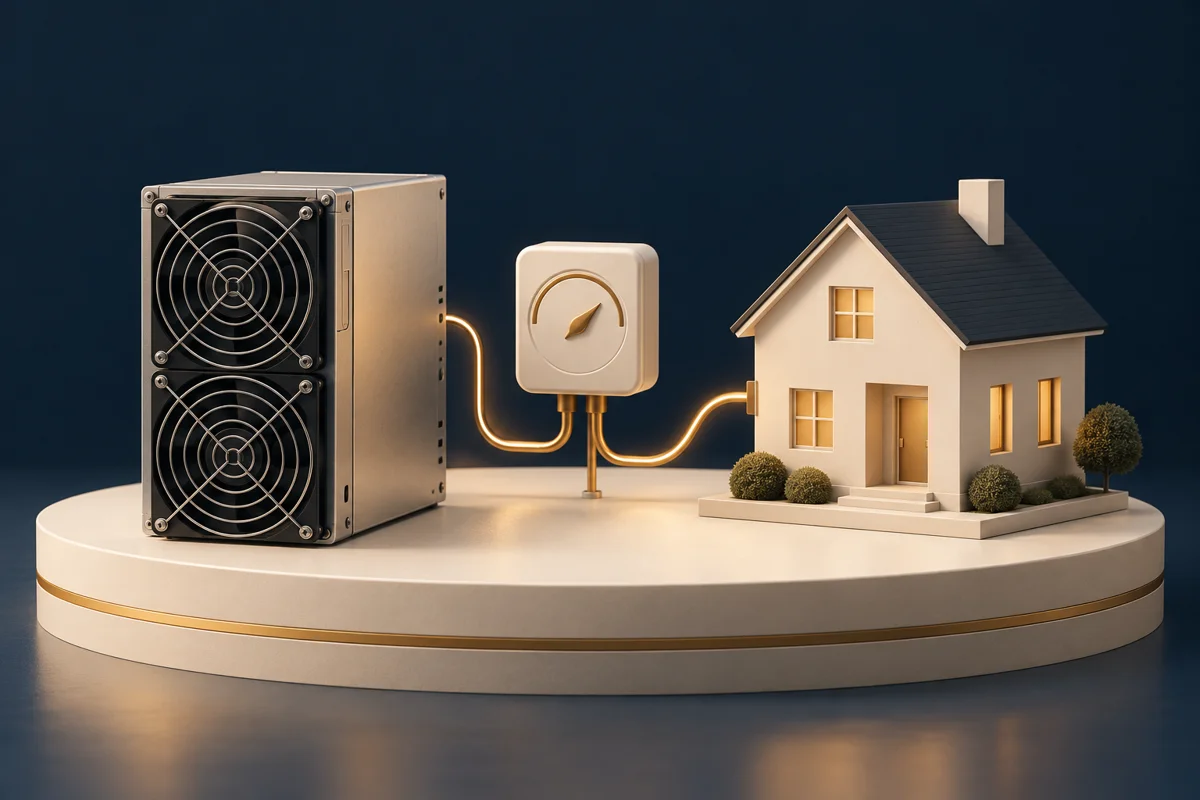
Yes, with suitable equipment and a setup that meets the equipment’s requirements. Bitcoin mining uses computing work to compete for block rewards. It is not a fixed payment for keeping a device switched on.
Start by deciding whether you want a learning project or an operation you expect to earn income. For a hobby, set a budget you can afford without recovering it through rewards. For an income plan, compare all costs with a clearly stated revenue estimate and revisit both as conditions change.
If you’re learning the mechanism first, read what Bitcoin mining does. This guide focuses on preparing a home setup.
Specialized Bitcoin mining computers are called ASICs. Compare the exact model’s hashrate, power at the wall, power-supply requirements, cooling and noise. A higher advertised hashrate is only one part of the decision.
Use the manufacturer’s setup and maintenance instructions. For example, BITMAIN’s precautions cover inspection, airflow and handling for its equipment. They do not establish the requirements for every miner. Don’t improvise electrical connections from a general article.
Use the power consumed at the wall, the operating hours and your electricity rate. Convert watts to kilowatts by dividing by 1,000.
Kilowatts × operating hours × price per kWh = electricity cost.
The starting values below are a hypothetical example. A 3,200-watt device uses 3.2 kW. Running it for 24 hours a day over 30 days uses 3.2 × 720 = 2,304 kWh.
Energy used in this period2,304 kWh
Electricity cost in this period$345.60
Electricity only. Excludes additional cooling, fixed or demand charges, taxes, equipment, repairs and pool charges. Include cooling power in the wattage if you want to estimate that electricity too. Your entries stay in this calculator; no information is submitted.
These are arithmetic examples, not equipment quotes, average U.S. bills or mining-income estimates. Use your own tariff and measured consumption. For time-of-use rates, calculate the periods separately and add their costs.
Make a separate list of the miner and power supply, shipping, installation, ventilation, maintenance and service charges. Keep one-time purchases separate from ongoing expenses so you can see both the cash required to start and the cost of continuing.
Compare costs and revenue over the same period. A calculator’s electricity result is neither a profit figure nor a prediction of when the equipment will pay for itself. Lower power costs alone do not guarantee a profitable operation.
With solo mining, your result depends on finding a valid block. Spending electricity does not entitle you to a partial reward if your work does not find one. A conventional pool combines work and distributes payments under its reward rules. The Bitcoin Developer Guide explains the distinction.
Ask these questions before choosing a pool:
Braiins’ payout documentation is one example of a pool publishing its reward and payment arrangements. It is a source to inspect, not our recommendation or an offer of a mining service.
A pool dashboard balance is different from a payment received in your wallet. Our solo-mining guide also explains why a service with “pool” in its name may still leave you dependent on your own successful block.
There is no fixed answer for your machine. Bitcoin targets an average of roughly ten minutes between network blocks. Ten minutes is not a minimum waiting time, and it does not tell you when an individual home miner will be paid.
A solo block win and accumulating pool payouts are different outcomes. Pool arrangements can change payment frequency and variability without creating a universal deadline for reaching one BTC. See our mining-time guide and worked probability example for the assumptions behind those estimates.
If actual costs or conditions differ from your plan, reassess before expanding. Keep records that let you separate BTC received, its dollar value at a stated time and your operating expenses.
If your goal is acquiring BTC rather than operating equipment, you can also compare our Bitcoin buying options. Review the full price, account requirements and delivery conditions before deciding. Buying Bitcoin also carries price risk and does not guarantee a return.
Bitcoin mining is competitive, and specialized hardware is used for it. An ordinary laptop should not be treated as a dependable Bitcoin income plan. Check what an app actually does before assuming a displayed balance represents Bitcoin you mined or can withdraw.
Include electricity and other applicable operating costs even if you already own the equipment. A service that calls mining free may have other conditions or may be describing something other than running your own Bitcoin miner.
No. Payments follow the pool’s rules, and any revenue still needs to be compared with your complete costs. Pool reward methods do not remove equipment costs, operating expenses or price risk.
There is no universal setup price. Get dated quotes for your chosen equipment, power supply, delivery and any work needed for your premises. Add an operating budget and keep hypothetical examples separate from actual offers.
The calculator on this page estimates electricity use and cost only. An income estimate needs additional assumptions about hashrate, network conditions, reward rules, deductions and price. Those assumptions can change.
This guide explains how to evaluate a home-mining project. It does not offer equipment, mining contracts or a managed mining service. For help with our Bitcoin purchase services, contact our team.
Prepared by the Crypto Dispensers team. Sources checked October 20, 2026. The power and tariff examples are hypothetical. The illustration is conceptual; this article does not present a tested mining installation. Manufacturer and pool references do not imply a partnership or endorsement.
Crypto Dispensers offers Bitcoin purchase services and has a commercial interest in the buying pages linked here. This educational guide does not promise mining income or investment returns. Fees, eligibility and available services vary.
Your next step
Learning opens the way. When you are ready, explore buying Bitcoin by wire, debit, credit or ACH, selling supported crypto for USD to your bank, or swapping supported assets. Your account shows the options available to you.
Creating an account does not authorize a payment. Availability depends on your location, account and required checks.
Helping people access Bitcoin since 2017.
Privacy controls
Necessary cookies are always on so the site works. You can also allow analytics to help us improve the experience, and advertising cookies to measure campaigns and show more relevant ads. You can change this anytime.
Read our privacy policy