
Bitcoin mining / Getting started
To mine Bitcoin, you connect a specialized mining computer to the Bitcoin network, usually through a mining pool, and supply electricity while it performs proof of work. You'll also need a compatible receiving wallet and a safe place to run the equipment. Whether the Bitcoin you receive covers your costs depends on your machine, electricity price and changing mining conditions.
If you're wondering where to begin, start with your electricity bill. We'll show you how to check the numbers, understand your payout options and prepare a setup before buying a miner.
By Crypto Dispensers · Published · 9 min read
Competitive Bitcoin mining uses purpose-built hardware called an application-specific integrated circuit, or ASIC. An ordinary laptop or phone has too little hashing power to compete economically with specialized machines. Bitcoin.org explains why specialized hardware became necessary.
A phone can display a mining dashboard or control equipment elsewhere. That doesn't mean its processor is doing the mining. Some services mine another cryptocurrency and pay you in Bitcoin. Check which asset is actually being mined, where the hardware runs and what you must pay.
If you want a small learning project, a low-power hobby ASIC can help you explore mining. Set a budget you can afford to spend on education without recovering it through rewards.
Mining hardware repeatedly hashes candidate block data, looking for a result that meets Bitcoin's difficulty target. When a miner finds a valid block, other network participants verify it against Bitcoin's rules. Valid blocks extend the blockchain and make its transaction history harder to change. The Bitcoin Developer Guide explains this process.
The successful block's reward includes newly issued Bitcoin, called the subsidy, plus its transaction fees. As of November 2, 2026, the subsidy is 3.125 BTC per block. The subsidy halves every 210,000 blocks; fees vary. You can check the schedule on Bitcoin.org's halving page.
That reward belongs to the successful mining operation. An individual pool participant receives payments according to the pool's rules. Turning on one machine doesn't earn the whole block reward on a schedule.
For a fuller explanation, read what Bitcoin mining does.
Gather these details before placing an equipment order:
| Item | What to check |
|---|---|
| SHA-256 ASIC miner | Exact model, sustained hashrate, watts at the wall, condition and warranty |
| Power supply and electrical installation | Manufacturer requirements and an assessment by a qualified electrician |
| Suitable operating space | Airflow, heat removal, noise, property permissions and cooling costs |
| Internet connection | Reliable connectivity and the manufacturer's network requirements |
| Bitcoin wallet | Supported payout network, custody arrangements and backup instructions |
| Pool account or solo setup | Reward method, fees, minimum payout and configuration instructions |
Hashrate measures how much hashing work a miner performs per second. Manufacturers often state it in terahashes per second, or TH/s. Efficiency may be expressed in joules per terahash, or J/TH. Compare power consumption alongside hashrate: a faster machine can still have higher running costs.
Use the manual for the exact miner and power supply. A general blog post can't establish whether your electrical circuit is suitable. Our home Bitcoin mining guide covers space and installation planning in more detail.
Start with a calculation you can reproduce:
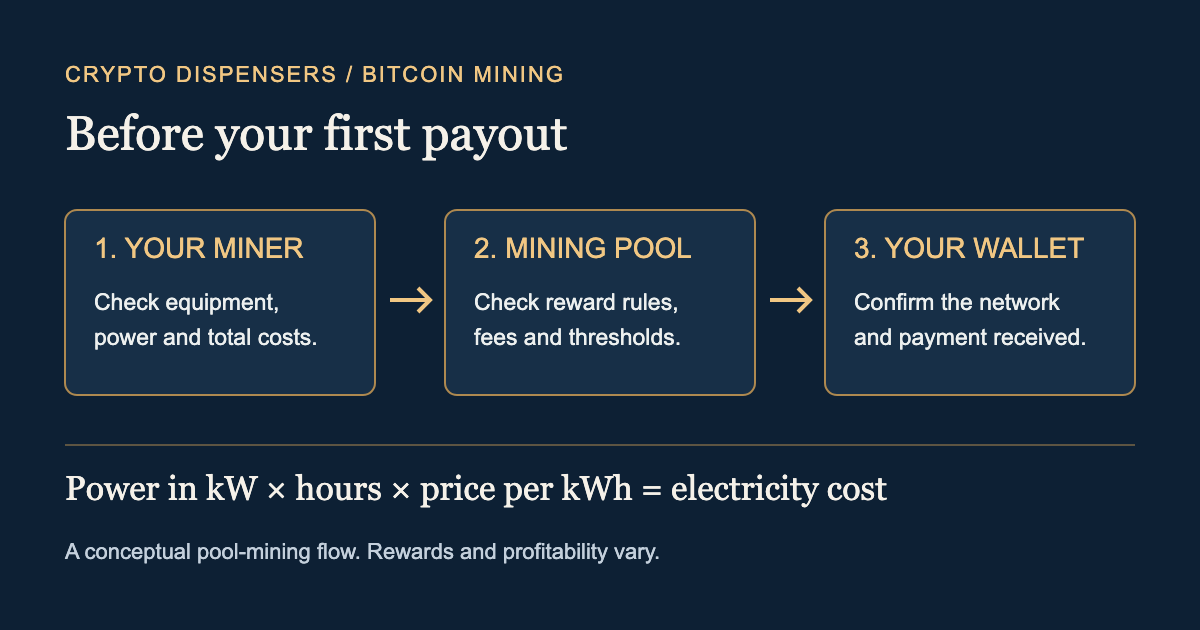
Electricity cost per day = watts ÷ 1,000 × operating hours per day × electricity price per kWh.
For a hypothetical 3,000-watt miner running 24 hours, daily energy consumption is 72 kWh. Over 30 days, it uses 2,160 kWh.
| Electricity price | Daily electricity cost | Cost for 30 days |
|---|---|---|
| $0.05/kWh | $3.60 | $108.00 |
| $0.10/kWh | $7.20 | $216.00 |
| $0.15/kWh | $10.80 | $324.00 |
| $0.20/kWh | $14.40 | $432.00 |
These are arithmetic examples using invented equipment inputs. They exclude cooling, hardware, repairs, installation, pool charges, taxes and any extra utility charges. Use your own tariff, including time-of-use periods where applicable.
Suppose your estimate shows $8 per day after pool deductions, before electricity and other costs. Assume another $1 per day for recurring expenses, excluding hardware recovery. With 72 kWh of daily electricity use:
Operating break-even electricity price = ($8 − $1) ÷ 72 = about $0.0972/kWh.
At $0.10/kWh, electricity costs $7.20, leaving an operating loss of $0.20 per day after that $1 expense. At $0.05/kWh, the operating surplus would be $3.40 per day. You would still need to recover the equipment and installation cost.
The $8 revenue figure is hypothetical. It isn't a current yield, an average or a forecast for a particular miner. This calculation helps you test a revenue estimate you obtain separately.
Try reducing that assumed revenue by 25%, to $6 per day. At $0.10/kWh, the operating loss becomes $2.20 per day. The break-even electricity price falls to about $0.0694/kWh.
Before relying on a mining calculator, record its date, hardware model, hashrate, difficulty, Bitcoin price, transaction-fee assumptions, uptime and pool deductions. Check whether cooling and hardware recovery are included. Changes in those inputs can turn a projected surplus into a loss.
A conventional pool combines participants' work and distributes payments under its reward method. Pooling generally reduces payment variability compared with solo mining. Read the operator's current terms rather than assuming every pool pays the same way.
For example, Braiins' rewards documentation describes its full pay per share, or FPPS, method and payout settings. This is an example of documentation to inspect, rather than a recommendation to choose that provider.
Ask how accepted work is credited, how fees are included, what the operator deducts and what balance triggers a payout. A dashboard balance may remain below the withdrawal threshold for some time.
With solo mining, you depend on finding a valid block yourself. You may spend electricity for a long period without receiving a block reward. A service can provide solo-mining infrastructure while still leaving that uncertainty with you. Check the reward arrangement even when a service uses the word “pool.” Our solo Bitcoin mining guide explains the distinction.
Hosting places equipment at someone else's facility. Cloud-mining contracts generally sell access to hashing capacity. Read who owns the machine, how electricity and maintenance are charged, when service can stop, and what happens to unpaid balances or equipment if the operator fails.
Treat guaranteed returns, pressure to deposit quickly and demands for extra payments to unlock supposed earnings as warning signs. The FTC's cryptocurrency scam guidance explains how fake investment dashboards and withdrawal demands can work.
Once your costs, installation and provider checks are complete, use this sequence alongside the manufacturer's instructions:
If something differs from the manual, stop and investigate. A running fan or rising dashboard number alone doesn't establish that a setup is working as expected.
There is no fixed time. For pool mining, you can divide one Bitcoin by an assumed daily BTC payment to explore the scale.
For example, 1 ÷ 0.0001 BTC per day = 10,000 days, or about 27.4 years. The daily payment is hypothetical and held constant only to demonstrate the calculation. Actual payments can change, and the equipment may stop operating long before that period ends.
Bitcoin's roughly ten-minute network block target doesn't mean your machine earns one Bitcoin every ten minutes. A small solo miner's outcome is especially uncertain.
Start with your goal. Mining can be a technical hobby or an equipment-based business requiring ongoing attention. Buying lets you acquire an amount of Bitcoin without operating mining hardware, although purchase fees, custody decisions and Bitcoin's price risk still matter.
If you're comparing the two, use the same budget and time period. For mining, include equipment, installation, electricity and ongoing costs. For buying, use the actual amount of Bitcoin you would receive after quoted costs. Avoid choosing whichever option looks better only under an assumed future price increase.
Crypto Dispensers provides Bitcoin purchase services, so we have a commercial interest if you choose to buy through us. If buying fits your goal, you can compare our payment options. Check current eligibility, verification requirements and the quote before proceeding.
Save these details in one place:
If any of those details are missing, resolve them before buying equipment. You'll have a much more useful starting point than an advertised daily earning figure.
Prepared by Crypto Dispensers with AI assistance and source checks on November 2, 2026. Primary sources are linked beside the explanations they support. The cost calculations are our illustrative arithmetic; we have not presented them as equipment tests or measured mining returns.
For the receiving side, read our Bitcoin wallet guide. Our guide to mining time estimates explains why an average is different from a deadline. Read our editorial and research standards for our approach to sources and corrections.
Your Crypto Dispensers account
Create an account to see the services available to you. You can buy Bitcoin by wire, debit, credit or ACH, sell supported crypto for a USD bank payout, or exchange supported assets. Contact our team if you need help choosing a service.
Creating an account does not authorize a payment. Availability depends on your location, account and required checks.
Helping people access Bitcoin since 2017.
Privacy controls
Necessary cookies are always on so the site works. You can also allow analytics to help us improve the experience, and advertising cookies to measure campaigns and show more relevant ads. You can change this anytime.
Read our privacy policy