Connect Bitcoin’s ideas in eight stages, from the basics and wallet ownership to purchase costs and receiving Bitcoin. Start where you are, save your reading progress and decide whether buying is right for you. There is no purchase required to learn.
Start with stage 1. Watch, listen or read the same short lesson, then try its example and check. The eight lessons take about 19 minutes. Detailed guides and practice are optional.
The lab adds fictional situations to the same topics. You can try one alongside a stage or use all nine later. It has its own progress, so a practice result does not mark a guide read or replace a stage check.
You can finish this path without buying anything. A correct quiz answer shows understanding of that question; it does not establish that you can afford a purchase or that now is a good time to buy.
Choose one format for each lesson. Open the guides for more detail and mark them read separately. The start button returns to your next unanswered stage.
Reading marks and successful checks are saved in this browser. They do not sync to your account. No purchase or login is needed.
Bitcoin is a form of digital money that people can own, buy, sell and send over the internet. There is no physical coin you need to collect. An asset means something you can own. Buying Bitcoin does not give you shares in a company.
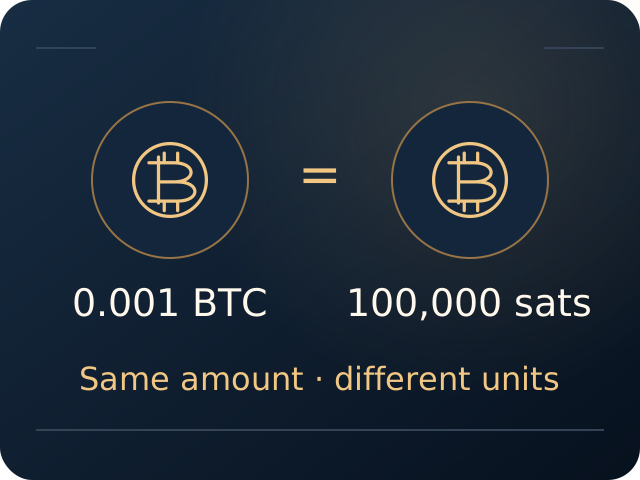
Bitcoin also names the network, the computers that communicate to check and record its transfers. BTC is the short label for the Bitcoin asset. You can buy a fraction: one BTC contains 100,000,000 smaller units called satoshis, or sats.
The worked example shows one amount in two units. One BTC is 100,000,000 sats.
Convert BTC and sats. Detailed fee calculations can wait.
Follow the example
Maya, our fictional learner, sees 0.001 BTC in one display and 100,000 sats in another. They show the same Bitcoin amount. This first example explains units, not how much a dollar budget will buy. We compare complete purchase offers in stage 7.
A transaction is a record of a Bitcoin transfer. A wallet prepares it. A private key is secret computer information that can authorize spending. The wallet uses it to make a digital signature, a mathematical proof that other computers can check without learning the key.
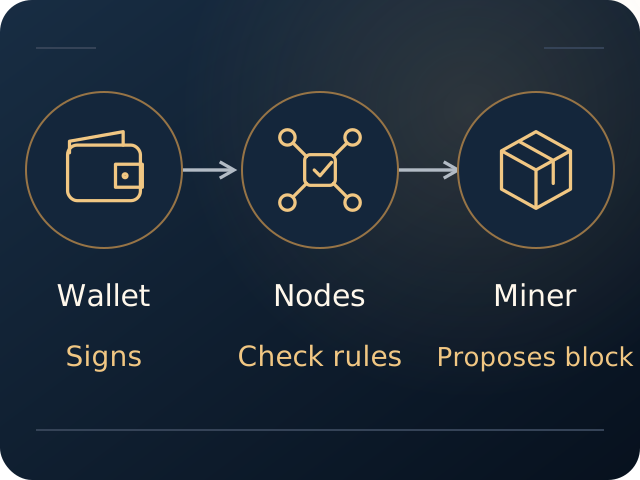
A node is a computer running Bitcoin software. A fully checking node checks the rules. A block groups transactions together; miners use computing work to compete to propose blocks. Accepted blocks form the blockchain, a linked history. A hash is a calculated fingerprint used in those links. Mining work cannot make a rule-breaking block valid.
These are different jobs. Nodes also check proposed blocks and reject any that break the rules.
See how miners propose blocks and nodes check them. Home-mining setup can wait.
Follow the example
Imagine Maya later sends Bitcoin. Her wallet uses the required keys to authorize a transaction. A miner may include it in a proposed block, and nodes check the block. A fully checking node rejects a block that creates more new Bitcoin than its rules allow.
Supply means how much Bitcoin exists or is available. Bitcoin’s current rules limit creation to 21 million BTC. Demand means how much people want to buy at a price. A supply limit does not guarantee a rising price.
New Bitcoin can form part of a miner’s permitted block reward. A halving cuts that new-coin portion in half at a scheduled block interval. It does not cut your balance in half or promise that the price will double. Consider the loss you could absorb and when you will need the dollars.
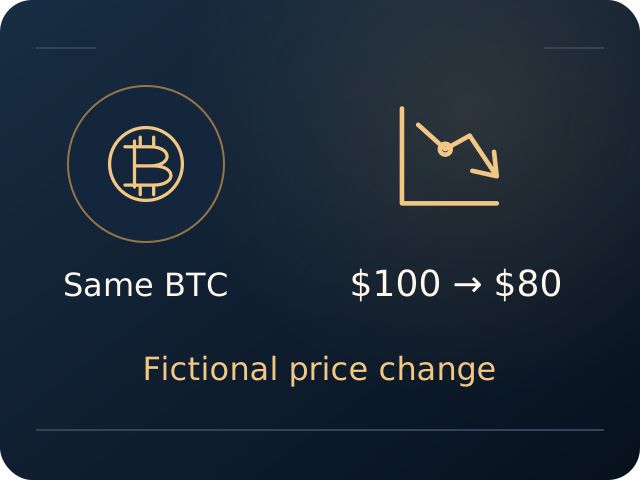
The BTC amount can stay the same while its dollar value falls. Limited supply does not guarantee a rising price.
Weigh the benefits, risks, possible losses and when you need your money.
Follow the example
At an invented price of $100,000 per BTC, Maya’s hypothetical 0.001 BTC is worth $100 before costs. If the price falls to $80,000, that same quantity is worth $80. No Bitcoin moved, but its dollar value fell. These prices are arithmetic examples, not current offers or a forecast.
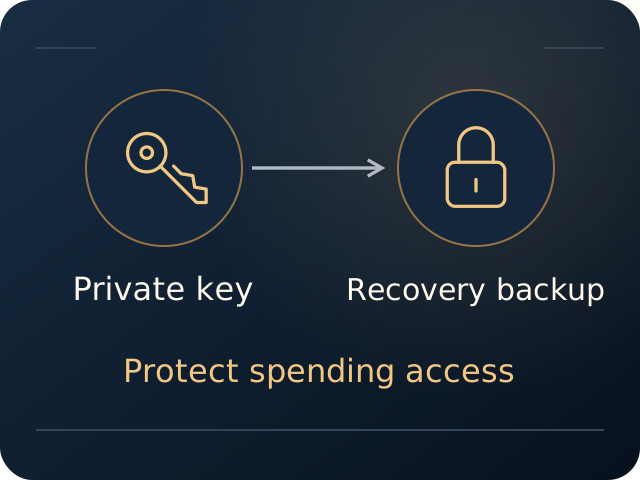
A wallet helps you receive and authorize Bitcoin payments. It manages keys; the coins are not files inside your phone. A private key is secret information that can authorize spending. A receiving address is the destination a wallet supplies for receiving a payment, shown as characters or a scannable QR code.
Custody means who holds and controls access. A custodian holds keys for you; you depend on its security and rules for moving Bitcoin out of the account. With self-custody, you hold the keys and protect the required backup. Many wallets use recovery words, also called a recovery or seed phrase, to recreate keys. These are different from an account password. Follow your actual wallet’s backup instructions.
A recovery backup can restore access to the keys. Keep both private; a receiving address is different and can be shared to receive Bitcoin.
Learn which backups your wallet uses and how to keep them private.
Follow the example
Before buying, Maya chooses who will hold the keys and learns the actual recovery method. She gets a receiving address from the genuine wallet’s Receive screen. She may share that address for receipt. Her private keys and recovery words stay private, including from anyone claiming to be support.
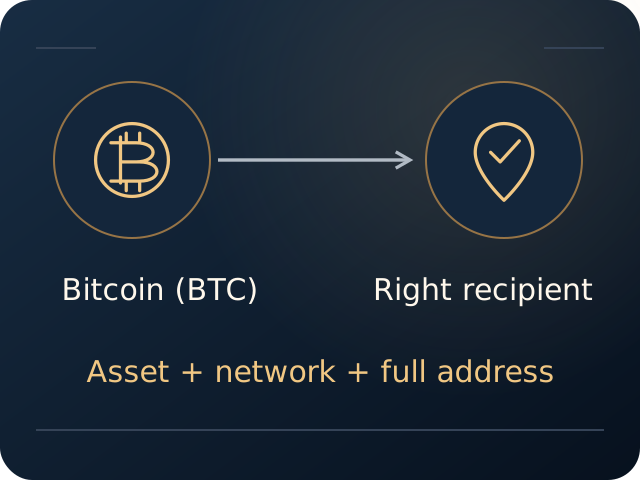
Check the asset, what you are sending, and the payment network, the system it travels through. On-chain means recorded on Bitcoin’s blockchain. Lightning is another way to pay with Bitcoin and uses different receiving instructions. An on-chain address and a Lightning invoice, a payment request, are not interchangeable.
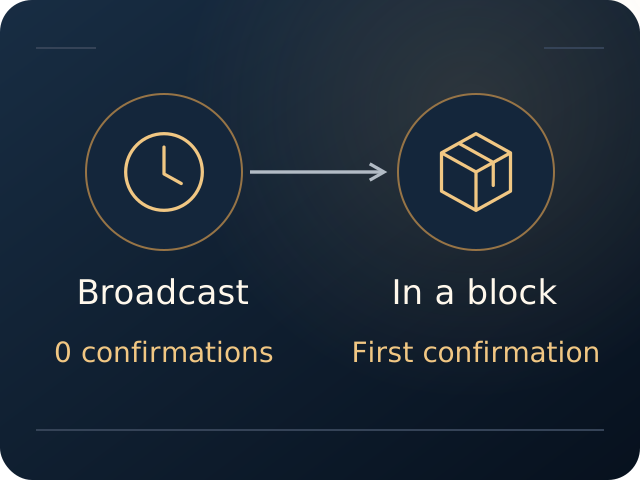
Broadcast means a signed transaction has been shared with other computers. Its first confirmation is inclusion in a block on the current chain; later blocks add confirmations. A receiving service can require several before making a payment available. Pending means a step is unfinished. A bank payment or account review can be pending before any Bitcoin transfer is broadcast.
Broadcast is not confirmation. Required confirmations depend on the receiving service; a bank receipt does not establish either network status.
Follow confirmations and the receiver’s rules for making a payment available.
Follow the example
Imagine Maya sees a genuine Bitcoin transfer with zero confirmations. It has not yet been included in a block on the current chain. She checks that record and the receiver’s requirements. About ten minutes is an average between blocks, not a deadline for this payment or a guarantee of inclusion.
The recipient is the person or service meant to receive a payment. Bitcoin’s computers check transfer rules; they cannot establish that a payment request is honest. Verify why you are paying, who should receive it and the complete destination through a source you independently trust.
A valid-looking address, logo, caller ID or QR code does not prove who is behind a request. A QR code is a scannable copy of information. Bitcoin has no central help desk that can simply reverse a confirmed payment. Pause and resolve unexpected instructions before buying or sending.
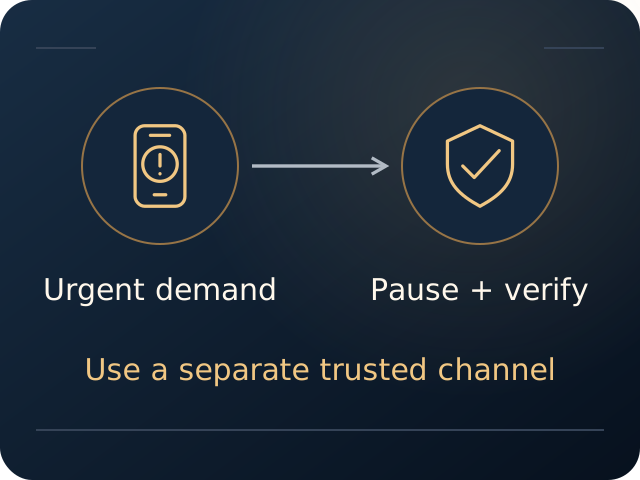
Stop the conversation and use a separate, trusted contact channel. Do not buy or send because someone pressures you.
Compare the whole receiving address with a trusted source.
Follow the example
A message changes Maya’s receiving address and says she must hurry. She stops and verifies through a separate, trusted channel. Correct-looking characters or a familiar logo do not establish who controls the address. She does not buy or send because someone pressures her.
A quote is an offer showing purchase terms. Compare the total dollars paid and the final Bitcoin received at the same destination. A purchase charge, a bank or card charge and an on-chain network fee pay for different steps. Check what is already included so you do not count it twice.
Wire and ACH are bank payment methods; ACH uses a bank-account payment system. Debit uses bank funds; credit may involve borrowing and charges from your card company. Available methods, requested identity checks and timing depend on the account and method. Check when you approve a price and when it is fixed for the order. A provider account balance and delivery to a separate wallet can be different steps.
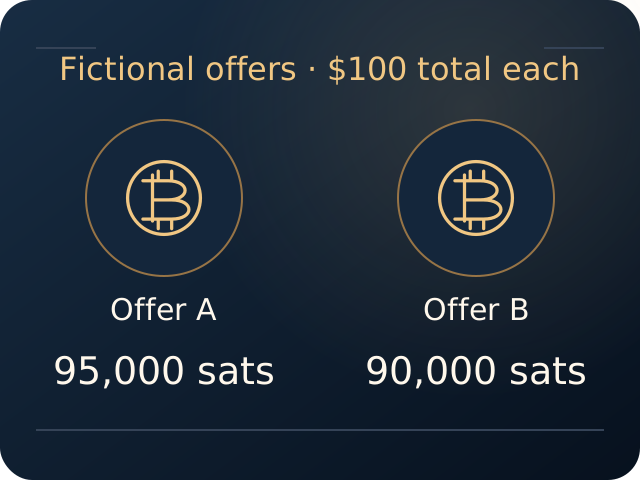
Worked example only: compare the same total cost and destination. Then check timing, custody, eligibility and terms. These are not live offers.
Separate purchase, bank or card charges and network fees.
Follow the example
Maya compares two invented offers for the same $100 total and wallet destination. A delivers 95,000 sats; B delivers 0.00090 BTC, or 90,000 sats. A delivers 5,000 more sats. She still checks who holds keys, timing, eligibility and terms. Our earlier 100,000-sat example explained units; it did not promise what $100 buys. Neither offer is our current quote.
A payment receipt shows a payment record. An order number identifies the provider’s order. A Bitcoin transaction ID is a different reference for looking up a transfer broadcast on the Bitcoin network. Keep the records that apply to each completed step.
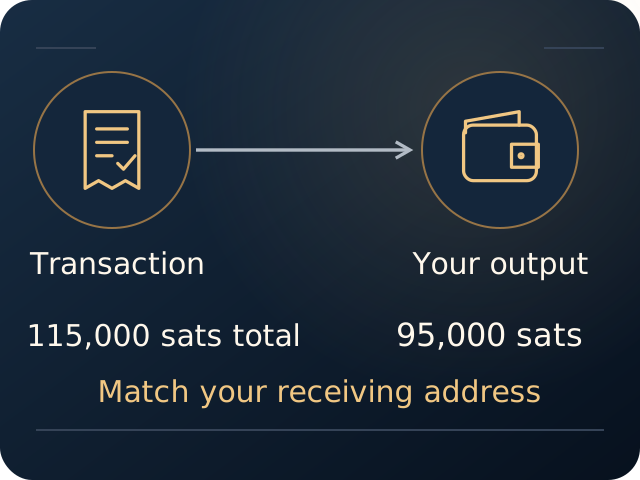
An output is an amount assigned to a receiving destination within a Bitcoin transaction. One transaction can have several outputs, including another payment or change returned to the sender. A block explorer is a website for viewing the public record. Match your receiving address to its output and check confirmations. An explorer cannot prove your private account review is complete.
Match your receiving address to its output. A transaction total can include other recipients; a public record cannot prove your private account status.
Read a fictional transaction without a payment, wallet connection or account.
Follow the example
Imagine Maya chose invented offer A: $100 total for 95,000 sats. Her fictional Bitcoin transaction sends 95,000 sats to her address and 20,000 elsewhere, a combined 115,000 sats. Her amount is 95,000 sats. She keeps the payment receipt, completed order and genuine transaction ID if a transfer was broadcast, and investigates any missing step before paying again.
There is no deadline or course score that tells you to buy. Consider why you want BTC, the loss you could absorb and when you will need the dollars. Learning more about Bitcoin does not predict its next price move.
I still have questions.
Return to the topic that is unclear. Wallet control, costs and receiving instructions should make sense before you send money.
You can keep your reading progress and return later. If losing the purchase money would interfere with bills, near-term needs or other commitments, pause and consider your circumstances before proceeding.
Check these privately against your own situation and the genuine order. These are preparation prompts, not account approval, investment advice or a guarantee of safety.
We’ve helped people access Bitcoin since 2017. Our team can explain account preparation, available payment methods, purchase costs and receiving-wallet checks. We cannot predict returns or recreate wallet keys or recovery information we do not hold.
Compare the wire, ACH, debit and credit options available to your account. Check location eligibility, the provider’s current terms, total costs and timing. Creating an account does not authorize a payment.
What happens when you create an account?
You’ll start with your legal name and email, then choose a password and review the terms. Creating an account does not buy Bitcoin. Available payment methods and any further checks depend on your account.
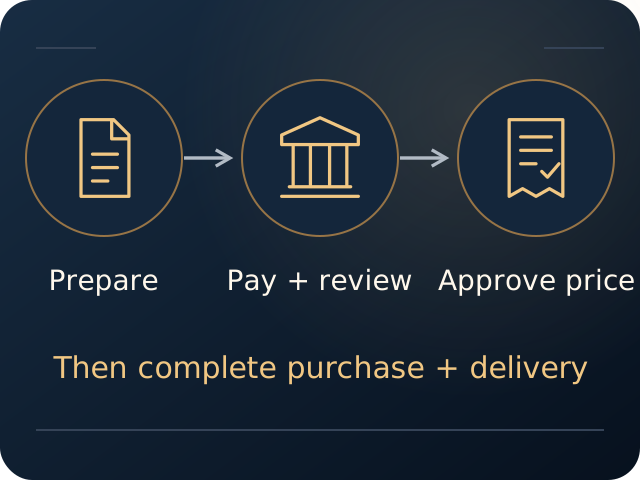
Create a request, complete the requested checks and prepare your confirmed receiving wallet. Wait for current approved bank instructions before funding. After funds arrive and required review is complete, inspect and choose whether to approve the final BTC price, costs and destination. Bitcoin delivery follows the completed purchase. Sending a wire does not lock the price.
Read the wire service and timing and purchase costs and return questions before sending money. As your transaction volume with us grows, we can review your service rate and may be able to lower it individually. There is no fixed discount schedule or automatic reduction.
Organized and reviewed by the Crypto Dispensers team on October 22, 2026. Our educational resources are free to read. We also offer purchase services, so we have a commercial interest if you choose to buy from us. The scenario checks are educational and do not certify that a purchase is right for you.
One fictional purchase, explained record by record
Follow the dollars. Find the Bitcoin.
Maya’s invented $100 example connects what you’ve learned. Explore each record to see what it answers and what to check next. You won’t enter payment details or move money.
All amounts and records are illustrations, not current Crypto Dispensers quotes, account screenshots or customer evidence. Payment and price-approval steps depend on the chosen method.
Illustration 1 of 4
Fictional record
Compare the offer
A comparison, before a purchase
Total dollars
$100
Bitcoin delivered
95,000 sats
Same amount in BTC
0.00095 BTC
Learning example only · No real payment instructions
What this record tells Maya
A quote is an offer showing the purchase terms. This invented comparison says $100 total would deliver 95,000 sats. BTC and sats are two units of Bitcoin.
What she checks next
Check when you approve a price and when it is fixed for the order, what costs are included and whether the method is available to you. A comparison is not a completed purchase.
Connect it to the lesson
A second invented offer delivers 90,000 sats for the same $100 total. The first delivers 5,000 more sats. That alone does not settle timing, access or suitability.
Illustration 2 of 4
Fictional record
Read the payment receipt
Dollars: received
Dollar payment
$100 received
Bank reference
Example bank reference
Bitcoin purchase
Check the order separately
Learning example only · No real payment instructions
What this record tells Maya
A receipt records a payment. This example shows the dollars received. It does not say a Bitcoin purchase or transfer has completed.
What she checks next
Open the genuine order to find the current step. A bank reference identifies the bank payment; it is not a Bitcoin transaction ID.
Connect it to the lesson
For our wire service, final price approval comes after funds arrive and required review finishes. Use current approved instructions for the actual request. Other methods have their own sequence.
Illustration 3 of 4
Fictional record
Read the completed order
Purchase: completed
Approved total
$100
Bitcoin purchased
95,000 sats
Order reference
Example order reference
Learning example only · No real payment instructions
What this record tells Maya
This invented order records a completed purchase at the terms Maya approved when required. It identifies the Bitcoin amount bought and the total cost.
What she checks next
Check how the chosen service delivers Bitcoin. A balance held with a provider and a transfer to a separate wallet can be different steps.
Connect it to the lesson
An account login gives access to the provider’s records. A wallet manages receiving and spending access. Before buying, Maya learns who holds the keys and which backup protects access.
Illustration 4 of 4
Fictional record
Find the Bitcoin delivery
Bitcoin transfer: recorded
Maya’s receiving output
95,000 sats
Another output
20,000 sats
All outputs combined
115,000 sats
Learning example only · No real payment instructions
What this record tells Maya
An output is an amount assigned to a destination in a Bitcoin transaction. Match Maya’s confirmed receiving address to its 95,000-sat output. The combined total is not her receipt.
What she checks next
Check the genuine transaction ID and current confirmations. A confirmation means inclusion in a block on the current chain; later blocks add confirmations. A receiver can require several before making funds available.
Connect it to the lesson
A block explorer is a website for reading the public transaction record. It cannot show private account reviews. You do not need recovery words, private keys or a wallet connection to read a public record.
For a real purchase, use your genuine account and current instructions. Never copy an example address, bank reference or order reference. If something is missing, identify the unfinished step before making another payment.
Learn by trying · fictional examples
Practice your first Bitcoin purchase.
Try one fictional decision at a time. Follow Maya’s worked example, then answer a different situation. There are nine topics; you can stop and return later.
One correct answer records a topic. A second example is optional. If a later answer is incorrect, that topic returns to your review list. These results are separate from your reading marks and stage checks.
Practice progress can be saved in this browser.
No money moves here. You do not need an account or a wallet. All amounts, offers and records are invented for learning. We will never ask for recovery words, private keys or payment details in this lab.
Choose a topic or review practice results
Practice 1 of 9 · fictional scenario
Read BTC and satoshis
Follow the worked example
A wallet is a tool for receiving and authorizing Bitcoin payments. BTC is Bitcoin’s short label. Satoshis, or sats, are smaller units: one BTC is 100,000,000 sats. Maya sees 0.001 BTC and 100,000 sats. Both show the same amount.
The worked example shows one amount in two units. One BTC is 100,000,000 sats.
A transaction records a Bitcoin transfer. A wallet uses secret keys to authorize, or sign, it. Nodes are computers that check the rules. A block groups transactions; miners use computing work to propose blocks, which nodes also check. Broadcast means shared with other computers. Its first confirmation means inclusion in a block on the current chain; timing varies.
These are different jobs. Nodes also check proposed blocks and reject any that break the rules.
BTC measures the Bitcoin amount. A dollar display values that amount at a price. Supply means how much Bitcoin exists; a limit on supply cannot guarantee a price. Maya’s same Bitcoin can be worth fewer dollars. She considers whether losing the money would affect bills or other needs.
The BTC amount can stay the same while its dollar value falls. Limited supply does not guarantee a rising price.
A private key is secret information that can authorize spending. Self-custody means Maya holds the keys. Some wallets use recovery words to recreate keys. These are different from an account password. A provider may reset a login but cannot recreate independent wallet keys or recovery information it does not hold. She keeps wallet secrets private.
A recovery backup can restore access to the keys. Keep both private; a receiving address is different and can be shared to receive Bitcoin.
The asset is what is sent; the network is the payment system. Maya selects Bitcoin (BTC) on the Bitcoin network. Wrapped BTC is a different digital token on Ethereum, another network. She opens Receive in her genuine wallet and compares the complete address with the sending instructions. A QR code is only a scannable copy of information.
Before sending, verify the asset, network and complete address from a trusted source. A familiar logo or matching address ends are not enough.
An unexpected caller tells Maya to buy Bitcoin to “protect” her bank savings. Caller ID, the number or name shown for a call, can be faked. She ends the call and contacts the bank using a number she independently verifies. She does not follow the caller’s payment instructions.
Stop the conversation and use a separate, trusted contact channel. Do not buy or send because someone pressures you.
A quote is a purchase offer. These are invented offers, not our prices. For the same $100 total and wallet destination, A delivers 95,000 sats and B delivers 0.00090 BTC, or 90,000 sats. These are units of Bitcoin. A delivers 5,000 more sats; who holds keys, timing, eligibility and terms still matter. A withdrawal moves funds out of an account and may have separate costs or conditions.
Worked example only: compare the same total cost and destination. Then check timing, custody, eligibility and terms. These are not live offers.
You can skip this wire example. For debit, credit or ACH, compare the available payment methods and follow the requirements, pricing and timing for the method you choose.
Follow the worked example
A bank wire is a payment you ask your bank to send using approved bank instructions. This exercise uses Crypto Dispensers’ wire process. Maya creates a request, completes the requested checks and waits for current approved bank instructions. After funds arrive and review is complete, she decides whether to approve the final price, costs and receiving details. Delivery follows the completed purchase. Other payment methods have their own steps.
Optional wire example: sending funds does not lock the Bitcoin price. Approval follows receipt of funds and required review; other payment methods have their own steps.
A receipt records a payment or purchase. A Bitcoin transaction ID is a reference for a network transfer. An output is an amount assigned to a destination in that transfer. Maya’s invented order delivers 95,000 sats. Its fictional Bitcoin record shows 95,000 sats to her address and 20,000 elsewhere, 115,000 combined. A public explorer website shows transfers, not private account reviews.
Match the address and its amount. This worked example uses 95,000 sats; the question below uses different details.
Practice each topic to build your learning summary.
Any topic without a saved correct answer appears below.
A practice result shows how you answered an example. Your decision also depends on your own circumstances, wallet responsibilities and the actual purchase terms. The learning path brings those questions together, including the option to wait.
Created and reviewed by the Crypto Dispensers team on October 22, 2026. Our team also provides purchase services. For independent explanations, see how Bitcoin works and what to know before using it.
Explore, practice and remember
Make the ideas click.
Use these tools alongside the learning path. See how Bitcoin fits into cryptocurrency, change an example yourself and check what you can explain without looking.
Where should I start?
Pick the question you have today. These shortcuts do not mark guides read or skip understanding checks.
I’m completely new
Begin with BTC, satoshis and the network. Follow the eight stages at your own pace. Start stage 1
Bitcoin or another cryptocurrency?
See which ideas carry over and which details change between assets and networks. See the crypto map
I need to see it work
Change an amount and a fictional record to see what changes and why. Try the demonstrations
I’m considering a first purchase
Work through fictional choices, then review whether to keep learning, wait or prepare. Open the practice lab
How does Bitcoin fit into cryptocurrency?
Cryptocurrency is the broad category. Bitcoin is one system within it. Sharing a word, ticker or logo does not make assets interchangeable.
Bitcoin and BTC
Bitcoin is the network; BTC is its native asset. Satoshis are smaller BTC units. Review stage 1.
Ethereum and ETH
Ethereum is another network with its own rules. ETH is its native asset and pays Ethereum transaction fees. It is not a Bitcoin balance. Compare these networks.
Stablecoins
These tokens aim to track a reference value, often a dollar. A target price is not a guarantee. Check the issuer, reserves, redemption terms and exact supported network. See one issuer’s risk disclosure.
Wrapped assets and bridges
A wrapped Bitcoin token on another network adds a mechanism and assumptions beyond native BTC. It cannot simply be sent to a native Bitcoin address. Understand wrapped Bitcoin.
Bitcoin on-chain and Lightning
Lightning moves BTC through payment channels; it is not a new coin. A Lightning invoice is a different payment request from an on-chain address. Wallet custody and availability vary. Read an invoice.
Provider account or your own keys
A balance inside a provider account depends on that provider’s records and withdrawal rules. Self-custody puts signing access and backup responsibility with you. Compare the responsibilities.
What about apps, NFTs and staking?
Smart contracts are programs that run under a blockchain’s rules. An NFT is a distinct token record; owning one does not automatically give you copyright. Staking, lending and promised yield have different mechanisms and risks. None is required to understand or buy BTC.
Connecting a wallet is different from signing a transaction or granting a token-spending approval. Read each request before approving it. An unfamiliar “claim” can ask for permissions that put funds at risk. Review wallet approval safety.
Before any transfer: confirm the exact asset, network and receiving instructions on both sides. A demo or an old message is never a real payment instruction.
A hash is a fingerprint calculated from data. Each block below records the previous block’s fingerprint. Change the first record and compare its new hash with the reference in block 2.
Simplified hash-link demonstration: these are real SHA-256 hashes of fictional text, not Bitcoin blocks. It omits signatures, mining and network consensus.
This example links three fictional records. Read the explanation below if interactive controls are unavailable.
Recalculating these toy links is easy. It does not make an altered Bitcoin history valid. Real nodes enforce transaction and block rules; proof of work makes replacing history costly, and nodes select the valid chain with the most accumulated work.
First ask who controls the signing keys. An app’s appearance, a password or a hardware device alone does not answer that question.
A provider controls the keys
You depend on the provider’s security, solvency, supported networks and withdrawal rules. Account recovery may help with a login, but it does not remove provider risk. Verify genuine account entry and use strong authentication.
You control the keys
You authorize spending and protect the wallet’s recovery method. A lost phone may be recoverable with a valid backup; a lost backup plus lost signing access may leave nobody able to recover the funds.
Hot wallet, hardware wallet and backup: how do they connect?
A hot wallet keeps signing keys in an online environment. A hardware wallet is designed to isolate signing keys from the connected computer or phone. Its recovery backup can restore access, so that backup needs protection too. A hardware wallet cannot make a wrong address or a malicious approval safe.
Use the wallet maker’s genuine setup instructions. Never use recovery words supplied by someone else. Never put real recovery words into a learning tool or send them to support.
What if someone needs access after I’m gone?
Plan how a trusted person could locate your instructions and carry out your wishes without exposing spending access today. Keep public instructions separate from secrets. Your custody arrangement and local estate rules matter; use qualified help for your situation. Read about access and inheritance.
BTC is the asset; a satoshi is one hundred millionth of a BTC. Return to this topic
Blockchain
An ordered record of blocks linked by hashes and checked under the network’s rules. Return to this topic
Node and miner
A full node checks the rules. A miner uses work to propose a block; that block still has to satisfy the rules. Return to this topic
Private key and recovery backup
A private key authorizes spending. A recovery backup can restore keys or access, depending on the wallet. Keep both private. Return to this topic
Address
Receiving instructions for a supported asset and network. It is different from a private key. Return to this topic
Custody
Who controls the keys, and therefore whose access and policies you rely on. Return to this topic
Mempool and confirmation
A mempool holds unconfirmed transactions known to a node. A transaction gets its first confirmation when included in a block. Return to this topic
UTXO
An unspent transaction output. A Bitcoin payment can create a recipient output and another output returning change to the sender. Return to this topic
Network fee and purchase cost
A Bitcoin network fee relates to the on-chain transaction. A purchase can also have provider, payment or withdrawal costs. Compare the complete result. Return to this topic
Stablecoin
A token aiming to track a reference value. Issuer, reserve, redemption and network risks still matter. Return to this topic
Smart contract and approval
A smart contract is a blockchain program. A token approval may authorize it to spend tokens, subject to that permission. Return to this topic
On-chain and Lightning
On-chain payments are recorded in Bitcoin blocks. Lightning uses payment channels and different payment requests. Return to this topic
No matching term here. Try a shorter word or open the full glossary above.
Can I explain it in my own words?
Try answering aloud before opening each explanation. Come back after a break and try again. Remembering an answer does not establish that a purchase is affordable or suitable for you.
Bitcoin review sheet
Crypto Dispensers · Reviewed October 22, 2026 · cryptodispensers.com/learn
1. Explain what you would own if you bought BTC.
A quantity of Bitcoin, possibly a fraction. It is not a share in a company, a stablecoin or a guarantee of future value. Review the stage
2. How do a wallet, node and miner have different jobs?
A wallet prepares and signs. Nodes check the rules. Miners use work to propose blocks that nodes must still validate. Review the stage
3. Could your BTC stay unchanged while its dollar value falls?
Yes. A wallet’s dollar display uses a price; the BTC quantity and its current dollar value are different measurements. Review the stage
4. What can recover a lost self-custody wallet, and what must stay private?
A valid recovery backup may restore access. Protect recovery words and private keys. A provider login has different recovery arrangements. Review the stage
5. Does a broadcast transaction mean the recipient has a confirmation?
No. Inclusion in a block gives the first confirmation. Provider processing and bank payment status are separate steps. Review the stage
6. What would you check before sending to an address someone supplied?
Verify the person or organization independently, then the exact asset, network and complete receiving address. Pause if someone applies payment pressure. Review the stage
7. How would you compare two purchase offers?
Use the same total dollars and destination, compare final BTC delivered, then check timing, eligibility, custody and terms. Do not count an included cost twice. Review the stage
8. What can a public Bitcoin record prove, and what can it not prove?
It can show transaction outputs and confirmations. It cannot establish your private account review, the completion of every purchase step or ownership from a name alone. Review the stage
Before deciding to buy
Know what asset you would receive, where it would be held and who controls access.
Understand the complete cost, payment steps and conditions for delivery.
Consider price falls and the money you need for other commitments.
Verify the provider and recipient independently. Keep secrets private.
Choose to keep learning, wait or consider a purchase. You do not owe anyone a purchase.
These references let you check the explanations and explore further. A source link is not an endorsement of its products, every opinion or every claim on the site.
These are external resources. Their privacy practices, commercial interests and viewpoints can differ from ours.
Who created this, and how do I report something confusing?
The Crypto Dispensers team created this toolkit and reviewed its explanations against the linked references on October 22, 2026. The date applies to this toolkit, not every article in the library. We provide paid crypto services, so we have a commercial interest if you later choose to buy from us.
Tell our team what needs a clearer explanation. Include the topic or page link and the sentence that confused you. Do not send recovery words, private keys or full payment information.
Choose the format that helps you learn. Each short lesson explains one stage with diagrams and a worked example. Watch with captions, listen to the same narration or read its complete transcript, then return to the stage example and check. You only need one format; the explanation is the same in all three.
Eight lessons · about 19 minutes total · Conversational AI-generated narration · No login or purchase required
Playback positions can be saved in this browser.
1. What Bitcoin is
(2:18)
Stage 1 of 8 · Your learning goal
What does Bitcoin mean?
Separate Bitcoin the asset from the network, and BTC quantity from its dollar value.
Captions are included in the picture. You can also enable the English text track in your player.
Listen to the same lesson
The audio explains every diagram in words. You can switch to Watch at the same point if a visual would help.
You can follow the full explanation without watching the screen.
Read the lesson
Bitcoin is something you can own
Bitcoin is a form of digital money. There is no physical coin you need to collect. People buy and sell amounts of it, and can send it over the internet. An asset means something you can own. Bitcoin is one kind of asset. Buying it doesn't give you shares in a company, and its dollar price can fall.
The money and the system
The word Bitcoin also names the system that records its transfers. A network means computers communicating with each other. Bitcoin has no single central company or bank running that record. BTC is the short label for the Bitcoin asset, like a currency abbreviation. Cryptocurrency is the wider category. Other cryptocurrencies have their own assets and rules. They aren't all Bitcoin.
You can buy a small fraction
You don't need to buy a whole Bitcoin. One Bitcoin divides into one hundred million smaller units called satoshis, or sats. Think of units like dollars and cents. One thousandth of a Bitcoin, written zero point zero zero one BTC, equals one hundred thousand sats. Changing the unit doesn't change the amount.
Amount and price answer different questions
Maya is our fictional learner. She sees the same Bitcoin amount shown in BTC and sats. Both tell her how much Bitcoin there is. A dollar display tells her what that amount is worth at a particular price. The dollar value can change while the Bitcoin amount stays the same. Buying also involves costs, which we'll explain later.
An account and a wallet are different
A provider is a business that offers a service, such as buying Bitcoin. An account is your login and the records that business keeps for you. A Bitcoin wallet is a tool for receiving and authorizing Bitcoin payments. A provider account and a separate wallet aren't automatically the same thing. We'll explain who controls access in stage four.
Explain the same amount in two units
Maya switches her display from one thousandth of a Bitcoin to one hundred thousand sats. Did she receive more Bitcoin? No. Only the unit changed. Return to stage one for its example and check. You don't need an account, a wallet or any money to continue learning.
Play from a part of this lesson
AI-generated narration with original educational diagrams. Examples are illustrations, not account screenshots or customer evidence.
Captions are included in the picture. You can also enable the English text track in your player.
Listen to the same lesson
The audio explains every diagram in words. You can switch to Watch at the same point if a visual would help.
You can follow the full explanation without watching the screen.
Read the lesson
A transfer needs a shared record
Imagine Maya later sends some Bitcoin. A transaction means a record of a Bitcoin transfer. Her wallet prepares the details, including the amount and where it should go. Computers need a way to check that spending is allowed and keep a shared history. Otherwise someone could try to spend the same Bitcoin twice.
A secret key gives spending permission
A private key is secret computer information that can authorize spending. The wallet uses it to create a digital signature, a mathematical proof of permission. Other computers can check that proof without learning the secret key. The signature doesn't prove the person requesting payment is honest. Maya still has to check the recipient.
Nodes check, miners propose
A node is a computer running Bitcoin software. A fully checking node, also called a full node, checks transactions and proposed blocks against the rules. A block groups transactions together. Miners use computing work to compete to propose the next block. Nodes reject a block that breaks the rules, even if the miner did the work.
The blockchain is the linked history
The blockchain is the history of accepted blocks. Each block refers to an earlier block using a hash, a calculated fingerprint of information. Those links help reveal changes. Bitcoin also requires valid transactions and proof of work, the miner's computing evidence. Recalculating a fingerprint alone cannot make a false payment history acceptable.
What this means for Maya
Maya doesn't have to run a node or mining equipment to buy or use Bitcoin. Her wallet and chosen service handle parts of the process. She still needs to understand their different jobs. A wallet prepares spending permission, nodes check the rules, and miners propose blocks. None of those jobs guarantees an investment return.
Can a miner ignore the rules?
Suppose a miner proposes a block creating more new Bitcoin than the rules allow. Must a full node accept it because the miner worked hard? No. It rejects the invalid block. Return to stage two to follow the diagram and try its check. The optional linked-record demonstration lets you explore fingerprints.
Play from a part of this lesson
AI-generated narration with original educational diagrams. Examples are illustrations, not account screenshots or customer evidence.
Captions are included in the picture. You can also enable the English text track in your player.
Listen to the same lesson
The audio explains every diagram in words. You can switch to Watch at the same point if a visual would help.
You can follow the full explanation without watching the screen.
Read the lesson
Limited supply does not set a price
Supply means how much Bitcoin exists or is available. Bitcoin's current rules limit the amount that can be created to twenty-one million BTC. Demand means how much people want to buy at a price. Buyers and sellers determine market prices. A supply limit does not guarantee that someone will pay more for your Bitcoin later.
What a halving actually changes
Miners can receive newly created Bitcoin as part of the permitted reward for a valid block. This new-coin portion is called the block subsidy. A halving reduces that portion by half at a scheduled block interval. It doesn't halve your wallet balance or automatically double Bitcoin's dollar price.
The same Bitcoin can be worth less
Imagine Maya holds one thousandth of a Bitcoin. At an invented price of one hundred thousand dollars per Bitcoin, that quantity is worth one hundred dollars before costs. If the price falls to eighty thousand dollars per Bitcoin, her same quantity is worth eighty dollars. Twenty dollars of displayed value is gone, even though no Bitcoin moved.
Why people use it, and the limits
Some people value being able to transfer Bitcoin and check its rules without relying on one central operator. Others buy it hoping its value will grow. Those reasons don't remove price risk, theft, mistakes or reliance on a provider. Useful technology and a profitable purchase are different questions.
Your own money has other jobs
Before considering a purchase, think about bills, near-term needs and the loss you could absorb. There is no lesson score that makes a purchase affordable. You can understand Bitcoin and choose to wait or never buy. Nobody can promise what its next price move will be.
Does a fixed limit promise a return?
If fewer new coins are created, must the price rise? Think about whether buyers still want them and what they are willing to pay. Supply alone cannot promise a return. Return to stage three for the loss example and its check. Waiting remains a valid decision.
Play from a part of this lesson
AI-generated narration with original educational diagrams. Examples are illustrations, not account screenshots or customer evidence.
Captions are included in the picture. You can also enable the English text track in your player.
Listen to the same lesson
The audio explains every diagram in words. You can switch to Watch at the same point if a visual would help.
You can follow the full explanation without watching the screen.
Read the lesson
A wallet manages spending access
A Bitcoin wallet is software, sometimes used with a separate device. It helps you receive Bitcoin and authorize spending with keys. The coins aren't files stored inside your phone. The Bitcoin network records transfers. Your wallet uses that record to work out the amount it can spend. Its secret keys provide spending permission.
Who holds the keys?
Custody means responsibility for holding and controlling access. With a custodian, a provider holds the keys. You depend on its security, financial condition and rules for moving Bitcoin out of your account. With self-custody, you hold the keys. You take responsibility for keeping spending access and the required backup safe. Neither arrangement removes every risk.
An address receives, a key spends
A receiving address is a destination supplied by the receiving wallet, usually shown as characters or a QR code. A QR code is a picture a device can scan to read information. You may share the appropriate receiving address to receive Bitcoin. A private key is different: it can authorize spending. Never share it with a sender or support.
Recovery words are not a login password
Many wallets give you recovery words, sometimes called a recovery phrase or seed phrase. Those words can recreate wallet keys. Other wallet designs use different backups. Follow your genuine wallet's instructions. Store its required backup securely and privately. A provider may reset an account password, but it cannot recreate self-custody keys or recovery information it doesn't hold.
Prepare the wallet before paying
A hardware wallet is a separate device designed to protect signing keys. It still needs a safe backup and careful checks of payment details. Before Maya buys, she chooses who will hold the keys and learns the recovery method. She uses the wallet's own receive instructions to get the right destination. She never copies an address from an educational diagram.
Would support need your recovery words?
A stranger offers to fix Maya's wallet if she shares its recovery words. Would a company logo make that safe? No. Keep those words private and contact genuine support independently. Return to stage four to compare receiving information with spending secrets.
Play from a part of this lesson
AI-generated narration with original educational diagrams. Examples are illustrations, not account screenshots or customer evidence.
Captions are included in the picture. You can also enable the English text track in your player.
Listen to the same lesson
The audio explains every diagram in words. You can switch to Watch at the same point if a visual would help.
You can follow the full explanation without watching the screen.
Read the lesson
Choose the payment network correctly
Before sending, check what both sides support. The asset is what you're sending, such as Bitcoin, labeled BTC. The network is the payment system it will travel through. On-chain means recorded on Bitcoin's blockchain. Lightning is another way to make Bitcoin payments and uses different receiving instructions. An on-chain address and a Lightning invoice, a payment request, aren't interchangeable.
Shared with the network, then in a block
Broadcast means the signed transaction has been shared with other computers. It may be waiting for inclusion in a block. That is zero confirmations. Its first confirmation means inclusion in a block on the current chain. Later blocks add confirmations. A receiving service can require several confirmations before making a payment available.
Why a transfer can wait
An on-chain network fee pays for using block space. It is different from a company's purchase charge or a bank's fee. Demand for block space affects waiting. Bitcoin targets about ten minutes between blocks on average. A particular block, or your transaction's inclusion, can take longer. A fee does not buy an exact completion time.
Find out which step is pending
Pending means a step hasn't finished. A bank payment, an account review or a provider's withdrawal processing may be pending before any Bitcoin transaction is broadcast. A withdrawal means moving funds out of an account. First ask which step is waiting. A bank receipt doesn't prove that Bitcoin was sent, and a Bitcoin record can't show a private account review.
One transaction can pay several destinations
An output is one amount assigned to a receiving destination in a Bitcoin transaction. A transaction can have several outputs, including another recipient or change returned to the sender. To check Maya's receipt, match her confirmed receiving address to its output. The combined total of every output isn't necessarily the amount she received.
What do zero confirmations tell you?
Maya sees a genuine transaction record with zero confirmations. Does that mean the bank never received her dollars, or that the payment must finish in exactly ten minutes? Neither. It tells her the transaction hasn't been included in a block on the current chain. Return to stage five to practice separating these statuses.
Play from a part of this lesson
AI-generated narration with original educational diagrams. Examples are illustrations, not account screenshots or customer evidence.
Captions are included in the picture. You can also enable the English text track in your player.
Listen to the same lesson
The audio explains every diagram in words. You can switch to Watch at the same point if a visual would help.
You can follow the full explanation without watching the screen.
Read the lesson
Check why someone wants you to buy
Maya gets an unexpected call saying she must buy Bitcoin to protect her bank savings. The caller tells her to hurry. She ends the conversation and contacts the real organization using details she finds independently. She doesn't buy or send money because the caller directs her to.
A familiar appearance is not proof
Caller ID, a logo and a polished website can be copied. An address in a message can be replaced. A valid-looking Bitcoin address doesn't prove who controls it. Use a source you independently trust, such as the genuine wallet's receive screen or the provider's actual account instructions. Don't verify a suspicious request only by asking its sender.
Compare the complete destination
Check the exact asset, supported payment network and complete receiving address. Recipient means the person or service meant to receive the payment. A QR code is a convenient way to read instructions, not proof they are honest. Compare the full destination with the trusted source and resolve any mismatch before approving.
Know what a confirmed transfer cannot do
Bitcoin has no central help desk that can simply reverse a confirmed payment. If you send to a wrong destination, you may depend on the recipient returning it, which isn't assured. A small test transfer may help check delivery when appropriate. It cannot prove that a stranger, investment or website is legitimate.
Ask for help without sharing secrets
If Maya is unsure, she pauses and contacts verified support. She can describe the step and status, and provide an order reference or public transaction ID when appropriate. She never shares private keys, recovery words, account passwords or security codes. Nobody needs her wallet secrets to explain a purchase. She doesn't connect a wallet just to use our lessons.
Choose the independent check
A message changes the receiving address and says to pay immediately. Should Maya trust it because the address looks valid? No. She verifies through a separate, trusted channel before moving money. Return to stage six for the example and check. A request to pay more to release supposed earnings also deserves a pause.
Play from a part of this lesson
AI-generated narration with original educational diagrams. Examples are illustrations, not account screenshots or customer evidence.
Captions are included in the picture. You can also enable the English text track in your player.
Listen to the same lesson
The audio explains every diagram in words. You can switch to Watch at the same point if a visual would help.
You can follow the full explanation without watching the screen.
Read the lesson
A quote is a purchase offer
A quote shows the terms offered for a purchase. Compare the total dollars you'll pay and the final Bitcoin you'll receive at the same destination. Include applicable purchase, bank, card and transfer costs. Ask whether each cost is already included. Otherwise you could count it twice. Timing, eligibility and who holds the keys also matter.
Compare matching amounts and units
Maya compares two invented offers for one hundred dollars total. Offer A delivers ninety-five thousand sats. Offer B delivers ninety thousand sats, also written zero point zero zero zero nine BTC. A delivers five thousand more sats in this example. The earlier one-hundred-thousand-sat example explained units; it wasn't a promise of what one hundred dollars buys. These offers aren't our current prices.
Prepare before opening an order
Maya chooses an amount she can afford to put at risk. She understands who will hold the keys and verifies the receiving instructions for the chosen payment method. She checks total costs, when the price is fixed for your order, and which steps may take time. If any part is unclear, she asks the genuine provider before paying.
Account setup comes before a purchase
At Crypto Dispensers, email signup starts with your legal name and email, then a password and the terms. Creating an account doesn't buy Bitcoin or authorize a payment. Our buying options include bank wire, bank ACH, debit and credit methods, subject to availability. ACH is a bank-account payment method. Debit draws on bank funds; credit can involve borrowing and charges from your card company. Requested checks depend on the account and method.
A wire has its own approval sequence
A bank wire is a bank transfer. For our wire service, prepare a request and complete the requested checks. Only fund using current approved instructions for your actual request. After funds arrive and required review finishes, review the final Bitcoin price, costs and destination, then decide whether to approve. Sending a wire alone doesn't lock the price. Other methods have their own steps.
Your real first step, if you choose to buy
Return to stage seven, compare the payment methods and review the preparation questions. You can create an account or ask our team about a service without committing to a purchase. If buying isn't affordable or the instructions don't make sense, wait. A correct answer about a quote is useful knowledge, not a reason to rush.
Play from a part of this lesson
AI-generated narration with original educational diagrams. Examples are illustrations, not account screenshots or customer evidence.
Captions are included in the picture. You can also enable the English text track in your player.
Listen to the same lesson
The audio explains every diagram in words. You can switch to Watch at the same point if a visual would help.
You can follow the full explanation without watching the screen.
Read the lesson
Track dollars, purchase and Bitcoin separately
Imagine Maya chooses our invented offer A. Its one-hundred-dollar total delivers ninety-five thousand sats to her confirmed receiving destination. This is an illustration, not a live order or customer record. She separates three questions: did the dollar payment arrive, did the purchase complete, and was any requested Bitcoin transfer made? One completed step doesn't establish the others.
Keep the matching references
A receipt records a payment or purchase. An order number identifies the provider's order. A Bitcoin transaction ID is a different reference, used to look up a transaction broadcast on the network. Keep the records that apply to your actual purchase. If no on-chain transfer has been broadcast, a bank reference or order number won't become a Bitcoin transaction ID.
Find Maya’s amount in the record
In our fictional Bitcoin transaction, one output sends ninety-five thousand sats to Maya's address. Another output sends twenty thousand elsewhere. The combined total is one hundred and fifteen thousand sats. Maya received ninety-five thousand, not the combined total. Match the address and its amount, then check confirmations.
An explorer shows the public record
A block explorer is a website for viewing Bitcoin's public transaction record. A genuine explorer can show outputs and confirmations using the transaction ID. It doesn't prove a private account review is complete. You don't need to share keys, recovery words or connect a wallet to read a public transaction. Avoid linking public addresses to your identity unnecessarily.
If something looks wrong, find the step
Maya compares the bank receipt, completed order and receiving-wallet record. If one step is missing, she asks verified support about that step instead of immediately paying again. Her Bitcoin quantity can remain unchanged while its dollar value falls. She checks quantities, costs, transfers and the price used for the display. She keeps protecting her backup and future access.
Bring the whole purchase together
Can you explain what you own, who can spend it, what you will pay, and which record confirms each step? You don't need to remember every technical term. Return to stage eight for its check, then review your decision. Keep learning, wait, or use the preparation checklist and account links when buying fits your own circumstances.
Play from a part of this lesson
AI-generated narration with original educational diagrams. Examples are illustrations, not account screenshots or customer evidence.
Lessons reviewed October 22, 2026 against the learning path and its protocol and safety references. Answering a check shows understanding of that question. It does not establish that buying is affordable or suitable for you.
The complete guide library
Every questionis a place to begin.
You do not need a technical background to start. Explore Bitcoin basics, wallets, buying methods, transactions and safety. Choose a topic or search for the question on your mind.
Keep control of the decision. Never send Bitcoin because a stranger, supposed support agent, investor, romantic contact, or online seller pressures you to act fast.
Ready to review our service? See the current wire fees, required verification and purchase process. This learning path is educational; it does not show your request status or approve a transfer.
Start with the plain language explanation, then open the full guide when you want more detail.
Our wire team can help with a Bitcoin purchase of any amount. There is no minimum or maximum. Purchases usually process within 1–2 days, though verification and compliance reviews can take longer. In-store cash deposits have ended. If you need help with an earlier cash payment, keep your receipt and contact us.
Necessary cookies are always on so the site works. You can also allow analytics to help us improve the experience, and advertising cookies to measure campaigns and show more relevant ads. You can change this anytime.

 01
 02
 03
 04
 05
 06
 07
 08


 Prepare your receiving wallet
 Online bank wire preparation
 Credit union wire preparation
 Bitcoin pricing and purchase methods
 Bitcoin funding and delivery
 Bitcoin funding and delivery
 Bank wire preparation
 Practical Bitcoin guide
 Practical Bitcoin guide
 Practical Bitcoin guide
 Practical Bitcoin guide
 Practical Bitcoin guide
 Practical Bitcoin guide
 Practical Bitcoin guide
 Practical Bitcoin guide
 Practical Bitcoin guide
 Practical Bitcoin guide
 Practical Bitcoin guide
 Practical Bitcoin guide
 Practical Bitcoin guide
 Practical Bitcoin guide
 Practical Bitcoin guide
 Practical Bitcoin guide
 Practical Bitcoin guide
 Practical Bitcoin guide
 Practical Bitcoin guide
 Practical Bitcoin guide
 Practical Bitcoin guide
 Practical Bitcoin guide
 Practical Bitcoin guide
 Practical Bitcoin guide
 Practical Bitcoin guide
 Practical Bitcoin guide
 Practical Bitcoin guide
 Practical Bitcoin guide
 Practical Bitcoin guide
 Prepare your bank wire
 Price confirmation
 Choose your payment method
 Plan the amount and funding
 From bank funding to your wallet
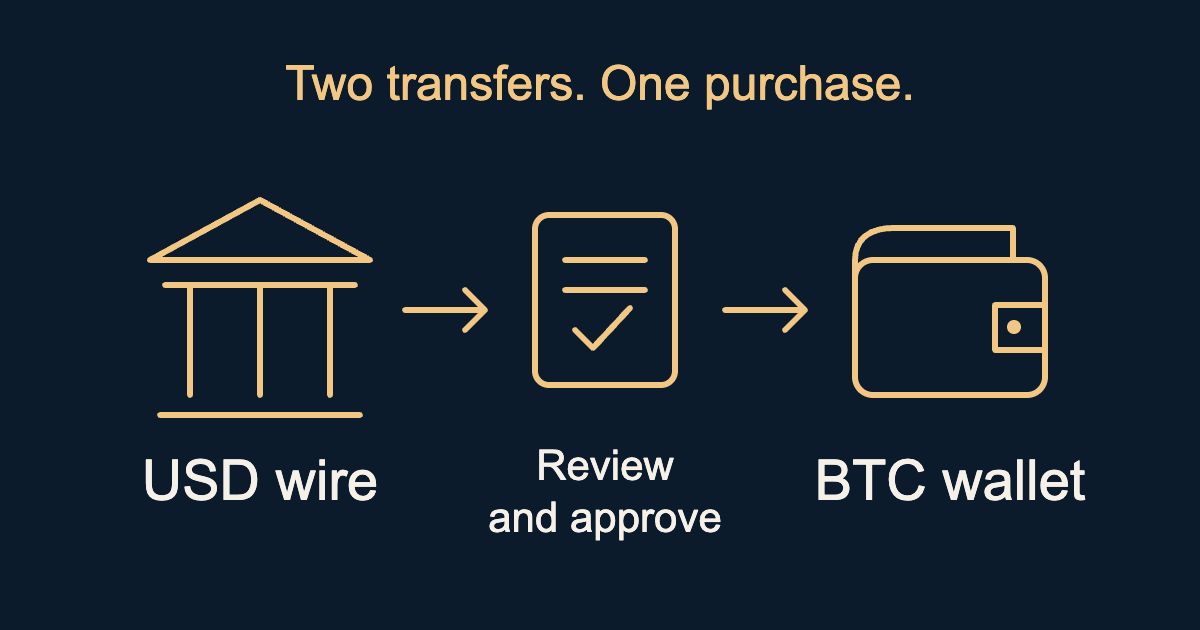 Bank funding and wallet delivery
 Bitcoin research and practical checks
 Bitcoin research and practical checks
 Bitcoin research and practical checks
 Bitcoin research and practical checks
 Bitcoin research and practical checks


 Buying Bitcoin
 Buying Bitcoin
 Buying Bitcoin
 Buying Bitcoin
 Buying Bitcoin
 Buying Bitcoin
 Buying Bitcoin
 Transactions
 Transactions
 Transactions
 Transactions
 Safety
 Safety
 Bitcoin ATM
 Transaction checks
 Transaction checks
 Transaction checks
 Buying and costs
 Buying and costs
 Buying and costs
 Bitcoin wallet security