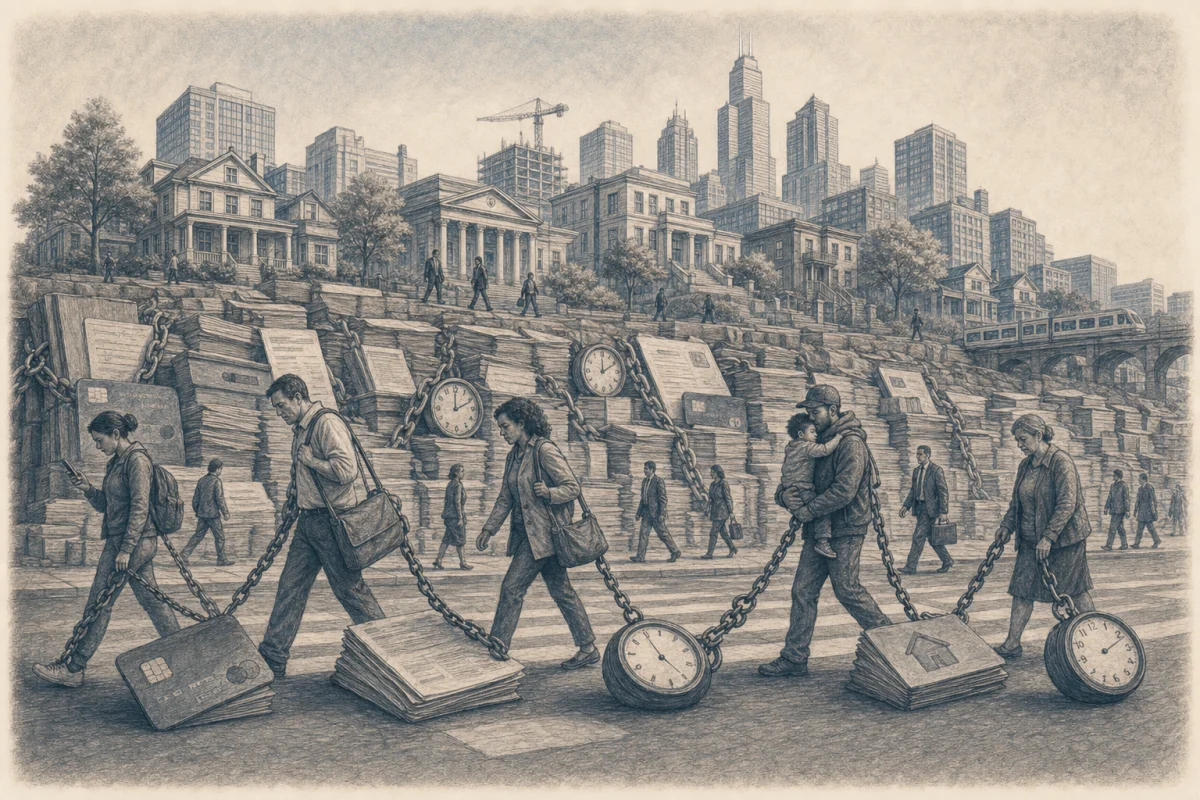
Founder Perspective

A country built on debt eventually produces people who think in debt.

By Firas Isa Founder & CEO, Crypto Dispensers Published May 2026

A founder essay on credit card debt, inflation, ownership, interest, financial pressure, sound money, and what debt-based monetary systems slowly do to the psychology of ordinary people.

People no longer feel like they are building ownership. They feel like they are managing obligations.

This article is for educational and thought leadership purposes only. It does not provide financial, investment, legal, tax, accounting, or economic advice. Cryptocurrency transactions carry risk, and consumers should verify all information before making financial decisions.

Section 01

Most people today technically live better than kings did centuries ago. And still spend their lives stressed about money.

They have air conditioning.
Instant communication.
Unlimited entertainment.
Access to information entire empires once could not obtain.
Machines performing labor that once required dozens of servants.

A medieval king could command armies and still never experience what an ordinary person casually carries in their pocket today.

And yet despite all of that advancement, millions of people still spend their lives stressed about money.

Not because they are trying to become billionaires.

Because ordinary life itself feels expensive to maintain.

The rent. The mortgage. The car payment. The insurance. The groceries. The credit cards. The interest. The bills already waiting before the paycheck even arrives.

And what confuses many people is that the pressure often stays there even after they begin making more money.

More income Somebody works harder. Gets promoted. Negotiates a better salary. Finally feels like they are moving upward.
Higher costs But during those same years, the cost of living keeps climbing too.
01Housing becomes more expensive.
02Food becomes more expensive.
03Healthcare becomes more expensive.
04Insurance becomes more expensive.

So by the time somebody finally reaches the income they once believed would make them feel financially secure, the definition of financial security already changed again.

That cycle repeats over and over.

And after enough years, people begin realizing that earning more money does not automatically create stability anymore.

It often just creates access to larger obligations.

Section 02

A larger apartment. A lifestyle that quietly becomes more expensive to maintain every single year.

01 A larger apartment.
02 A more expensive neighborhood.
03 A financed luxury car.
04 Higher monthly payments.
05 A lifestyle that quietly becomes more expensive to maintain every single year.

And underneath all of this sits another pressure people rarely speak about honestly.

The pressure to look successful.

People are judged constantly by visible signals now.

The car. The clothes. The apartment. The vacations. The restaurants. The lifestyle projected outward into the world.

Very few people want to publicly look like they are struggling financially, even while privately trying to escape debt or build something meaningful long term.

So people make tradeoffs that quietly damage them.

Tradeoff 01 They finance the nicer car instead of driving the older one longer.
Tradeoff 02 They stretch for the larger apartment instead of living smaller temporarily.
Tradeoff 03 They spend money to maintain appearances while telling themselves stability will come later.
01And later keeps getting delayed.
02The balances continue rolling forward.
03The interest continues accumulating.
04The pressure continues sitting quietly underneath everyday life.

Until eventually many people realize they are no longer building ownership.

They are managing obligations.

Section 03

And once people stay inside that cycle long enough, something even deeper starts changing.

People stop thinking about ownership entirely.

Not temporarily. Not “until things get better.” Ownership itself slowly stops feeling realistic.

Life becomes a series of payments attached to things other people actually own.

01 The apartment belongs to the landlord.
02 The house belongs to the bank.
03 The car belongs to the financing company.
04 The paycheck already belongs partly to creditors before it even arrives.

And after enough years inside that system, people stop seeing this as strange.

It starts feeling normal.

01Normal to spend decades making payments on things you technically do not own.
02Normal to carry balances month after month.
03Normal to finance lifestyles using future labor that has not even happened yet.

That is what debt-based societies quietly do over time.

They normalize permanent obligation.

Section 04

And eventually people stop organizing their lives around ownership and start organizing their lives around monthly survival calculations.

01What can I afford right now?
02What payment can I survive?
03What balance can I refinance?
04What expense can I push forward another month?

That mentality slowly reshapes the psychology of entire populations.

People become more anxious about slowing down because slowing down starts threatening their ability to maintain the system of obligations attached to their lives.

Rest starts feeling dangerous. Patience starts feeling unrealistic. Saving starts feeling too slow.

And once people stop believing they can realistically build ownership through patience and discipline, speculation starts looking emotionally rational.

Because ordinary financial progress no longer feels powerful enough to create meaningful stability anymore.

Section 05

That is why so many people today look financially successful from the outside while privately feeling trapped underneath everything holding their lives together.

01The car looks expensive.
02The apartment looks expensive.
03The vacations look expensive.

But behind much of it sits debt, pressure, and future income already promised away before it even arrives.

And eventually people wake up realizing that enormous portions of their labor no longer fully belong to them.

Years of future work already have claims attached to them.

The mortgage. The interest. The financing. The balances. The obligations waiting every month no matter how exhausted somebody becomes.

That changes a country over time.

01People become more financially anxious.
02More short-term in the way they think.
03More afraid of falling behind.
04More willing to sacrifice long-term stability for immediate relief.

Because when somebody spends enough years running just to maintain their position, life eventually stops feeling like ownership.

It starts feeling like financial servitude disguised as normal adulthood.