
Firas Isa/What Does It Mean to Be Unbanked?
Essay

What Does It Meanto Be Unbanked?

Being unbanked means more than living without a checking account. It means paying more to participate in the economy while being denied a fair path into the transition toward digital money and ownership.

01A condition
02The access premium
03Inclusion spectrum
04Why exclusion persists
05Crypto's promise
06Builder responsibility
07The real measure
From the author
Cash-dependent people deserve the right to participate in the future of money without being priced out before they arrive.
Firas Isa
Chapter 01

Unbanked Is a Condition, Not an Identity

The word unbanked sounds like a category created for a spreadsheet. It is clean, technical, and easy to repeat.

The reality is none of those things.

For years, I have built at the point where cash, traditional banking, and digital assets meet. That experience changed how I understand the word. “Unbanked” may be a useful measurement, but it is an incomplete description of a human life.

To be unbanked is to earn money in an economy that may charge you simply to receive it. It is to pay bills without the tools many people take for granted. It is to solve ordinary financial problems through a patchwork of cash, prepaid cards, payment apps, money orders, check-cashing counters, and favors from people you trust.

It can mean waiting in line to turn a paycheck into usable money. It can mean carrying more cash than feels safe because there is nowhere else to keep it. It can mean that a late payment is not the result of irresponsibility, but of a system that required more time, more travel, and more fees to complete the same transaction.

Most of all, it means being expected to participate fully in the economy while receiving only partial access to its infrastructure.

That is the part of the conversation we often miss. We talk about the unbanked as though they stand outside the financial system. They do not. They work, earn, spend, save, send money, support families, and absorb risk like everyone else. They are already inside the system. They are simply asked to navigate it with fewer tools and less margin for error.

Now the world is entering a new financial era. Bitcoin and cryptocurrency are moving digital ownership from the margins toward the center of the global economy. I believe this may become the greatest transition of wealth in history, not only because of the value involved, but because of the deeper shift from closed financial systems toward open networks and greater individual control.

Cash-dependent, unbanked, and underbanked people deserve the right to participate in that transition. If the future of money is available only to people already well served by banks, then we have not created financial inclusion. We have created a new layer of opportunity for the already included.

In the United States, the Federal Deposit Insurance Corporation defines an unbanked household as one in which no one has a checking or savings account at a bank or credit union. By that measure, 5.6 million U.S. households, or 4.2 percent, were unbanked in 2023.

The Federal Reserve measures adults rather than households and uses a slightly different definition. Its latest survey found that 6 percent of adults were unbanked in 2024.

These numbers describe a condition. They do not describe a type of person.

There is no single unbanked experience. One person may have left a bank after being hit with fees they could not predict. Another may not have enough money to maintain an account. Another may distrust institutions because of prior treatment. Someone else may rely on cash because it is immediate, familiar, and accepted in the community where they live and work.

Globally, the scale is even larger. The World Bank reported in 2025 that nearly 80 percent of adults worldwide had a financial account, yet 1.3 billion adults still lacked one.

5.6MU.S. households were unbanked in 2023FDIC, 2023
19.0MU.S. households were underbanked in 2023FDIC, 2023
1.3Badults worldwide still lacked a financial accountWorld Bank, 2025

A category that large cannot be explained by one failure, one behavior, or one solution.

This matters because language shapes design. If we treat the unbanked as a fixed demographic, we build products around assumptions. If we understand unbanked status as a condition produced by cost, trust, geography, documentation, technology, and institutional design, we begin asking better questions.

Not “Why do these people refuse to join the system?”

But “What has the system required from them, and what has it offered in return?”

Chapter 02

The Hidden Cost of Partial Access

A bank account is not just a place where money sits. It is an operating layer for modern life.

It helps a person receive income, pay bills, store value, document transactions, move money remotely, dispute certain errors, and establish a history that other institutions recognize. When that operating layer is missing, the need does not disappear. The person must rebuild its functions one transaction at a time.

That reconstruction has a cost.

Some of it is visible: check-cashing charges, cashier's check or money-order fees, prepaid-card fees, remittance charges, transportation, and time away from work. A banked customer may be able to move money from a phone. A cash-dependent customer may need to travel to a counter, pay a fee, wait, and trust another intermediary just to accomplish the same result.

Some of it is less visible: the inability to schedule a payment, the difficulty of proving a transaction, the risk of carrying cash, the stress of depending on business hours, and the absence of a clean record when something goes wrong.

And some of it compounds. A person without a bank account may also have a harder time building mainstream credit. According to the FDIC, 78.4 percent of unbanked households had no mainstream credit in 2023, compared with 13 percent of banked households. The issue is not merely that one product is missing. One form of exclusion can reinforce another.

People with the least financial cushion are often charged the highest price for basic financial motion. They pay more in money, more in time, and more in uncertainty.

I think of this as an access premium. The person with the fewest financial options is repeatedly charged for needing an alternative: to cash a check, obtain a payment instrument, send money to family, load cash onto a card, or convert cash into a digital asset. Each fee may be presented as the price of one service. Together, they become a recurring penalty for not fitting the assumptions of the traditional system.

That same access premium has appeared in crypto. Bitcoin ATMs created a physical bridge for cash customers, but the Consumer Financial Protection Bureau has warned that Bitcoin kiosks may charge high transaction fees. Operating physical infrastructure, handling cash, managing compliance, and preventing fraud all carry real costs. But those realities do not change the outcome for the customer: cash access can cost more than a bank-funded online route, and the people who most need an alternative can end up paying the most to reach it.

When friction and fees consume too much of the transaction, access becomes symbolic. A person may technically be allowed to participate while the economics make participation impractical.

That is why I do not think of financial inclusion as the presence of an account. I think of it as the presence of usable financial capacity.

Can a person receive money safely? Can they store it without being penalized for having too little? Can they move it at a clear cost? Can they understand what will happen before they confirm a transaction? Can they recover when something goes wrong?

If the answer to those questions is no, formal access may exist while meaningful access does not.

Chapter 03

Banked Does Not Always Mean Included

The language of “banked” and “unbanked” creates a clean dividing line. Real financial life is a spectrum.

In 2023, another 19 million U.S. households were underbanked. They had a checking or savings account but still used nonbank services such as check cashing, money orders, international remittances, payday loans, pawn loans, auto-title loans, or rent-to-own services to meet core financial needs.

That tells us something important: opening an account does not automatically solve the problem.

A product can be technically available and still be economically impractical. It can be affordable on paper and unpredictable in use. It can be digital and still be difficult to navigate. It can offer convenience while withholding clarity. It can satisfy a definition of access without creating trust.

Eligibility is not usability.

This is one of the most important lessons I have learned from building financial technology. Institutions tend to define success at the moment access is granted. Customers define success by what happens next.

Does the product work when the need is urgent? Are the fees understandable before the transaction begins? Is support available when the customer is confused? Is the person treated as a participant with agency, or as a problem to be managed?

Financial inclusion is not achieved when someone enters a system. It is achieved when that person can use the system with clarity, dignity, and a reasonable ability to recover from mistakes.

Chapter 04

Why People Remain Unbanked

The easiest explanation is that unbanked people need more financial education. Sometimes education helps. But education is not a substitute for honest product design.

The FDIC found that the most frequently cited primary reason for not having an account was not having enough money to meet minimum-balance requirements. The next was a lack of trust in banks.

Those answers should change the way the industry thinks.

If someone believes they do not have enough money to qualify for safe storage, the product has turned scarcity into a barrier. If someone does not trust the institution, another advertisement about convenience will not repair the relationship.

Trust is not created by asking people to trust more. It is created by making costs predictable, terms understandable, support reachable, decisions explainable, and conduct consistent over time.

The burden of trust cannot sit entirely on the customer.

The same is true of technology. Digitization can lower costs and expand reach, but a digital-only product may still assume reliable internet, a modern phone, stable identification, a permanent address, strong literacy, technical confidence, and the ability to wait when an automated system places a transaction under review.

Every assumption removes someone from the design.

The question is not whether financial institutions should abandon standards. Identity verification, fraud prevention, anti-money-laundering controls, and consumer protection are necessary. The question is whether those responsibilities can be carried out without making ordinary people feel that access itself is a test they were expected to fail.

Good systems manage risk. Great systems manage risk while preserving dignity.

Chapter 05

What Crypto Changes, and What It Does Not

Crypto introduced a powerful idea: a person can hold and transfer a digital asset over an open network without needing a traditional bank account to authorize every movement.

That matters.

It creates the possibility of financial tools that are portable, programmable, available across borders, and not limited to the operating hours of a single institution. Bitcoin, in particular, showed that digital ownership could be governed by transparent network rules rather than the private ledger of one company.

That is why I see Bitcoin and cryptocurrency as more than another investment category. They represent a transition in who can hold value, how value can move, and how much control an individual can exercise without asking a centralized institution for permission at every step. That transition may create extraordinary wealth, but its greater promise is the distribution of financial agency.

The people historically charged the most to participate in the old system should not be priced out of the new one.

But possibility is not the same as access.

A wallet does not explain itself. A private key does not protect a person from deception. An open network does not automatically provide a safe way to convert cash, understand fees, correct a mistaken address, identify a scam, or recover from lost credentials. Volatility can be devastating to someone who cannot afford to absorb it. Irreversible transactions create freedom from intermediaries, but they also create a different kind of responsibility.

The data should make the crypto industry humble. In the FDIC's 2023 survey, crypto use was higher among banked households than unbanked households: 5 percent compared with 1.2 percent.

The technology may be bankless. Access to the technology is not.

That is the uncomfortable truth. Much of crypto has been built for people who already possess a bank account, a smartphone, disposable income, technical confidence, and the time to learn through trial and error. The industry speaks the language of inclusion while often designing for people who are already included.

If crypto is going to expand financial agency, it must do more than remove an intermediary at the network level. It must solve the human problems that appear before and after the transaction.

How does a cash-based customer enter safely? How are identity and compliance handled without humiliation? How are fees disclosed? How are scams detected? How does a first-time user get help? How do we give people greater control without pretending that greater control carries no risk?

These questions are not obstacles to the mission. They are the mission.

Chapter 06

What Builders Owe the People They Claim to Serve

Building for financial inclusion begins with respect.

It means respecting cash as a legitimate financial reality, not treating it as a defect waiting to disappear. It means providing more than one path into a product because customers do not all begin from the same place. It means using plain language when money, fees, timing, and risk are involved.

It also means refusing to confuse access with exposure.

Giving someone a route to a volatile asset without helping them understand the risks is not inclusion. Giving someone a digital account they cannot navigate is not inclusion. Moving a person from one opaque system into another is not progress.

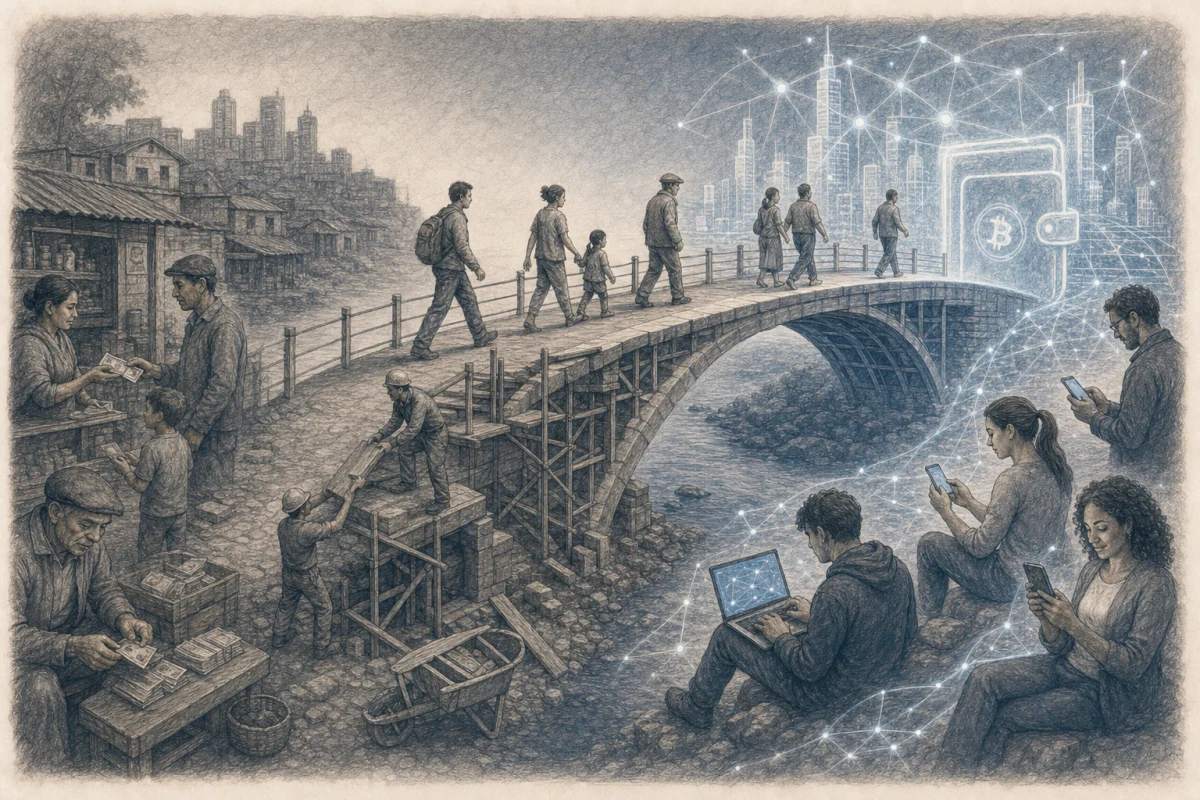
At Crypto Dispensers, the problem we have tried to solve is the distance between the money people already use and the digital assets they may choose to own. The methods have evolved, from physical Bitcoin ATMs to a broader account-based platform, because the mission was never a machine or a transaction type. The mission was to build a bridge.

That bridge is especially important for cash-dependent, unbanked, and underbanked people. They should not have to become ideal banking customers before they are allowed to participate in the future of digital ownership. They deserve a practical path from the form of money they have today to the assets they may choose to hold tomorrow.

They deserve the same opportunity as anyone else to learn, compare costs, evaluate the risks, and decide for themselves whether investing in Bitcoin or other cryptocurrencies is right for them.

Our goal at Crypto Dispensers has been to make that path both easier and more economically accessible. Those are separate barriers, and both matter. A service can be simple but too expensive to use. It can be affordable but so confusing, restrictive, or unsupported that a customer cannot complete the journey with confidence. Real access requires us to reduce difficulty and cost together.

Building that bridge has taught me that financial access requires four things at once: practical entry points, transparent economics, serious compliance, and human support.

Remove any one of them and the bridge weakens.

Without practical entry points, innovation remains theoretical. Without transparent economics, access becomes extraction. Without compliance and consumer protection, the people seeking alternatives inherit new forms of risk. Without human support, a product may be efficient for the company while remaining frightening for the customer.

Reducing barriers does not mean pretending every cost can disappear or every customer should buy cryptocurrency. It means refusing to accept unnecessary friction, hidden economics, or cash dependence as reasons to exclude someone. It means giving people a fair opportunity to understand the choice, evaluate the risks, see the cost, and decide for themselves.

Technology can remove gatekeepers without removing responsibility.

The companies that understand that distinction will build the future of finance. The companies that do not will simply recreate the failures of the old system on newer infrastructure.

Chapter 07

The Real Measure of Financial Innovation

So what does it mean to be unbanked?

It means far more than not having a checking account.

It means living in the gap between economic participation and institutional access. It means being visible as a worker, a consumer, and a source of revenue, but too often invisible when products are designed, policies are written, and risks are distributed.

It means having money without always having a safe, affordable, and understandable way to use it.

And at this moment in history, it can mean watching one of the most important transformations in money and ownership unfold while the cost of entry remains highest for you.

That should not make the unbanked an object of pity. People outside traditional banking arrangements display enormous resourcefulness. They build working financial lives from imperfect tools. The failure is not that they have not found a way to participate. The failure is that participation demands so much more from them.

The future of money will not be judged by how elegantly it works for people who already have choices.

It will be judged by whether it creates real, safe, and understandable choices for people who do not.

Cash-dependent, unbanked, and underbanked people do not need permission to matter. They already participate in the economy every day. What they need is a fair route into the opportunities the next economy may create.

That is the standard banks, fintech companies, and crypto builders should accept. Not access in theory. Not inclusion as a slogan. Not an account opened, a wallet downloaded, or a transaction completed.

The standard is whether a person leaves with more agency than they had before.

Anything less is only a new interface on an old exclusion.

Firas Isa
Firas Isa Founder & CEO, Crypto Dispensers · Chicago