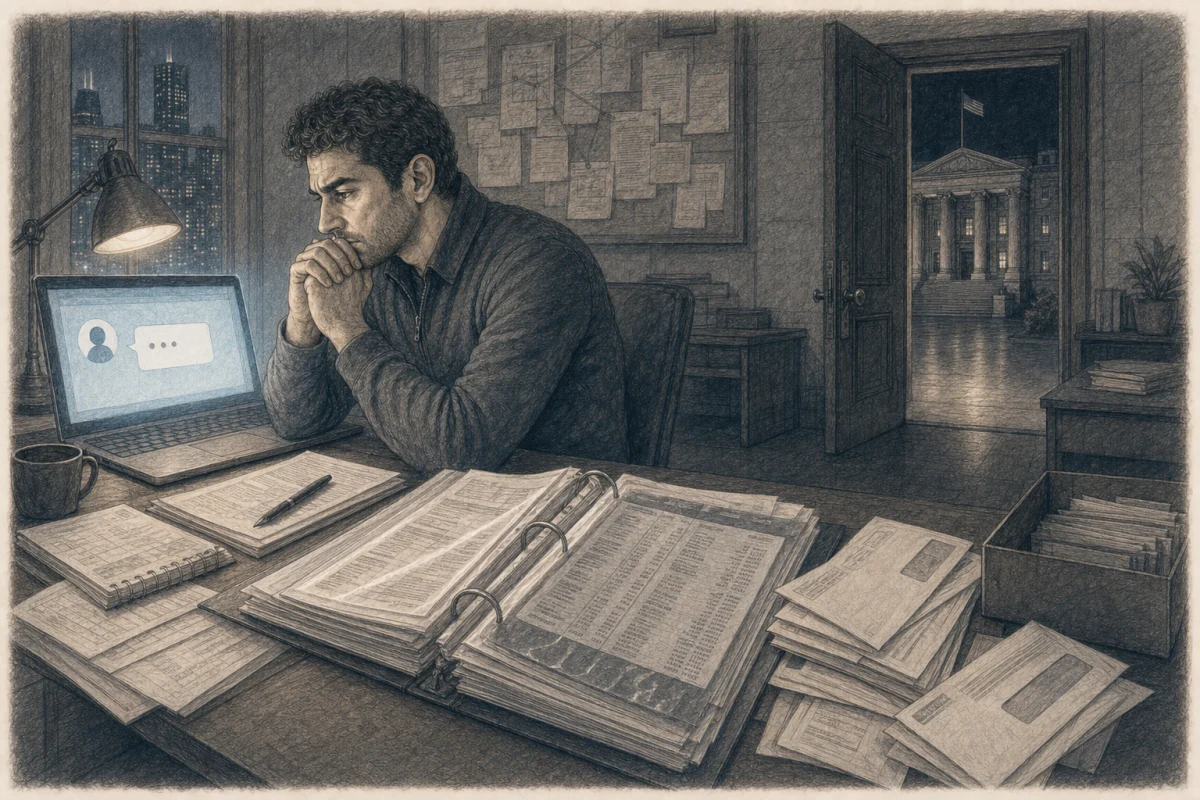
It began with a customer support message promising a solution to Crypto Dispensers’ banking crisis. What followed was a web of false identities posing as employees of Mercury and other financial institutions, company money directed into an account we could not access, promises that kept collapsing, and a federal report that produced no meaningful answer.
Being a founder is difficult enough. A bootstrapped founder begins without a cushion or an institution waiting to rescue the company when something breaks. Building in cryptocurrency added a burden most founders never face: fighting for the right to hold a bank account.
For almost a decade, banking has never been stable ground beneath Crypto Dispensers. An account could be approved, our compliance program reviewed, and ordinary transactions processed. Then the bank would decide that the industry itself created too much risk, close the relationship, and force us to explain the company somewhere else while the business kept running.

When we operated Bitcoin ATMs, the amount of physical cash moving through the business made some institutions uncomfortable. The word Bitcoin created another barrier. In those early years, it often felt as if banks saw cryptocurrency not simply as risky, but as a challenge to the financial system they existed to protect.
I understood the fear. We believed Bitcoin could reshape money, reduce dependence on banks, and compete with the dollar's place in everyday finance. If we believed the technology could change banking, we could not be surprised when banks treated businesses like ours as a threat.
So we accepted instability as part of building Crypto Dispensers. We found banks willing to understand the company, opened accounts, and built operations around them. Then another closure notice would arrive. Customer funds, payroll, rent, vendors, and liquidity all depended on access that could disappear without warning. Long before David Levine asked for our trust, the banking system had taught us how urgently we needed someone who appeared able to help.
BankLine had helped us navigate that problem before. Our relationship reached back to banking agreements in 2018. In November 2021, when Crypto Dispensers needed to apply again, Andy Benjamin, the BankLine representative who handled our relationship, asked his team how much of our old compliance file they still had. The question carried a small measure of hope. We were not starting from nothing. Someone remembered the company, still had the record, and knew what we had already survived.
The application took months. On May 24, 2022, we received word that the account had been approved and that the bank was ready to order checks and debit cards once the final wet signatures arrived. The next morning, Vince Barraco, who had helped us establish an earlier relationship with First National Bank of Ottawa, reacted with exhausted relief. The process had taken so long that he joked we had started the application before a child in our family was born.
The new account was at Georgia Primary Bank, facilitated through BankLine. For the second time, as I remember it, BankLine had helped us obtain a banking route that allowed the company to keep operating. But opening an account was never the same as achieving stability. By September, First National Bank of Ottawa had closed, and the Georgia Primary account was still not authorized to receive one of the deposit flows the business depended on. We had found another bank, yet we were still trying to make the machinery work.
That was the environment in October 2022 when David Levine entered my life. He did not arrive through a close friend or a trusted business partner. He sent an ordinary message to Crypto Dispensers customer support.
He offered help with the problems already keeping me awake: banking, cryptocurrency ATMs, and liquidity. We answered because those were not abstract business opportunities. They were the difference between a company that could function and one that could be stranded by its own money.
Levine described himself as a financial strategist with connections. He seemed to understand the exact pressure we were under. He did not have to persuade us that banking mattered. We were living that fact every day.
One month later, the United States Secret Service also contacted Crypto Dispensers through our support system. A Chicago agent who specialized in cryptocurrency and electronic crime said he wanted to establish a relationship and discuss collaborating to stop fraud. At that moment, the man who would later become the subject of my complaint and the agency that would later receive it had entered through the same door.
One offered access. The other offered cooperation. I believed both were approaching a legitimate company in good faith.
By February 2023, the ground shifted again. On February 20, Andy sent me a list of possible crypto-friendly banks. His warning was blunt: after the collapse of FTX, some of them might no longer be friendly at all. Three days later, Levine introduced us to Prime Trust. On March 1, he introduced me to attorney Sasha Hodder and said she could help Crypto Dispensers pursue an account at BankProv.
Then, on March 10, the Georgia Primary accounts facilitated through BankLine were closed.
The account we had spent months obtaining was gone. The company was again scrambling for a way to receive and move money. Every day without a dependable account increased the danger to customers, employees, vendors, and the business itself.
That timing changed the emotional weight of Levine's promises. He had first appeared months earlier, but now the problem he claimed he could solve had become an emergency. When he said he could help us reach a new banking arrangement through Mercury and Choice Financial Group, it did not sound like another sales pitch.
It sounded like rescue.
Levine did not begin with a request for $150,000. He began by being useful.
He described himself as working in strategic development for Freeda Inc. He spoke fluently about banking, compliance, liquidity, exchanges, and institutional finance. Over time, he connected Crypto Dispensers with prospective legal, technology, and financial relationships, including people at Google and parties discussing the possible acquisition of hundreds of cryptocurrency kiosks.

The introduction to Sasha was especially important. In his March 1 email, Levine called me a good friend and a client of Freeda, and said I needed help securing a BankProv account. Sasha had already represented him. She offered to learn about Crypto Dispensers and help present the company to the bank.
When I asked Sasha about Levine, I remember her vouching for him. The written record independently shows why her involvement reassured me: she treated Levine as a client, agreed to help my company pursue banking, and later acknowledged that she had represented both of us. She was not a faceless name supplied by Levine. She was a real attorney with her own professional reputation.
That mattered. I was not being asked to trust one man standing alone. I was being asked to trust a man whose relationships appeared to be confirmed by lawyers, bankers, vendors, and financial institutions.
The contacts arrived one at a time. Each one made the previous contact appear more credible. A conversation produced a name. A name produced an email. An email carried a title, a signature, a logo, and the vocabulary of a real institution.
That is how the trust accumulated. Not through one dramatic lie, but through a sequence that appeared to confirm itself.
As the Georgia Primary account disappeared, Levine's proposed solution centered on Mercury and Choice Financial Group. Mercury was familiar in the fintech world. Choice was a real financial institution. The communications surrounding the proposed relationship looked formal and organized. People presented to us as lawyers, compliance officers, banking personnel, and exchange employees appeared to be moving the process forward.
I later identified those purported contacts in my federal complaint: a lawyer named Yohan Lee, a supposed Choice Financial representative named Megan Hill-Glover, a supposed Mercury compliance employee named JB Kim, a supposed Choice executive named Alexander Bell, and a supposed OKCoin representative named Pablo Margo.
At the time, I did not see a collection of false identities. I saw a network.
I also met Levine in person in Los Angeles. That mattered to me. He was no longer only a name appearing on a screen. We sat across from each other and discussed the banking problem and the money that Crypto Dispensers was supposed to be able to access.
There was a moment at dinner that stayed with me. We were at a nice restaurant when Levine told me I would need to pay because his credit cards were not working. It seemed strange, especially for someone presenting himself as a person with banking access and financial relationships. But by then the larger story around him had been built from months of calls, documents, introductions, and apparent institutional involvement. One strange moment did not yet outweigh the structure surrounding it.
That is one of the cruelest things about hindsight. Once the truth begins to emerge, every small inconsistency looks illuminated. Before that, each inconsistency can feel like an ordinary complication inside a complicated business.
Levine had found the pressure point. Then he surrounded his promises with enough apparent legitimacy to make us keep believing the solution was almost there.
Beginning in the spring of 2023, Crypto Dispensers directed customer-related deposits toward the banking arrangement Levine was facilitating.
From April through July, approximately $150,000 in ACH deposits moved from Green Dot Bank into the account we had been given. Another $60,000 was wired to what had been represented as a required savings account for our cryptocurrency operations.

The numbers make the story sound clean. The experience was anything but clean.
The funds were connected to real customers who had deposited cash at retail locations. Crypto Dispensers depended on those deposits for liquidity. We did not maintain an unlimited reserve of digital assets waiting for every order. When a customer placed an order, the company needed access to the corresponding funds so it could obtain and deliver the requested cryptocurrency.
As the money moved, access did not arrive.
There was always an explanation. The account setup needed another approval. A manual wire was being arranged. A technical issue had interrupted the process. A compliance review was taking longer than expected. The bank needed another document. The balance had to remain in place. A transfer was coming.
Every explanation asked us to wait a little longer.
That waiting was not passive. Customers still expected their orders. Vendors still expected payment. The company still had rent, employees, contractors, and operating expenses. Money that should have been available to run the business was somewhere beyond our control, while Levine continued telling us that the problem was being solved.
By August, the situation had become serious enough that I asked Sasha to prepare a settlement. On August 15, she declined because she had previously represented both Levine and me. Her conflict prevented her from taking either side, so she referred me to two other lawyers. The first name was Michael Frisch.
Mike was not a casual referral. He was a partner at a leading Chicago law firm whose background included investigating and litigating market misconduct at the Commodity Futures Trading Commission, advising the mayor of Chicago, and working on digital asset enforcement and regulation. He understood financial institutions, government investigations, and cryptocurrency.
At first, even Mike did not see what I thought I was seeing. In my recollection, he thought I sounded paranoid about Levine. The story seemed too elaborate. Too many people, institutions, explanations, and delays had to be connected for my suspicion to be right.
That skepticism mattered because it was rational. People have doubted me before and concluded that I was overreacting, only to watch the facts catch up later. I also know my own weakness. I trust people too easily. Mike did what a serious lawyer should do. He did not accept my conclusion because I felt it strongly. He began testing it against the record.
Two days after Sasha referred me to Mike, an agreement dated August 17 stated that Freeda would transfer $148,126.18 to Crypto Dispensers by August 30. It also contained additional payment and penalty provisions if the promised resolution failed.
The agreement looked like an ending. It had dates, obligations, signatures, and remedies. Instead, it became another layer of the story.
The next day brought another detail that made the relationship look real. Crypto Dispensers owed a $4,100 invoice to BankLine, a banking service provider whose Andy Benjamin had been communicating with us about payment. Earlier, Sasha had written that Levine was ready to send the wire on our behalf. On August 18, after a thread involving Levine and the wiring instructions, Sasha wrote that she had sent the wire herself and had emailed Andy to let him know. The settlement record also described the $4,100 BankLine payment as one Freeda made for Crypto Dispensers to prevent litigation.
That payment deepened the confusion. An attorney who had represented both sides had used real money to satisfy a real company invoice after Levine said the payment would be handled. To me, that did not look like the edge of a fabricated world. It looked like proof that the network around Levine was solid.
The deadlines passed.
The money did not arrive as promised.
Levine kept changing the explanation.
On a human level, this is the part that is easiest to lose inside documents and transaction figures: we did not understand what was happening. We did not know where the money had gone. We did not know why Levine was doing this. We did not know whether we were the only company caught inside the same pattern or whether there were others.
What I understood was that Levine seemed to be playing us. He would say one thing and then say something different. When one explanation stopped working, another appeared. When one deadline failed, a new date replaced it. Looking back, I believe he was buying time.
At the time, I was still trying to save the company from a banking disaster I could not yet fully see.
The story broke open on September 21, 2023, when we stopped relying on the contacts Levine had placed in front of us and reached the real Mercury support team directly.
The response was devastating in its simplicity.

Authentic Mercury support told us that two addresses used by the purported Mercury and Choice representatives were not genuine. Real Mercury communications came from its official domain. Real Choice communications came from a different official banking domain. Mercury told us to stop responding to the suspicious senders, file a police report, and work with Green Dot to dispute the transfers.
Months of explanations collapsed inside one verification.
This was also where Mike's skepticism began to give way. The concern was no longer based only on my reading of Levine's behavior. A real financial institution had examined the addresses and told us they were not genuine.
The names still existed. The logos still looked official. The signatures were still sitting inside the correspondence. But the institutional structure behind them was gone.
What had appeared to be a complicated banking process now looked to me like a constructed world of impersonated people, false domains, and official-looking documents.
The next twenty-four hours revealed the pattern more clearly.
On September 22, Levine wrote to me and my lawyers. He said an investigation had been conducted, said his side understood what had happened, accepted "full responsibility," apologized, and said repayments would begin the following Monday.
The next day, in a message to my lawyer, he took a different position. He denied involvement in fraudulent activity and said Freeda was also a victim.
That contradiction became the engine of everything that followed.
Levine was responsible, but not responsible. He would repay the money, but said he had not stolen it. The payment was coming, but the date would move. The issue was understood, but a new explanation would replace the old one.
I kept returning to the same question: if no money had been wrongfully taken from my company, why was there a balance to repay?
Early on September 25, 2023, I filed a complaint through the FBI's Internet Crime Complaint Center.
I did not describe a vague business disagreement. I reported what I believed was a six-month scam led by David Levine. I identified Virtual Assets LLC, doing business as Crypto Dispensers, as the victim business. I described the false banking communications, the people and institutions that had been presented to us, the ACH transfers, the separate wire, the account information, and the confirmation from real Mercury support that key domains were not genuine.

The complaint required me to certify that the information was true and accurate to the best of my knowledge and warned that false information could carry criminal consequences. I signed it.
I preserved the correspondence. I worked with counsel. I documented the transfers. I identified witnesses. I supplied bank information, dates, names, domains, and a financial trail.
Then something happened that captured the entire contradiction in one day.
Later on September 25, Levine asked my lawyer to confirm the Bitcoin address where payments should be sent. That afternoon, he wrote that he had sent approximately $1,135 in Bitcoin. He provided a transaction identifier and wrote that the balance on the main amount was exactly $147,000.
The same day I reported a scam to the federal government, the man I reported was discussing the remaining balance and making a partial payment.
Two days later, I contacted an FBI representative directly and asked for help escalating the matter. I explained that we had filed the IC3 complaint, were working with the financial institutions, and believed the scale and sophistication of the conduct required federal attention.
I was not hiding a problem from the government. I was carrying it to the government and asking the government to look.
On November 29, 2023, Special Agent Nick Schlereth of the United States Secret Service's Chicago Field Office contacted me.
He said he was the office's cryptocurrency subject-matter expert and that my IC3 complaint concerning David Levine had been forwarded to him. He wanted to understand the incident and learn more about Crypto Dispensers.

My lawyer, Michael Frisch, answered immediately. Mike explained that he had worked through the entire matter with me, had communicated with Levine many times, and could print the documents needed to walk an investigator through the story.
The agent preferred to meet in person. He wrote that he liked speaking directly with the victim.
On December 6, at approximately one in the afternoon, Mike and I sat down with two agents in a law office at 180 North LaSalle Street in Chicago. The meeting lasted about thirty minutes.
This is the scene I want people to understand.
We did not arrive with a theory written on a napkin. Mike brought an organized binder. It contained correspondence and the contract between Crypto Dispensers and Levine's company. We explained how the banking relationship had been presented, how the funds moved, how the spoofed domains were confirmed, and how the money was affecting a company that needed liquidity to fulfill customer orders.
The agents asked how I had met Levine. They asked about the banking arrangement. They asked about the Bitcoin address connected to a partial repayment.
After the meeting, Mike sent the agent the transaction information and confirmed that the agents had requested the settlement agreement. The agent thanked him for the information and for the conversation.
The federal process had everything a victim could reasonably bring: a signed complaint, the names, the timeline, the false domains, the authentic bank response, a settlement contract, a lawyer who had communicated directly with Levine, a partial Bitcoin payment, and a traceable transaction.
For the first time in months, I believed the confusion might finally give way to an answer.
It did not.
I received no meaningful explanation of what happened after the interview. No one told me whether Levine had been questioned, whether the payment trail had been traced, whether another office had reviewed the matter, whether prosecutors had declined it, or whether investigators believed there were other victims.
The government had asked to speak directly with the victim. I sat in the room. I answered the questions. I brought the evidence.
Then the government went silent.
The absence of a government answer did not end the private pursuit. It left me alone inside it.
By December, Mike's view of Levine had changed completely. After reviewing the record and communicating with him directly, Mike wrote that Levine was putting up "fake barriers" to avoid paying what he owed. Mike also said he had firsthand evidence of serious financial crimes after concluding that Levine had impersonated a bank employee. By February 2024, he was warning Levine that a proposed lawsuit would describe fraud, bank-employee impersonation, and other misconduct.

The lawyer who had initially doubted my suspicions had reached the conclusion I had been struggling to explain. He did not get there because I insisted. He got there by reading the documents, speaking with Levine, watching the explanations change, and following the payment trail.
Levine continued to move between denial and obligation. He said he had not stolen from me. He said he did not have the money to pay. He said he needed to take a loan. He asked for more time. In the same chain of communications, he discussed returning the $150,000 principal and proposed a broader $500,000 settlement subject to confidentiality and legal protections.
The mechanism changed, but the pattern did not.
The money would come through a loan. Then through a commission. Then through an exchange. Then through escrow. Then in Bitcoin. Then in USDT. Then through ACH. Then in weekly installments.
Each version sounded temporary. Each version required patience. Each version bought more time.
Some payments arrived. In February 2024, Levine wrote that he had sent $2,000 and would send another $500. In May, he asked for the remaining balance after another $4,000 payment. In June, he promised several $5,000 payments during the following week and said weekly payments would continue.
Those partial payments mattered because they were not the behavior of a person discussing an imaginary balance. Levine himself referred to what had been paid, what would be paid next, and what remained.
But the promised resolution never arrived. The dates moved. The explanations changed. The balance remained.
This is why I say he was playing us. The purpose of each new story, as I experienced it, was not to explain the last failure. It was to keep us waiting through the next one.
We still did not know what he had done with the money. We did not know why he had targeted Crypto Dispensers. We did not know how many other people or businesses may have heard similar promises.
Those were questions I believed federal investigators were equipped to answer.
I could not answer them by chasing another payment date.
I believe David Levine scammed me and my company. That is my conclusion from the chronology and the contemporaneous record. It is not a criminal judgment, and this essay does not pretend to replace one.
Levine approached through company support in October 2022. His offer became urgent when the Georgia Primary accounts facilitated through BankLine closed in March 2023.
Authentic Mercury support said key domains used by purported representatives were not genuine.
Levine denied theft while discussing responsibility, settlement, partial payments, and a remaining balance.
Firas Isa and Michael Frisch attended the December 6 interview and supplied the contract and Bitcoin transaction trail.

The record shows how the contact began, what Levine offered, and why banking access mattered so much to the company. It shows months of institutional-looking communications and people presented as representatives of real organizations. It shows substantial company funds moving into an account I could not access. It shows a written settlement with a specific repayment deadline.
It shows Sasha Hodder's prior representation of both sides, her referral to Michael Frisch, and the $4,100 BankLine wire she said she sent after a thread involving Levine and Andy Benjamin. It shows the authentic Mercury response stating that key domains were not genuine. It shows how Mike's initial skepticism changed after he tested the story against the documents and his own interactions with Levine.
It also shows Levine accepting responsibility and apologizing, then denying involvement in fraud. It shows the IC3 complaint, the partial Bitcoin payment, the stated balance, the Secret Service interview, the evidence binder, and years of repayment discussions.
The record also preserves the limits of what I know.
I cannot tell the public where every dollar went. I cannot explain Levine's motive. I cannot identify other possible victims or claim that there were any. I cannot say what federal investigators did outside my presence.
Those unknowns are not weaknesses in the story. They are the reason I went to law enforcement.
Victims report crimes because they do not possess subpoena power, banking intelligence, nationwide databases, or the authority to compel answers. We preserve what we can. We identify what we know. We give the government the trail and ask investigators to go where private citizens cannot.
I did that.
What I never received was a meaningful explanation of where the trail led.
On November 18, 2025, the federal government returned to my life in a very different role.
The United States Attorney's Office for the Northern District of Illinois announced that a federal grand jury had indicted me and Virtual Assets LLC on one count of money laundering conspiracy. The indictment alleges that I knowingly allowed criminals to use Crypto Dispensers to launder at least $10 million in proceeds from wire fraud and narcotics offenses.

My company and I pleaded not guilty. An indictment is an allegation, not evidence of guilt. I am presumed innocent unless the government proves its case beyond a reasonable doubt.
The contrast is difficult to describe without sounding angry. I am angry.
In 2023, Crypto Dispensers reported a scam. We preserved the records, involved counsel, identified the institutions, documented the transactions, and sat across from federal agents with a binder of evidence. We did not avoid government scrutiny. We requested it.
Two years later, the government publicly portrayed me and my company as participants in money laundering while still giving me no meaningful answer about the scam we had reported as a victim business.
Reporting a crime does not prove that the reporting person could never commit another offense. I understand that. The Levine complaint does not decide the criminal case against me, and I do not offer it as a substitute for evidence.
But it does show conduct. It shows what Crypto Dispensers did when we believed criminal activity had reached our business. We documented it. We reported it. We retained Michael Frisch, a prominent Chicago attorney, to help us present it responsibly. Then we walked into a meeting with two Secret Service agents and handed over the trail.
I had been in trouble with authority earlier in my life. I knew what fear of scrutiny felt like. People who believe the truth will expose what they are doing usually avoid investigators. They do not ordinarily pay a respected attorney to organize the evidence, arrange a federal meeting, sit across from agents, identify the money, provide a traceable Bitcoin transaction, and ask the government to keep looking.
So the question is not merely whether reporting a crime establishes innocence. It does not. The question is why a person who believed his own company could not survive serious scrutiny would voluntarily summon that scrutiny, place the records on the table, and trust federal investigators to follow them wherever they led.
What did I think would happen? That agents would investigate Levine but somehow fail to notice me? That they would study the banking records, the company, and the transaction while remaining blind to criminal conduct if it were there? That is not what I believed. I went because I believed Crypto Dispensers was a compliant business that had been harmed, because I believed the evidence could withstand scrutiny, and because I believed the government would help a victim who came forward.
That decision is not a legal verdict. It is evidence of state of mind and conduct. It belongs in any honest account of who I was, what I believed about my company, and why the government's later accusation is so difficult to reconcile with the man who had already asked federal agents to examine the record.
The government watched us arrive as a victim, listened to the story, accepted the evidence, and gave us no meaningful public or private resolution. Then it returned with an indictment and placed the full force of the federal criminal system against us.
That is not a side note in my story. It is one of its central contradictions.
By January 2026, I was still asking Levine whether he intended to resume paying the balance.
I considered suing him. My lawyers told me the economics did not make sense. Civil litigation would be expensive. Even a favorable judgment might be worthless if Levine did not have assets that could be found and collected. I could spend more money proving on paper that I was owed money and still recover nothing.

That left me between two failed systems.
The criminal system had taken the complaint, interviewed me, received the evidence, and stopped communicating. The civil system offered a path that could cost more than the remaining recovery was worth.
The victim became the investigator, archivist, collection department, and litigation funder. I kept the correspondence. I traced payments. I paid lawyers. I negotiated. I followed up. I watched promised dates pass and new explanations appear.
The first injury was the money. The second was the years spent trying to make the facts matter.
I am writing because silence should not erase a documented experience. People deserve to see how a scam can exploit an ordinary support message and a real business crisis. Before money moves, use the Bitcoin safe-buying checklist.
I am writing because the public should know that before the government called me a defendant, I had gone to the government as a founder asking for help.
I did not approach them casually. I retained a prominent attorney. I signed the complaint. I sat in the room with two federal agents. My lawyer placed the evidence on the table. We provided the contract and the Bitcoin transaction. We answered the questions. We invited the government to look deeper.
I went to the government because I believed the truth would protect us. If I had believed the truth would expose a hidden criminal enterprise, why would I have opened the door myself?
The government had the story.
The government had the trail.
The government had the victim sitting directly in front of it.
What it never gave me was an answer.
Privacy controls
Necessary cookies are always on so the site works. You can also allow analytics to help us improve the experience, and advertising cookies to measure campaigns and show more relevant ads. You can change this anytime.
Read our privacy policy